-
Your next favorite book
is waiting.
Summary | Excerpt | Reading Guide | Discuss | Reviews | Beyond the book | Read-Alikes | Genres & Themes | Author Bio

A Novel
by Francesca McDonnell Capossela Book Reviewed by:
From Northern Ireland to Southern California and back―a mother and daughter confront the violence of the past in an enthralling novel about the possibility of love and redemption during the most transforming and unsettled times.
It's the final years of the Troubles in Northern Ireland, and Bríd and her sister, Ina, try to maintain a stable life in a divided country. Pushed by her mother's fanaticism and a family tragedy, Bríd joins the IRA and makes a devastating choice. Frightened and guilt ridden, she flees, leaving behind Ireland and her family for America.
Years later, her guilt and tragic history still buried, Bríd is an overprotective mother raising her sensitive daughter, Bernie, in Southern California. Growing up amid a different kind of social unrest, Bernie's need for independence and her exploration of her sexuality drive a wedge into their already-fragile relationship. When mother and daughter are forced to return to Northern Ireland, they both must confront the past, the present, and the women they've become.
As they navigate their troubled legacies, mother and daughter untangle the threads of love, violence, and secrets that formed them―and that will stubbornly, beautifully, bind them forever.
Chapter One
1997, County Tyrone, Northern Ireland
On the first sunny day in April, when the world smelled as clean as water tastes, Ma took us to see the border.
"No boys allowed," she said, closing the door of the blue station wagon in our brother Tad's face. She had told Ina and me that we were going shopping for the wedding. In the back seat, Ina wore a bright-yellow turtleneck, her hair pinned like a halo on top of her head. She had a pimple below her left nostril; in every other regard, she was perfect.
On the motorway, Ma drove quickly. I rolled down my window and dangled my wrist out, catching the wind. She kept her gaze on the road, her body still despite the speed, but I had the feeling she was watching me.
We drove on back roads until I was sure we were not, after all, going dress shopping, until I became entirely disoriented as to our location. Only then did Ma pull onto a spot of grass and park the car by a stream. The sun was strong even though it was not warm. I ...
Here are some of the comments posted about Trouble the Living in our legacy forum.
You can see the full discussion here.
Alcohol plays a big role in this story; do you think this is symbolic?
I didn't find alcohol to play a huge role in the book, and I found the portrayal of Da as an alcoholic to be the one stereotype among the characters. The role of alcohol for some of the others was that it led them to make mistakes that had ... - juliaa
Aoife takes her daughters to view the border and cautions them not tell their brothers, because "girls understand these things much better than fellas." Why did she do this, and what do you think means?
This comment and action by Aoife is unclear. She may have felt tied down by her children and few fathers accept that restriction. She may have believed women are more emotional and ‘feel’ more strongly. The message from the author, if any... - paulagb
Bernie opines that "too much love could drown you just as well as neglect could." What do you think she meant, and do you agree with her?
I do feel that Bernie felt "drowned" by her mothers love. Brid was so consumed with Bernie and was afraid that she would lose her because she felt she was all she really had. - beckys
Bernie thinks, "I felt lucky ... to be in control of my body, self-governing and whole. It was what we all wanted. To choose our own freedom, to choose our own pain." Do you agree with her?
I absolutely agree with Bernie... the freedom to make our own choices for our own bodies is very important. Often times when we are teenagers, we don't make the wisest choices, but we are the ones who have to live with those consequences in ... - beckys
Brid knew without being told that the Northern Ireland conflict was "set in stone." Treaties have largely kept the peace, but still education and neighborhoods are heavily segregated. How can deep divisions be overcome?
This is such a tough question. There are so many divisions in our current world. As others have mentioned, with events in Gaza, Ukraine and even in this country, people seem to be on firm opposing sides. Maybe some generational changes, but I don&#... - ColoradoGirl
The narrative touches on many themes: mother/daughter relationships, domestic and political violence, sexuality and dysfunctional families, to name just a few. A book that covers this much ground might feel overstuffed, but in this case Capossela weaves together these thematic threads so seamlessly that only after the conclusion does one truly recognize and appreciate the novel's density. The real highlight, though, may be the author's skill with character development. At first Brid and Bernie seem swept away by people and events—passive players trying to live up to others' ideals. In the end, though, each is empowered to decide her own destiny; they assert themselves and choose the path they feel is best, no longer controlled by their mothers' expectations...continued
Full Review
 (543 words)
(Reviewed by Kim Kovacs).
 Beck Dorey-Stein, author of From the Corner of the Oval and Rock the Boat
Commanding and provocative, Trouble the Living is a hauntingly beautiful exaltation and cross-examination of family. Francesca Capossela's sharp observations are as tremendous as her sure-handed guidance across time, violence, and oceans. Each page proves rich with generosity and sticky with resonance as Capossela expertly weaves together the competing textures of identity. Trouble the Living is a masterful debut from a singular new voice. Elizabeth Gaffney, author of Metropolis and When the World Was Young
In Trouble the Living, Francesca Capossela has gorgeously braided the stories of two remarkable women, Brid Kane and Bernie Evans. A debut that will sweep you away and also make you rethink the boundaries between love and revenge, mothers and daughters, the old country and the promised land. Hugo Hamilton, best-selling author of The Speckled People and The Pages
Francesca Capossela writes with outsider/insider clarity, following the trajectory of a brutal sectarian crime from Northern Ireland to the US and back with all its guilt and shame. A debut novel full of intrigue and heart. Jonathan Lethem, bestselling author of Motherless Brooklyn and The Fortress of Solitude
Francesca Capossela is a startling new talent, elegant, erudite, humane, and with a true novelist's sense of form and proportion. Her debut straddles continents and generations with seemingly effortless lyricism and verve. Her exacting insight into the emotional dynamics of family is astonishing. Kevin Power, author of White City and Bad Day in Blackrock
Trouble the Living is a beautiful, perceptive, heartfelt novel about family: how it shapes us, how we need it, how we struggle against it. Every page contains half a dozen perfectly captured nuances―of mood, of emotion, of weather, of politics. This is a debut by a novelist of startling gifts; Francesca Capossela's scenes come powerfully to life on the page, and she has the true writer's sense of character and place. A hugely impressive and enjoyable book. Lauren Fox, New York Times bestselling author of Send for Me
Trouble the Living is an exquisite meditation on violence―a contradiction that kept me riveted from start to finish. On every page, the intimate and the political are enmeshed and inextricable, brought to life by the novel's mothers and daughters who love and damage one another in equal measure. Francesca McDonnell Capossela's debut is an absolute stunner. Lauren Mechling, author of How Could She
With soaring beauty and mighty undertows of pain and intimacy, Francesca Capossela's Trouble the Living is a coming of age story that burns from within and announces the arrival of a great writer. I inhaled it. Melissa Payne, author of A Light in the Forest and The Night of Many Endings
Trouble the Living is an honest portrait of mothers and daughters that spans generations and cultures, illuminating the cracks formed when lies and deception define relationships. With exquisite writing that transports the reader through time and place, Capossela explores with heart and keen insight the lengths we will go to for the ones we love and ultimately what we are willing to sacrifice to protect our own hearts. Mina Seçkin, author of The Four Humors
A brilliant novel that navigates pain as gracefully as it does love, Trouble the Living will cast an unbreakable spell on you from its very first page. Francesca Capossela has written here a family saga so powerfully imagined, you'll find yourself caught, like its heroines, between two generations; between Ireland and LA, between duty and desire―all while grappling with what it really means to be a mother, a sister, a daughter. Paul Lisicky, author of Later: My Life at the Edge of the World
Francesca Capossela's Trouble the Living is that rare novel that's both wonderfully propulsive and attuned to the textures of intimate exchange. An accomplished exploration of family, time, place, and autonomy by a writer of great power.
Beck Dorey-Stein, author of From the Corner of the Oval and Rock the Boat
Commanding and provocative, Trouble the Living is a hauntingly beautiful exaltation and cross-examination of family. Francesca Capossela's sharp observations are as tremendous as her sure-handed guidance across time, violence, and oceans. Each page proves rich with generosity and sticky with resonance as Capossela expertly weaves together the competing textures of identity. Trouble the Living is a masterful debut from a singular new voice. Elizabeth Gaffney, author of Metropolis and When the World Was Young
In Trouble the Living, Francesca Capossela has gorgeously braided the stories of two remarkable women, Brid Kane and Bernie Evans. A debut that will sweep you away and also make you rethink the boundaries between love and revenge, mothers and daughters, the old country and the promised land. Hugo Hamilton, best-selling author of The Speckled People and The Pages
Francesca Capossela writes with outsider/insider clarity, following the trajectory of a brutal sectarian crime from Northern Ireland to the US and back with all its guilt and shame. A debut novel full of intrigue and heart. Jonathan Lethem, bestselling author of Motherless Brooklyn and The Fortress of Solitude
Francesca Capossela is a startling new talent, elegant, erudite, humane, and with a true novelist's sense of form and proportion. Her debut straddles continents and generations with seemingly effortless lyricism and verve. Her exacting insight into the emotional dynamics of family is astonishing. Kevin Power, author of White City and Bad Day in Blackrock
Trouble the Living is a beautiful, perceptive, heartfelt novel about family: how it shapes us, how we need it, how we struggle against it. Every page contains half a dozen perfectly captured nuances―of mood, of emotion, of weather, of politics. This is a debut by a novelist of startling gifts; Francesca Capossela's scenes come powerfully to life on the page, and she has the true writer's sense of character and place. A hugely impressive and enjoyable book. Lauren Fox, New York Times bestselling author of Send for Me
Trouble the Living is an exquisite meditation on violence―a contradiction that kept me riveted from start to finish. On every page, the intimate and the political are enmeshed and inextricable, brought to life by the novel's mothers and daughters who love and damage one another in equal measure. Francesca McDonnell Capossela's debut is an absolute stunner. Lauren Mechling, author of How Could She
With soaring beauty and mighty undertows of pain and intimacy, Francesca Capossela's Trouble the Living is a coming of age story that burns from within and announces the arrival of a great writer. I inhaled it. Melissa Payne, author of A Light in the Forest and The Night of Many Endings
Trouble the Living is an honest portrait of mothers and daughters that spans generations and cultures, illuminating the cracks formed when lies and deception define relationships. With exquisite writing that transports the reader through time and place, Capossela explores with heart and keen insight the lengths we will go to for the ones we love and ultimately what we are willing to sacrifice to protect our own hearts. Mina Seçkin, author of The Four Humors
A brilliant novel that navigates pain as gracefully as it does love, Trouble the Living will cast an unbreakable spell on you from its very first page. Francesca Capossela has written here a family saga so powerfully imagined, you'll find yourself caught, like its heroines, between two generations; between Ireland and LA, between duty and desire―all while grappling with what it really means to be a mother, a sister, a daughter. Paul Lisicky, author of Later: My Life at the Edge of the World
Francesca Capossela's Trouble the Living is that rare novel that's both wonderfully propulsive and attuned to the textures of intimate exchange. An accomplished exploration of family, time, place, and autonomy by a writer of great power.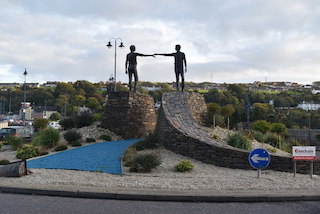 Francesca McDonnell Capossela's novel Trouble the Living is in part set in Northern Ireland during the waning days of the Troubles, a 30-year period of violence brought mostly to an end by the signing of the Good Friday Agreement on April 10, 1998.
In 1921, at the end of the Irish War of Independence, Ireland was partitioned into two self-governing territories: the predominantly Protestant Northern Ireland and the mostly Roman Catholic Irish Free State to the south. The Irish Free State was declared a Republic in 1949 and became an independent country (now called the Republic of Ireland), but Northern Ireland remained part of the United Kingdom.
Roman Catholics living in Northern Ireland experienced discrimination in employment, ...
If you liked Trouble the Living, try these:
The End of the World Is a Cul de Sac
by Louise Kennedy
Published 2024
Brilliant, dark stories of women's lives by "a very major talent" (Joseph O'Connor, Irish Times)
by Michelle Gallen
Published 2022
A funny, fierce, and unforgettable read about a young woman working a summer job in a shirt factory in Northern Ireland, while tensions rise both inside and outside the factory walls.

by Anna Burns
Published 2018
Winner of the 2018 Man Booker Prize, Milkman is a tale of gossip and hearsay, silence and deliberate deafness. It is the story of inaction with enormous consequences.
 (1).gif)
It is a fact of life that any discourse...will always please if it is five minutes shorter than people expect
Click Here to find out who said this, as well as discovering other famous literary quotes!

Can you name the title?
Test your book knowledge with our daily trivia challenge!