-
See Our Best Book
Club Books of 2026!
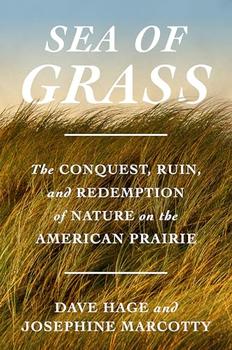
The Conquest, Ruin, and Redemption of Nature on the American Prairie
by Dave Hage, Josephine Marcotty
A vivid portrait of the American prairie, which rivals the rainforest in its biological diversity and, with little notice, is disappearing even faster.
The North American prairie is an ecological marvel, a lush carpet of grass that stretches to the horizon, and home to some of the nation's most iconic creatures—bison, elk, wolves, pronghorn, prairie dogs, and bald eagles. Plants, microbes, and animals together made the grasslands one of the richest ecosystems on Earth and a massive carbon sink, but the constant expansion of agriculture threatens what remains.
When European settlers encountered the prairie nearly two hundred years ago, rather than a natural wonder they saw an alien and forbidding place. But with the steel plow, artificial drainage, and fertilizers, they converted the prairie into some of the world's most productive farmland—a transformation unprecedented in human history. American farmers fed the industrial revolution and made North America a global breadbasket, but at a terrible cost: the forced dislocation of Indigenous peoples, pollution of great rivers, and catastrophic loss of wildlife. Today, industrial agriculture continues its assault on the prairie, plowing up one million acres of grassland a year. Farmers can protect this extraordinary landscape, but trying new ideas can mean ruin in a business with razor-thin margins, and will require help from Washington, D.C., and from consumers.
Veteran journalists and midwesterners Dave Hage and Josephine Marcotty reveal humanity's relationship with this incredible land, offering a deep, compassionate analysis of the difficult decisions as well as opportunities facing agricultural and Indigenous communities. Sea of Grass is a vivid portrait of a miraculous ecosystem that makes clear why the future of this region is of essential concern far beyond the heartland.
"[A] scintillating study ... Hage and Marcotty excel at elucidating the complex workings of prairie ecosystems, and they provide cogent explanations of how to undo the damage of industrial agriculture by, for instance, preserving next to crop fields uncultivated 'buffer strips' that would absorb fertilizer and pesticide runoff. This troubling wake-up call will galvanize readers." —Publishers Weekly (starred review)
"A sweeping history of the American prairie ... a welcome addition to the literature of America's grasslands, which need all the champions they can get." —Kirkus Reviews (starred review)
"An engaging read that provides a well-rounded portrait of agriculture on the American prairie." —Library Journal
"One of our human frailties is a short memory; Sea of Grass is an antidote, freshening our cultural recollection with abundance, beauty, and ecology of what was. This captivating book offers tears of repentance wiped away with renewed hope for the future." —Joel Salatin, co-owner of Polyface Farm and editor of The Stockman GrassFarmer
"Now this is a book well worth the read. It describes—in loving, living prose—one of the world's greatest and most important landscapes. And it does so while there's still time to save some serious part of it, and in the process to save much else... . Balanced, nuanced—but overpowering." —Bill McKibben, author The End of Nature
This information about Sea of Grass was first featured
in "The BookBrowse Review" - BookBrowse's membership magazine, and in our weekly "Publishing This Week" newsletter. Publication information is for the USA, and (unless stated otherwise) represents the first print edition. The reviews are necessarily limited to those that were available to us ahead of publication. If you are the publisher or author and feel that they do not properly reflect the range of media opinion now available, send us a message with the mainstream reviews that you would like to see added.
Any "Author Information" displayed below reflects the author's biography at the time this particular book was published.
Dave Hage oversaw environmental and health reporting at the Minneapolis Star Tribune for a dozen years, editing projects that won a Pulitzer Prize and an Edward R. Murrow Award, among other honors. His previous books include No Retreat, No Surrender: Labor's War at Hormel, and Reforming Welfare by Rewarding Work. A Minneapolis native, he lives in St. Paul with his wife.
Josephine Marcotty is an award-winning environmental journalist who has spent her life in the Midwest. She was a reporter for the Minneapolis Star Tribune, where she covered complex, science-based topics. Sea of Grass is a natural expansion of her reporting on the vanishing prairie and the consequences of intensive agriculture. She lives in Minneapolis with her husband.
The Sister's Curse
by Nicola Solvinic

The Lost Story of Eva Fuentes
by Chanel Cleeton

The Vanishing Place
by Zoë Rankin
 (1).gif)
Knowledge is of two kinds. We know a subject ourselves, or we know where we can find information on it.
Click Here to find out who said this, as well as discovering other famous literary quotes!

Can you name the title?
Test your book knowledge with our daily trivia challenge!
Your guide toexceptional books
BookBrowse seeks out and recommends the best in contemporary fiction and nonfiction—books that not only engage and entertain but also deepen our understanding of ourselves and the world around us.