
-
See Our Best Book
Club Books of 2026!
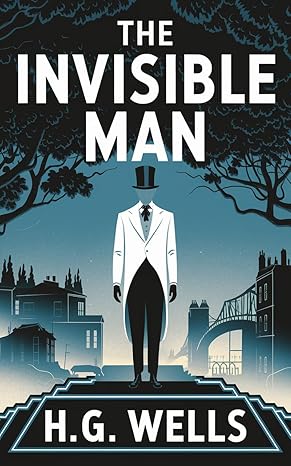
by H.G. Wells
From the twentieth century's first great practitioner of the novel of ideas comes a consummate masterpiece of science fiction about a man trapped in the terror of his own creation.
First published in 1897, The Invisible Man ranks as one of the most famous scientific fantasies ever written. Part of a series of pseudoscientific romances written by H. G. Wells (1866–1946) early in his career, the novel helped establish the British author as one of the first and best writers of science fiction. Wells' years as a science student undoubtedly inspired a number of his early works, including this strikingly original novel. Set in turn-of-the-century England, the story focuses on Griffin, a scientist who has discovered the means to make himself invisible. His initial, almost comedic, adventures are soon overshadowed by the bizarre streak of terror he unleashes upon the inhabitants of a small village. Notable for its sheer invention, suspense, and psychological nuance, The Invisible Man continues to enthrall science-fiction fans today as it did the reading public nearly 100 years ago.
Media reviews not yet available.
This information about The Invisible Man was first featured
in "The BookBrowse Review" - BookBrowse's membership magazine, and in our weekly "Publishing This Week" newsletter. Publication information is for the USA, and (unless stated otherwise) represents the first print edition. The reviews are necessarily limited to those that were available to us ahead of publication. If you are the publisher or author and feel that they do not properly reflect the range of media opinion now available, send us a message with the mainstream reviews that you would like to see added.
Any "Author Information" displayed below reflects the author's biography at the time this particular book was published.
Herbert George Wells was born in Bromley, Kent, England, on September 21, 1866. His father was a professional cricketer and sometime shopkeeper, his mother a former lady's maid. Although 'Bertie' left school at fourteen to become a draper's apprentice (a life he detested), he later won a scholarship to the Normal School of Science in London, where he studied with the famous Thomas Henry Huxley. He began to sell articles and short stories regularly in 1893. In 1895, his immediately successful novel rescued him from a life of penury on a schoolteacher's salary. His other 'scientific romances'—The Island of Dr. Moreau (1896), The Invisible Man (1897), The War of the Worlds (1898), The First Men in the Moon (1901), and The War in the Air (1908)—won him distinction as the father of science fiction.
The Sister's Curse
by Nicola Solvinic

The Lost Story of Eva Fuentes
by Chanel Cleeton

The Vanishing Place
by Zoë Rankin
 (1).gif)
He has only half learned the art of reading who has not added to it the more refined art of skipping and skimming
Click Here to find out who said this, as well as discovering other famous literary quotes!

Can you name the title?
Test your book knowledge with our daily trivia challenge!
Your guide toexceptional books
BookBrowse seeks out and recommends the best in contemporary fiction and nonfiction—books that not only engage and entertain but also deepen our understanding of ourselves and the world around us.