-
Your next favorite book
is waiting.
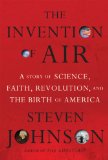
The Invention of Air is a book of world-changing ideas wrapped around a compelling narrative, a story of genius and violence and friendship in the midst of sweeping historical change that provokes us to recast our understanding of the Founding Fathers.
It is the story of Joseph Priestley—scientist and theologian, protégé of Benjamin Franklin, friend of Thomas Jefferson—an eighteenth-century radical thinker who played pivotal roles in the invention of ecosystem science, the discovery of oxygen, the founding of the Unitarian Church, and the intellectual development of the United States. And it is a story that only Steven Johnson, acclaimed juggler of disciplines and provocative ideas, can do justice to.
In the 1780s, Priestley had established himself in his native England as a brilliant scientist, a prominent minister, and an outspoken advocate of the American Revolution, who had sustained long correspondences with Franklin, Jefferson, and John Adams. Ultimately, his radicalism made his life politically uncomfortable, and he fled to the nascent United States. Here, he was able to build conceptual bridges linking the scientific, political, and religious impulses that governed his life. And through his close relationships with the Founding Fathers—Jefferson credited Priestley as the man who prevented him from abandoning Christianity—he exerted profound if little-known influence on the shape and course of our history.
As in his last bestselling work, The Ghost Map, Steven Johnson here uses a dramatic historical story to explore themes that have long engaged him: innovation and the way new ideas emerge and spread, and the environments that foster these breakthroughs. And as he did in Everything Bad Is Good for You, Johnson upsets some fundamental assumptions about the world we live in—namely, what it means when we invoke the Founding Fathers—and replaces them with a clear-eyed, eloquent assessment of where we stand today.
"Starred Review. As a reminder of the underlying sanity and common sense of this country ... The Invention of Air succeeds like a shot of the purest oxygen." - Publishers Weekly Signature Review by Simon Winchester.
"Recommended for all large public and all academic libraries." - Library Journal.
"Like Priestley, Johnson - who wrote the bestselling Everything Bad Is Good for You - is a polymath, and it's often exhilarating to follow his unpredictable trains of thought. To explain why some ideas upend the world, he draws upon many disciplines: chemistry, social history, geography, even ecosystem science.
This information about The Invention of Air was first featured
in "The BookBrowse Review" - BookBrowse's membership magazine, and in our weekly "Publishing This Week" newsletter. Publication information is for the USA, and (unless stated otherwise) represents the first print edition. The reviews are necessarily limited to those that were available to us ahead of publication. If you are the publisher or author and feel that they do not properly reflect the range of media opinion now available, send us a message with the mainstream reviews that you would like to see added.
Any "Author Information" displayed below reflects the author's biography at the time this particular book was published.

Steven Johnson is the bestselling author of ten books, including How We Got to Now, Where Good Ideas Come From, The Invention of Air, The Ghost Map, and Everything Bad Is Good for You. The founder of a variety of influential websites, he is the host and co-creator of the PBS and BBC series How We Got to Now. Johnson lives in Marin County, California, and Brooklyn, New York, with his wife and three sons.


If you liked The Invention of Air, try these:

by Louise Erdrich
Published 2009
The unsolved murder of a farm family haunts the small, white, off-reservation town of Pluto, North Dakota. The vengeance exacted for this crime and the subsequent distortions of truth transform the lives of Ojibwe living on the nearby reservation and shape the passions of both communities for the next generation.

by Kent Haruf
Published 2005
Haruf returns to the small town of Holt, Colorado to continue the story he started in Plainsong (1999) with an engrossing and profoundly moving novel rich in wisdom, humor and humanity.

by Fannie Flagg
Published 2003
The time is 1946 until the present. The town is Elmwood Springs, Missouri. Once again, Flagg gives us a story of richly human characters, the saving graces of the once-maligned middle classes and small-town life, and the daily contest between laughter and tears.


 (1).gif)
The silence between the notes is as important as the notes themselves.
Click Here to find out who said this, as well as discovering other famous literary quotes!

Can you name the title?
Test your book knowledge with our daily trivia challenge!
Your guide toexceptional books
BookBrowse seeks out and recommends the best in contemporary fiction and nonfiction—books that not only engage and entertain but also deepen our understanding of ourselves and the world around us.