
-
See Our Best Book
Club Books of 2026!
by Caro De Robertis
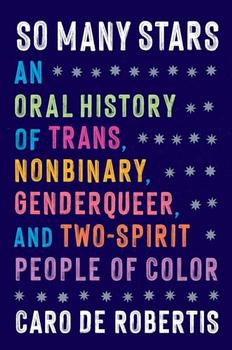
So Many Stars knits together the voices of trans, nonbinary, genderqueer and two-spirit elders of color as they share authentic, intimate accounts of how they created space for themselves and their communities in the world, how they pursued their passions, and how they continue to be at the vanguard of social change. This singular project collects the testimonies of over a dozen elders, each a glimmering thread in a luminous tapestry, preserving their words for future generations—who can more fully exist in the world today because of these very voices.
Award-winning novelist De Robertis creates a collective coming-of-age story based on hundreds of hours of interviews, offering rare snapshots of ordinary life: kids growing up, navigating family issues and finding community, coming out and changing how they identify over the years, building movements and weathering the AIDS crisis, and sharing wisdom for future generations. Often narrating experiences that took place before they had the array of language that exists today to self-identify and to describe life beyond the gender binary, this generation lived through remarkable changes in American culture, shaped American culture, and yet rarely takes center stage in the history books. Their stories feel particularly urgent in the current political moment, but also remind readers that their experiences are not new. Young trans and nonbinary people of color today belong to a long lineage.
The anecdotes in these pages are riveting, joyful, heartbreaking—so full of life and personality and wisdom, and artfully woven together into one immersive narrative. In De Robertis's words, So Many Stars shares "behind-the-scenes tales of what it meant—and still means—to create an authentic life, against the odds."
Caro de Robertis' So Many Stars shares the personal stories of 20 trans and nonbinary people of color over age 50 who, through their activism, art, and courage, have helped pave the way for the LGBTQ+ community as we know it today. The book is divided into four sections. The first, "Emergence," focuses on childhood, family, and coming of age. This section highlights the interviewees' wide range of backgrounds and hometowns, from Cuba to Oklahoma to New York and elsewhere. It begins with the narrators sharing their earliest memories of their gender, such as Yoseñio Lewis, who knew he was a boy, "from Day One, the moment of consciousness," and the excitement and curiosity felt by Nicky Calma (see Beyond the Book) at a chance meeting with a trans musician when she was eight years old. The section further explores how the narrators' gender affected their relationships with their birth families, and their first forays into the LGBTQ+ community.
The second section, "Forging Lives," is about finding one's place and building a satisfying life. Several of the interviewees are immigrants, who recall moving to the United States and the challenges they faced in doing so, both as people of color and members of the LGBTQ+ community. Though more tolerant attitudes in the US were often a factor in the decision to immigrate, the benefits were very much relative—it took ten years for Nelson D'Alerta Pérez to get a green card after she made the mistake of admitting she was homosexual in an interview. This section also delves into sexuality, emotional intimacy, and the process of transitioning.
The third section, "Being the Change," covers activism and the effects of AIDS on the LGBTQ+ community, as well as self-expression and storytelling through art in general and drag specifically. The chapter on the AIDS crisis is unsurprisingly difficult to read, but still contains moments of warmth, and the chapters discussing art and drag are very community-focused. The interviewees discuss not only what their art means to them in terms of self-expression, but how it honors those who came before and connects them to those they share it with. As Donna Personna says of the play she co-wrote and produced about a now famous moment of trans resistance to police brutality: "I wasn't there, at the historic Compton's Cafeteria riot, but I knew these women's stories…this story was buried and hidden for almost fifty years. What if it had never emerged? It impassions me now. This story is not going to die. Every word I wrote, and we wrote, in the play, is the truth."
The fourth and final section, "Horizons," focuses on the present and future, rather than the past. It covers the interviewees' experiences with aging and the ways in which their understanding of gender has changed, their advice for the younger generations, and their hopes for the future. So much discussion in and around the LGBTQ+ community is focused on the experiences of young people, so it is wonderful to see the joy and wisdom the narrators have found in old age.
Issues pertaining to how gender interacts with race are woven throughout the book, as the interviewees share both the happiness they have found in their communities, such as Landa Lakes' excitement at cofounding the first two-spirit Pow Wows, and the pain of enduring racism from both society at large and within the LGBTQ+ community. KB Boyce and Fresh "Lev" White both discuss how stereotypes about Black men have affected their transitions. As White puts it: "Once I was being seen as masculine, I remember having a white trans male friend say to me, 'Isn't the privilege amazing?' My immediate response was, 'If you mean I'm even more likely to get pulled over and shot, I'm not feeling it.'"
My main critique is that the structure of the book makes it challenging to trace each narrator's individual story. At the end there is a section called "About the Narrators"; I would recommend readers start here rather than simply opening the book to the first page. With 20 different speakers and interviews cut together with varying lengths of text only prefaced with the name of the subject, keeping track of who is who takes a lot of flipping back and forth between the biographies and the chapters. In fact, aside from the introduction, de Robertis allows the interviewees' words to stand entirely on their own. In some ways this is a powerful choice, but I feel the stories might have been more effectively communicated through a documentary or audio recording as opposed to text, as these media allow one to more easily identify the speaker. The introduction, by contrast, includes a brief but vivid account of de Robertis' first meeting with Adela Vázquez—I would have appreciated similar descriptions of the other narrators.
Given the current political backlash against gains in LGBTQ+ rights, with trans rights being targeted in particular, this book is timely and essential. It demonstrates that trans and nonbinary people of color have a long history of fighting for the right to exist and live authentically as themselves. Some stories collected here are joyful, some heartbreaking, and everything in between. Shining through all of them is the warmth, resiliency, and hard-earned wisdom of 20 remarkable people. In taking in the words of these elders, readers will gain not only an appreciation for what those before them overcame, but hope for their own futures.
Book reviewed by Katharine Blatchford
 In Caro de Robertis' work of transcribed oral history, So Many Stars, one of the interviewees is Nicky Calma. She shares the story of how, along with others at the Filipino Task Force on AIDS, she created the drag persona of Tita Aida in order to educate the people in her community about HIV/AIDS.
Born in 1967 to a Catholic family in the Philippines, Calma immigrated to the United States and settled in San Francisco at the age of 22. Once there, she found support among transgender women, mostly African American, whom she met on the street, as well as with her fellow Filipino immigrants, eventually leading her to join the Asian AIDS Project and work with the Filipino Task Force on AIDS.
The character they created together drew from multiple sources of inspiration. Her name is based on how Filipinos were already discussing HIV/AIDS—it translates to "Aunty AIDS," and was a common slang term for the disease in that community. Aspects of the character's personality were inspired by Doña Buding, a comic, nouveau riche character played by Filipina comedian Nanette Inventor. Tita Aida's first performance was in 1990. She fought the disease's stigma and educated audiences about prevention through the Rubber Club, guerilla theater productions often hosted at the N'Touch nightclub. These productions were structured like advice shows in which Tita Aida responded to fictional letters asking for help on topics related to HIV/AIDS. One famous demonstration involved showing how silicon-based lubricant can reduce the effectiveness of condoms by using it to pop a balloon. In addition to teaching about prevention, she reached out to those who had contracted AIDS. At the time, stigma surrounding HIV/AIDS could lead to patients becoming extremely isolated. Tita Aida visited them to provide comfort and support.
She also performed at AsiaSF, a groundbreaking cabaret and restaurant that opened in 1998. The venue became known for the celebrated performances of the "Ladies of AsiaSF," a group of transgender entertainers, Nicky Calma among them. The restaurant closed its doors in 2024, citing difficulties adapting to the post-Covid nightlife scene.
In the years since Tita Aida's debut, Calma has continued her activist work both on and off stage. Her work during the AIDS crisis has led to a decades-long career at the San Francisco Community Health Center, destigmatizing and promoting awareness of HIV in the city's LGBTQ+ and Asian and Pacific Islander communities. She is Director of Community Programs and HIV Services and a member of the city's Trans Advisory committee.
In 2024, Calma was named Hermana Mayor at the San Francisco Pistahan Parade and Festival, the largest Filipino cultural festival on the West Coast. The Hermana Mayor serves as parade leader and the designation is intended to honor a respected member of the Filipino community. She was the first trans woman to receive this recognition.
Though great progress has been made in the fight against HIV/AIDS, there is still work to be done. As Calma says in So Many Stars, "Stigma is still the strongest enemy here."
Nicky Calma aka Tita Aida receiving an award at a Trans Day of Visibility celebration in 2016, photo by Pax Ahimsa Gethen CC BY-SA 4.0
by Susanna Kwan
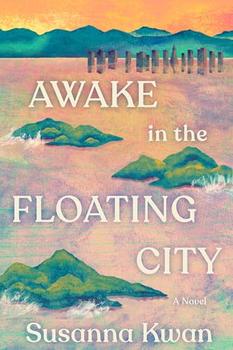
Bo knows she should go. Years of rain have drowned the city and almost everyone else has fled. Her mother was carried away in a storm surge and ever since, Bo has been alone. She is stalled: an artist unable to make art, a daughter unable to give up the hope that her mother may still be alive. Half-heartedly, she allows her cousin to plan for her escape—but as the departure day approaches, she finds a note slipped under her door from Mia, an elderly woman who lives in her building and wants to hire Bo to be her caregiver. Suddenly, Bo has a reason to stay.
Mia can be prickly, and yet still she and Bo forge a connection deeper than any Bo has had with a client. Mia shares stories of her life that pull Bo back toward art, toward the practice she thought she'd abandoned. Listening to Mia, allowing her memories to become entangled with Bo's own, she's struck by how much history will be lost as the city gives way to water. Then Mia's health turns, and Bo determines to honor their disappearing world and this woman who's brought her back to it, a project that teaches her the lessons that matter most: how to care, how to be present, how to commemorate a life and a place, soon to be lost forever.
Susanna Kwan's debut novel, Awake in the Floating City, is an ode to her hometown of San Francisco, nostalgic about the city's past and poignantly speculative of a post-apocalyptic future. Middle-aged painter Bo has lived her whole life in the city, which is now flooded and rainforest lush, forcing its denizens to ascend to the rooftops. Her only family left are her cousin and uncle, who fled to Canada years ago and are constantly trying to persuade her to join them. But Bo remembers walking along the streets of San Francisco as a child, before it became "a moonscape" of "streets ulcerated into potholes," before "streets transformed into rivers [that] blew out windows, tore doors from their frames," and refuses to leave.
She also remembers the storm and flash flood that swept away her mother—and countless others—one evening. It's been years since Bo's mother disappeared, but Bo cannot give up the hope that she's alive somewhere and that Bo may one day spot her along the rooftops. Bo hasn't painted since her mother vanished; instead, she drifts, depressed, through her days, thinking about how in "the scheme of things, she was close to nothing." "Nothing I made had any meaning," she says.
Then, Bo's 130-year-old neighbor Mia, her health failing, hires Bo as a caregiver. When Bo begins clearing out Mia's closet to make room for her wheelchair, she finds a lifetime of items stored away, clues to the various lives Mia has led: village girl, fortune teller, entrepreneur, mother, housewife, matriarch, retiree. Each item represents a memory that Mia shares with Bo: a gold dress, her fiftieth wedding anniversary celebration with her deceased husband; her I Ching sticks, how she made her living during the Second Sino-Japanese War. Bo is moved by Mia's stories but also disheartened by how a memory can be flattened into one simple item, by how a lifetime can fit into a forgotten closet. Inspired, she decides to create a memorial for Mia, one that celebrates her legacy and the history of San Francisco.
The action of the novel takes place over about a year, but the history covered, through the characters' memories and through Bo's research into San Francisco for her memorial, spans centuries—Bo learns about the early Coast Miwok communities in California; Chinese immigration in the 19th century; and the 1906 earthquake that razed the city. And Mia's stories of her past—which, because the novel is set in a speculative future, take place in years that haven't happened yet for the reader—are based on true events, like the San Francisco controversy in which housing was built on top of radioactive waste left by Navy shipyards, leading to high cancer rates in certain neighborhoods.
Kwan is interested in both the experience of memory and its potential to shape the future. For example, Bo learns about photographer Arnold Genthe, whose images of post-earthquake Chinatown helped transform the neighborhood into a spectacle for tourists. And she beautifully describes the tender feeling of remembrance in this strange, alternative future:
"Everywhen. That's what an archaeologist studying aboriginal people in Australia had called it, that seamless melding of time... [like] when you felt a warm and familiar hand rest on your shoulder at the hole-in-the-wall Cantonese restaurant, and turned around, expecting an aunt or an old classmate, but there was no one, only the painted brick wall you leaned your back on. And here, now, they inhabited a place that seemed to have little memory of a time without precipitation and so harbored a sense of timelessness, or time so broad and long that it allowed other time to live inside it."
Awake in the Floating City is also attentive to the elusive process of artistic creation; Kwan describes the conception, research, experimentation, and redrafting of Bo's work, as well as the doubt that can often plague the creative process. Kwan's level of detail may seem excessive to those who are not interested in San Francisco or the visual arts. But the thematic core of her novel—the conviction that despite our transience in this world, life is still worth living, and that it is the job of those who are still alive and present to remember the past—is universal. Through caring for Mia, Bo is drawn out of her listlessness and isolation, and once again feels the urge to create and plan for the future, in this gorgeous and moving story of human connection.
Book reviewed by Pei Chen
 In Awake in the Floating City, Bo is an artist who supports herself by working as a caregiver to home-bound elderly clients. Remaining in one's own home, often living alone and having caregiver help, is referred to as "aging in place," and is frequently preferable to living in a nursing home or assisted living facility; according to the AARP, nearly 90 percent of adults over 65 want to remain in their current homes as they grow older.
The benefits of aging in place include things like maintaining one's independence; preserving familiarity and comfort; and being healthier and safer (with fewer people, there is less microbial spread for an already vulnerable population). Also, aging in place is less expensive than living in a facility.
Many elders, and people with disabilities, need additional resources to be able to remain in their own homes, whether it's equipment like ramps and lifts or formal help from caregivers. For those without family nearby to help out, or without the means to pay for help, there are community programs that offer support. Some of these include:
Many of these services are funded through Medicaid or nonprofit organizations. Those who are interested in aging in place, or have loved ones who are, should look into public services that can help them stay in their homes.
by Lucas Schaefer
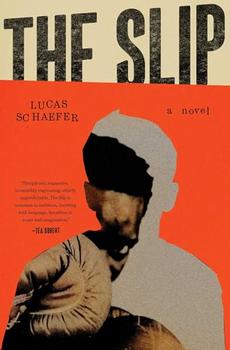
Austin, Texas: It's the summer of 1998, and there's a new face on the scene at Terry Tucker's Boxing Gym. Sixteen-year-old Nathaniel Rothstein has never felt comfortable in his own skin, but under the tutelage of a swaggering, Haitian-born ex-fighter named David Dalice, he begins to come into his own. Even the boy's slightly stoned uncle, Bob Alexander, who is supposed to be watching him for the summer, notices the change. Nathaniel is happier, more confident—tanner, even. Then one night he vanishes, leaving little trace behind.
Across the city, Charles Rex, now going simply by "X," has been undergoing a teenage transformation of his own, trolling the phone sex hotline that his mother works, seeking an outlet for everything that feels wrong about his body, looking for intimacy and acceptance in a culture that denies him both. As a surprising and unlikely romance blooms, X feels, for a moment, like he might have found the safety he's been searching for. But it's never that simple.
More than a decade later, Nathaniel's uncle Bob receives a shocking tip, propelling him to open his own investigation into his nephew's disappearance. The resulting search involves gymgoers past and present, including a down-on-his-luck twin and his opportunistic brother; a rookie cop determined to prove herself; and Alexis Cepeda, a promising lightweight, who crossed the US-Mexico border when he was only fourteen, carrying with him a license bearing the wrong name and face.
Bobbing and weaving across the ever-shifting canvas of a changing country, The Slip is an audacious, daring look at sex and race in America that builds to an unforgettable collision in the center of the ring.
The Slip by Lucas Schaefer begins with a newspaper clipping highlighting the ten-year disappearance of Nathaniel Rothstein. Nathaniel, a troubled Jewish sixteen-year-old from Newton, Massachusetts, was sent to spend the summer of 1998 in Austin, Texas with his uncle Bob Alexander, a University of Texas history professor, after being suspended for fighting. The summer was meant to be transformative for Nathaniel, and it fulfilled that promise. His Uncle Bob arranged a volunteer opportunity for him at the Shoal Creek Rehabilitation Center, where David Dalice, a Haitian-born former boxer, mentored him. As the summer unfolded and David's guidance extended to the local boxing gym, a bond formed between David and Nathaniel, and both of them underwent personal shifts: "He'd never before spent so much time with someone not his mom in such short order. But that's what was happening, David, ever generous with his advice, Nathaniel always ready to receive it."
As the summer continued, changes in Nathaniel became increasingly apparent. "He was so much more confident, so much more relaxed. So much more … tan." It seemed Nathaniel was finally taking a turn for the better, from caterpillar to butterfly, as everyone hoped he would, until August 8, when he vanished. Within a rich tapestry of characters and intertwining subplots—including subject matter ranging from sex hotlines and illegal immigration to mischievous clowns, questionable Google searches, and race dynamics set against the vibrant backdrop of Terry Tucker's Boxing Gym—the truth behind Nathaniel's disappearance is uncovered with a captivating mix of humor and daring, clever storytelling, and the exploration of themes central to American life.
Terry Tucker's Boxing Gym acts as the central link among the characters and their storylines. The gym draws a diverse array of individuals, including academics, police officers, amateur boxers, high school students, housewives, and trainers, all seeking transformation in the fitting setting of Austin—a city known for its constant evolution, as Bob notes: "Been here forty-five years … Now our little town is all grown up. Not like it used to be, is it?" The varied cast shares a passion for boxing and a desire for change, venturing into self-discovery.
While the sport is a cornerstone of this story, The Slip is as much about boxing as Friday Night Lights is about football. Schaefer has crafted a narrative whose plot is as engrossing as its perfect representation of American life through issues of race, gender, sexuality, desire, power, class, immigration, and policing. We see how Nathaniel's upbringing in predominantly white Newton, Massachusetts, with limited exposure to Black people, fosters a sense of fascination and curiosity when he meets the charming David Dalice. This fascination deepens as David serves as a reminder of the traits Nathaniel lacks, such as self-assurance, confidence, sexual experience, and comfort in his own skin, all of which Nathaniel associates with race. "Nevertheless, as Nathaniel followed his new boss on his morning rounds, that was how he conceived of the question: How did Black people do it? How did David Dalice?" Nathaniel's inner thoughts are honest, even if they touch on some uncomfortable truths about his feelings—almost an obsession—for David. Interestingly, David doesn't seem to care about and even encourages Nathaniel's questionable fixations, viewing mentorship as "a second chance, a second act: to turn the boys they once were into the men they'd never managed to become."
Many of the novel's characters are connected by a search for identity and how they suffer from avoiding their reality while still ultimately finding ways to survive. These include Miriam Lopez, a recent addition to the gym and the police department; Alexis Cepeda, Terry Tucker's newest boxing protégé, who crossed the border with the assistance of a clown; David, as he grapples with the divergence of his career from that of his former subordinate Terry Tucker; and Charles Rex Markham, who is exploring his gender identity and going by the name X. Through their journeys, we witness these characters wrestling with their current selves, their desired selves, and the selves they believe they can become—while navigating a life that doesn't go as imagined, par for the course for adulthood. As the narrator observes of David: "It was not a tragedy, compared to all the other tragedies out there, that the life he'd worked for didn't end up his life. It was not a tragedy: it was life."
One of my favorite aspects of Schaefer's book is watching how every character's storyline interweaves with the others. This keeps you on your toes, making the reading experience engaging. The direction of the narrative consistently defied my expectations ("Stories that start as one thing sometimes become another"), and as Schaefer's novel travels from 2008 to 1998 to show the summer through the eyes of each character, each serves a role and unlocks a new puzzle piece of Nathaniel's disappearance. Subsequently, we see the day Nathaniel disappeared, with continuous flips to the present, 2014. Thankfully, the ending does resolve the mystery, which is both unbelievable in the way fiction allows but also believable within the intricate realities of life in America.
This nearly 500-page novel is a delightful journey filled with moments of humor, witty banter, and lively dialogue, such as when Dr. Gloria Abruzzi, an elderly woman, amusingly relates her Italian identity to David's experience as a Black man: "Gloria's sense that David's experience was her experience — 'Italy and Haiti, we know a little something about being on the outside.'" Every character makes their share of mistakes, and none emerge morally unscathed. Schaefer has crafted a truly gripping mystery that highlights the transformative power of boxing. Preoccupied with serious themes, it remains thought-provoking without becoming didactic. The storylines are seamlessly woven together, creating a bold, sometimes raunchy, and above all entertaining narrative. With a story centered on boxing, you can't help but hope for the opportunity for a clever pun, and The Slip is an absolute knockout.
Book reviewed by Letitia Asare
 A central element of The Slip by Lucas Schaefer is Terry Tucker's Boxing Gym in Austin, Texas, which serves as a hub connecting the story's characters. The gym, attracting individuals from diverse backgrounds, illustrates a universal appeal: boxing is a sport that can be found in every city across the nation and in many countries worldwide. As one character notes, "you can find it down an alley and up a creaky staircase in Tokyo; in church basements in Belfast and Boston; through unmarked doors of crumbling buildings in Philadelphia, Fortaleza, Rawalpindi, and Rome. On east sides and outskirts."
The roots of boxing can be traced back to ancient Greece, where it became popular as an Olympic sport. Boxing was originally simpler than it is now: there were no gloves, weight classes, or rounds. Two fighters would continue until one conceded defeat or was knocked out. The sport evolved further with the contributions of the Romans and the British, who introduced new equipment and regulations. Today, the brutality has decreased considerably. However, one aspect that has remained unchanged is the one-on-one hand-to-hand combat in which competitors battle for glory and a prize.
Olympic-style boxing became an organized sport in 1888, and has developed a rich and storied tradition in the United States and elsewhere. Today, competitive boxing exists at both amateur and professional levels. Safety regulations are one of the most noticeable differences between amateur and professional boxing. In amateur boxing, fighters are required to wear headgear, gloves tend to be heavier, and matches typically last no more than three rounds. In professional boxing, headgear isn't used, and matches last up to twelve rounds.
As seen in The Slip, boxing gyms in the US and worldwide have provided genuinely welcoming spaces where people of different genders and skill levels can participate in the sport: "It was real, this place, in a way the big box gyms weren't. And though many of the nonfighters were drawn to Terry Tucker's, at least in part, out of that weird, white-collar obsession with 'authenticity,' it was this crossing of worlds that also gave the gym its magic."
Schaefer, in a Texas Standard interview, remarks that "part of what really attracted me to the gym was it was one of those rare spaces – really, in America, but in Austin, too – where people of every race and age and personality type and body type and profession were all sort of mixed together." He views boxing to be an interesting sport as "it's a little bit more of a meritocracy than a lot of sports. You don't need as much money to participate initially." This lower barrier to entry, along with its appeal to a diverse range of people from different backgrounds, makes boxing a wide-reaching sport.
Topless man in red boxing gloves
Photo by Prateek Katyal, via Unsplash
by Caroline Fraser
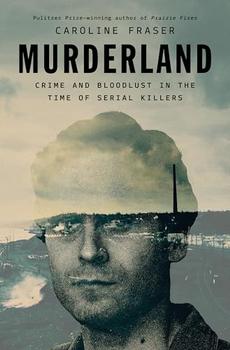
Caroline Fraser grew up in the shadow of Ted Bundy, the most notorious serial murderer of women in American history, surrounded by his hunting grounds and mountain body dumps, in the brooding landscape of the Pacific Northwest. But in the 1970s and '80s, Bundy was just one perpetrator amid an uncanny explosion of serial rape and murder across the region. Why so many? Why so weirdly and nightmarishly gruesome? Why the senseless rise and then sudden fall of an epidemic of serial killing?
As Murderland indelibly maps the lives and careers of Bundy and his infamous peers in mayhem—the Green River Killer, the I-5 Killer, the Night Stalker, the Hillside Strangler, even Charles Manson—Fraser's Northwestern death trip begins to uncover a deeper mystery and an overlapping pattern of environmental destruction. At ground zero in Ted Bundy's Tacoma stood one of the most poisonous lead, copper, and arsenic smelters in the world, but it was hardly unique in the West. As Fraser's investigation inexorably proceeds, evidence mounts that the plumes of these smelters not only sickened and blighted millions of lives but also warped young minds, including some who grew up to become serial killers.
A propulsive nonfiction thriller, Murderland transcends true-crime voyeurism and noir mythology, taking readers on a profound quest into the dark heart of the real American berserk.
America in the 1970s has been described as "the golden age of serial killers." The I-5 Killer, BTK, the Night Stalker, the Hillside Stranglers, the Grocery Bag Killer, John Wayne Gacy, Jeffrey Dahmer, Ted Bundy, and more were active during the decade and were responsible for hundreds of murders across the country. Caroline Fraser's latest book, Murderland, not only explores the acts of these killers but also examines the correlation between their violent crimes and exposure to high levels of lead and other heavy metals.
Fraser focuses on the Bunker Hill Mine and Smelting Complex, a lead and silver mining and processing operation that heavily polluted the air, soil, and waterways throughout the Pacific Northwest over the course of a century, affecting the health of countless individuals, particularly children (see Beyond the Book). When a 1973 fire destroyed the baghouse—the building designed for filtering lead and other pollutants from the aerosol released from the smelter—the company decided that the prevention of further exposure to children wasn't worth the cost of closing the smelter for repairs. Even if the company had to pay a settlement of thousands of dollars to each subsequently affected child, they calculated, they would still make millions in profit if they kept the smelter running as usual. And indeed, Bunker Hill even increased production, exposing hundreds of children in the immediate area to dangerously high levels of lead. The next year, the Idaho health department found that 98% of blood samples collected from children living within a mile of Bunker Hill showed "dangerous lead concentrations," including one infant who had a blood lead level of 164 µg/dL, the highest blood lead level ever recorded in a human.
In this way, Fraser seems to be accusing the smelter of being a different kind of serial killer. She also links its pollution—as well as the high levels of lead that children were being exposed to throughout the country via lead paint and leaded gasoline, "a toxic cocktail" that poisoned a generation—to the development of serial killers. "Many horrors play a role in warping these tortured souls, but what happens if we add a light dusting from the periodic table on top of all that trauma?" she asks. Other researchers have proposed the same connection, and recent studies have found that the abatement of lead pollution (caused by stricter environmental regulation and the phase-out of leaded gasoline) may be responsible for seven to 28 percent of the fall in homicides in the US since the 1980s.
And the extraordinarily high levels in Washington, Oregon, and Idaho seemed to have created the perfect breeding ground for serial killers. Fraser discusses many of them throughout the book; it seems like a new killer pops up every few pages. Most of these men grew up in areas rife with pollution from Bunker Hill, and those few who didn't, such as BTK and the Yorkshire Ripper, grew up in other areas poisoned by lead. But Murderland mainly focuses on one of America's most infamous serial killers: Ted Bundy, who grew up in Tacoma, Washington, squarely in the area impacted by Bunker Hill's pollution, and who confessed to 30 victims in his life (although experts suspect his true victim count could be as high as 100). Fraser uses quotes from interviews, court testimonies, and victim reports to convey the chilling depravity of Bundy's actions.
Between discussions of environmental toxicity and Ted Bundy, Fraser intersperses her own story: she was born and raised in Seattle in the '70s, and her personal history provides the perspective of a "normal life" during this period of serial killers and the Bunker Hill pollution. She also talks about other Pacific Northwest oddities, including the Lacey V. Murrow Memorial Bridge, a floating bridge across Lake Washington that connects Seattle to Mercer Island—due to a quirk of design, one section of the bridge became a hotspot for horrific accidents—and the Olympic-Wallowa Lineament, a fault line-like "optical illusion or topographic feature of 'unknown origin'" that runs diagonally across Washington. Fraser calls the lineament "a route wreathed in bodies," because it runs through both Bundy's main territory and areas that have experienced or could experience severe natural disasters.
Fraser seems to be calling the bridge and the lineament "serial killers" as well, but also examples of the way that profit motives and government inaction have put countless lives at risk over the decades: the bridge, for example, cuts an hour off the commute between Seattle and the east side of Lake Washington, a convenience that no one wants to see eliminated; and as Washington's population has exploded, developers have continued to build in the lineament's potentially dangerous areas. Although these sections slow down the narrative a bit, they contribute to Fraser's overall idea that greed at a large scale can have significant and deadly repercussions; and Murderland is a tragic look at a generation poisoned by this greed and one man whose terrifying proclivities may have been caused by that poison.
Book reviewed by Jordan Lynch
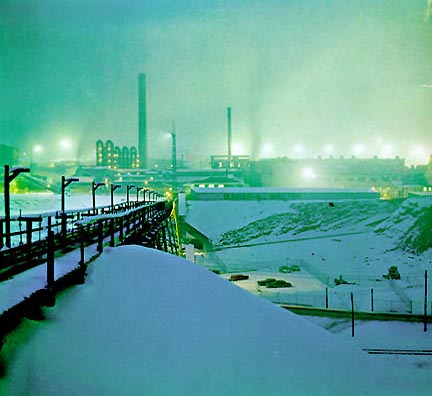 In her book Murderland, Caroline Fraser examines the lead-crime hypothesis, the theory that children exposed to high levels of lead have neurological changes that lead to increased aggressiveness in adulthood. Ted Bundy serves as Fraser's example of a child exposed to high levels of lead who proceeded to live a life of very violent crime. His exposure was largely due to environmental contamination from the Bunker Hill Mining and Metallurgical Complex.
Located in Smelterville, Idaho, the Bunker Hill Company began lead and silver mining operations at the end of the nineteenth century and continued for almost a hundred years, dumping tons of waste containing lead and other heavy metals into the air, soil, and waterways. In the 1970s and 80s, several families in the region brought lawsuits against the company when tests showed that their children had blood lead levels far above 30 µg/dL, the level considered harmful by the Centers for Disease Control and Prevention. The plant closed for economic reasons in 1981, and by 1983, the site had been identified as a candidate for a cleanup process as part of the Comprehensive Environmental Response, Compensation, and Liability Act (CERCLA), informally called "Superfund."
In the late 1970s, sites like Love Canal in New York and the Valley of the Drums in Kentucky became infamous as toxic waste dump sites. In response, Congress established CERCLA in 1980, which granted the Environmental Protection Agency (EPA) the power to clean up contaminated sites across the country and charge the responsible parties for the cost. If no responsible parties could be identified, a trust funded by a CERCLA-created tax on chemical and petroleum industries would be used. Within five years, 1.6 billion dollars had been collected for this "superfund."
The cleanup of a Superfund site is a complex process. First there is an initial assessment, at which point the site is placed on a prioritized list. Then the EPA must evaluate the nature and extent of contamination and the threat to human health and the environment. Once all the data are in hand, the EPA works with state, local, and other federal agencies to create a plan for removing contaminants, monitoring the site for continued contamination, and enforcing long-term restrictions before the site can be considered cleaned. If possible and safe, the EPA attempts to return the site to productivity in some way, like as a pollinator habitat, recreational area, community infrastructure, or an energy production site.
In the case of the Bunker Hill site, there were several environmentally concerning factors that led to its placement on the Superfund list, including the accumulation of lead in soil, hazardous waste in a storage pond, and other heavy metal contamination. The site spans 1,500 square miles and 166 river miles, making it one of the nation's largest and most complex Superfund sites. Cleanup efforts have been ongoing since 1994 and have included remediation of over 7,000 yards, parks, and commercial properties, the cleanup of mine waste, and an upgrade to the groundwater collection system.
These efforts have had a noticeable effect: between the closure of Bunker Hill, the cleanup, and the decline of leaded gasoline, blood lead levels in local children have decreased to below 5 µg/dL, which was the CDC's acceptable level until 2021, although now, the CDC's acceptable level is 3.5 µg/dL, which has still not been achieved. The current levels of contamination overall still present a risk to public health and the environment, and the EPA and its local partners expect complete cleanup to take decades. The Bunker Hill Mining and Metallurgical Complex has detrimentally impacted the Pacific Northwest for over a century, and although the actions of the EPA and Superfund have helped clean up the company's pollution, substantial work is still required to restore the area to a state that is truly protective of human health and the environment.
Photo courtesy of Wikimedia Commons and the Environmental Protection Agency.
Your guide toexceptional books
BookBrowse seeks out and recommends the best in contemporary fiction and nonfiction—books that not only engage and entertain but also deepen our understanding of ourselves and the world around us.

.jpg)
