-
Your next favorite book
is waiting.
Summary | Excerpt | Reviews | Readalikes | Genres & Themes | Author Bio
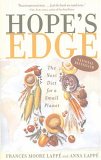
The Next Diet For A Small Planet
by Frances Moore Lappe, Anna Lappe
I'd been increasingly concerned with this stunningly rapid agricultural revolution-one that has been largely invisible, especially for us Americans. So I am hoping I can learn something.
Apparently responding to anticipated criticism, the professor proclaims with Ivy League authority that, well, maybe we here in the rich countries can afford to be skittish about potential risks in the genetic engineering of seeds; after all, we have plenty to eat. But our skittishness jeopardizes the future of the poor abroad because they need genetically modified seeds to produce more food to stave off hunger. Then, for half an hour, the discussion hovers around only one question-the possible risks in using genetically engineered seeds.
I sit up straight with alarm, as I realize that even after all these years, no one is challenging the premise that scarcity causes hunger. I want to stand and shout out: We're still asking the wrong question! Not only is there already enough food in the world, but as long as we're only talking about food-how best to produce it-we'll never end hunger, nor create the communities and food safety we want. We must ask a different question:
How can we build communities in tune with nature's wisdom in which no one, anywhere, has to worry about putting food-safe, healthy food-on the table?
Asking this question takes us far beyond food and ultimately brings us back to food-as you will see in the lives of people we meet on our journey. It takes us to the heart of democracy itself: to whose voice gets heard in matters of land, seeds, credit, trade, food safety-all stuff that can sound dry and abstract. It can, that is, until it comes to life in real people risking their lives and claiming their voices-people like the Brazilians you'll meet who are facing down big landowners to create vibrant communities, the villagers in Kenya who are turning back the encroaching desert, and the Bangladeshi women who are taking huge risks to free their families from hunger.
Later that afternoon, sitting in the serenity of the Montana mountains after the professor's presentation, I suddenly see more. While little has changed, much has changed. Thirty years ago I couldn't have imagined the almost overnight, massive spread of genetically modified organisms-with incalculable risks of disrupting ecosystems; of creating new strains of super-resistant pests; of introducing new allergens, or something even more harmful, into our diet.
In one sense I see the genetic-engineering craze-absorbing hundreds of millions of dollars and untold time and energy both of promoters and doubters-as yet another catastrophic diversion from deeper questions about democracy itself. It keeps us from asking, Why hunger? It jumps over this question entirely, reinforcing the myth that inadequate production is to blame.
But I also see this craze-just like the sudden emergence of grain-fed meat I wrote about thirty years ago-as a symptom. It is a symptom of our silencing. None of us called for genetic manipulation of seeds. Just as with the risks of feedlot beef, which now contributes to heart disease, groundwater depletion, antibiotic resistance, and more, no citizens were asked to weigh the risks of GMOs against possible gains.
So, might we come to see GMOs as a symptom of a deeper crisis?
Instead of distracting us from questions of democracy, genetic engineering could turn out to be our ultimate wake-up call. Where is democracy, we can ask, when just one company, Monsanto, controls 85 percent of all genetically engineered germplasm and has the power to saturate the commercial-seeds supply with genetically engineered varieties-with no input from the public, who must bear the consequences? Genetic engineering may be what finally shocks us into finding our voices to ask the questions we must if we are to heal our planet.

 (1).gif)
We have to abandon the idea that schooling is something restricted to youth...
Click Here to find out who said this, as well as discovering other famous literary quotes!

Can you name the title?
Test your book knowledge with our daily trivia challenge!
Your guide toexceptional books
BookBrowse seeks out and recommends the best in contemporary fiction and nonfiction—books that not only engage and entertain but also deepen our understanding of ourselves and the world around us.