
-
Your next favorite book
is waiting.
Summary | Excerpt | Reviews | Readalikes | Genres & Themes | Author Bio
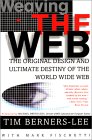
The Original Design and Ultimate Destiny of the World Wide Web by its Inventor
by Tim Berners-Lee
I am the son of mathematicians. My mother and father were part of the
team that programmed the world's first commercial, stored-program
computer, the Manchester University 'Mark I,' which was sold by Ferranti
Ltd. in the early 1950s. The were full of excitement over the idea that,
in principle, a person could program a computer to do most anything. They
also knew, however, that computers were good at logical organizing and
processing, but not random associations. A computer typically keeps
information in rigid hierarchies and matrices, whereas the human mind has
the special ability to link random bits of data. When I smell coffee,
strong and stale, I may find myself again in a small room over a corner
coffeehouse in Oxford. My brain makes a link, and instantly transports me
there.
One day when I came home from high school, I found my father working on
a speech for Basil de Ferranti. He was reading books on the brain, looking
for clues about how to make a computer intuitive, able to complete
connections as the brain did. We discussed the point; then my father went
on to his speech and I went on to my homework. But the idea stayed with me
that computers could become much more powerful if they could be programmed
to link otherwise unconnected information.
This challenge stayed on my mind throughout my studies at Queen's College
at Oxford University, where I graduated in 1976 with a degree in physics.
It remained in the background when I built my own computer with an early
microprocessor, an old television, and a soldering iron, as well as during
the few years I spent as a software engineer with Plessey
Telecommunications and with D.G. Nash Ltd.
Then, in 1980, 1 took a brief software consulting job with CERN the
famous European Particle Physics Laboratory in Geneva. That's where I
wrote Enquire, my first weblike program. I wrote it in my spare time and
for my personal use, and for no loftier reason than to help me remember
the connections among the various people, computers, and projects at the
lab. Still, the larger vision had taken firm root in my consciousness.

Excerpted from Weaving The Web by Tim Berners-Lee. (c)Tim Berners-Lee 1999. Published by permission of the publisher, HarperCollins.


 (1).gif)
A classic is a book that has never finished saying what it has to say
Click Here to find out who said this, as well as discovering other famous literary quotes!

Can you name the title?
Test your book knowledge with our daily trivia challenge!
Your guide toexceptional books
BookBrowse seeks out and recommends the best in contemporary fiction and nonfiction—books that not only engage and entertain but also deepen our understanding of ourselves and the world around us.