-
Your next favorite book
is waiting.
Summary | Excerpt | Reviews | Beyond the Book | Readalikes | Genres & Themes | Author Bio
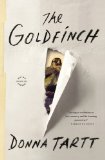
A Novel
by Donna Tartt Book Reviewed by:
I allowed myself another stealthy glimpse in the girl's direction. She was standing on one leg, with her hip swung out to the side. Then—quite suddenly—she turned and looked me in the eye; and in a heart-skip of confusion, I looked away.
What was her name? Why wasn't she in school? I'd been trying to make out the scribbled name on the flute case but even when I leaned in as far as I dared without being obvious, still I couldn't read the bold spiky marker strokes, more drawn than written, like something spray-painted on a subway car. The last name was short, only four or five letters; the first looked like R, or was it P?
"People die, sure," my mother was saying. "But it's so heartbreaking and unnecessary how we lose things. From pure carelessness. Fires, wars. The Parthenon, used as a munitions storehouse. I guess that anything we manage to save from history is a miracle."
The grandfather had drifted away, a few paintings over; but she was loitering a few steps behind, the girl, and kept casting glances back at my mother and me. Beautiful skin: milky white, arms like carved marble. Definitely she looked athletic, though too pale to be a tennis player; maybe she was a ballerina or a gymnast or even a high diver, practicing late in shadowy indoor pools, echoes and refractions, dark tile. Plunging with arched chest and pointed toes to the bottom of the pool, a silent pow, shiny black swimsuit, bubbles foaming and streaming off her small, tense frame.
Why did I obsess over people like this? Was it normal to fixate on strangers in this particular vivid, fevered way? I didn't think so. It was impossible to imagine some random passer-by on the street forming quite such an interest in me. And yet it was the main reason I'd gone in those houses with Tom: I was fascinated by strangers, wanted to know what food they ate and what dishes they ate it from, what movies they watched and what music they listened to, wanted to look under their beds and in their secret drawers and night tables and inside the pockets of their coats. Often I saw interesting-looking people on the street and thought about them restlessly for days, imagining their lives, making up stories about them on the subway or the crosstown bus. Years had passed, and I still hadn't stopped thinking about the dark-haired children in Catholic school uniforms—brother and sister—I'd seen in Grand Central, literally trying to pull their father out the door of a seedy bar by the sleeves of his suit jacket. Nor had I forgotten the frail, gypsyish girl in a wheelchair out in front of the Carlyle Hotel, talking breathlessly in Italian to the fluffy dog in her lap, while a sharp character in sunglasses (father? bodyguard?) stood behind her chair, apparently conducting some sort of business deal on his phone. For years, I'd turned those strangers over in my mind, wondering who they were and what their lives were like, and I knew I would go home and wonder about this girl and her grandfather the same way. The old man had money; you could tell from how he was dressed. Why was it just the two of them? Where were they from? Maybe they were part of some big old complicated New York family—music people, academics, one of those large, artsy West Side families that you saw up around Columbia or at Lincoln Center matinees. Or, maybe—homely, civilized old creature that he was—maybe he wasn't her grandfather at all. Maybe he was a music teacher, and she was the flute prodigy he had discovered in some small town and brought to play at Carnegie Hall—
"Theo?" my mother said suddenly. "Did you hear me?"
Her voice brought me back to myself. We were in the last room of the show. Beyond lay the exhibition shop—postcards, cash register, glossy stacks of art books—and my mother, unfortunately, had not lost track of the time.
Excerpted from The Goldfinch by Donna Tartt. Copyright © 2013 by Donna Tartt. Excerpted by permission of Little Brown & Company. All rights reserved. No part of this excerpt may be reproduced or reprinted without permission in writing from the publisher.

 (1).gif)
Everywhere I go, I am asked if I think the university stifles writers...
Click Here to find out who said this, as well as discovering other famous literary quotes!

Can you name the title?
Test your book knowledge with our daily trivia challenge!
Your guide toexceptional books
BookBrowse seeks out and recommends the best in contemporary fiction and nonfiction—books that not only engage and entertain but also deepen our understanding of ourselves and the world around us.