
-
Your next favorite book
is waiting.
Summary | Excerpt | Reviews | Beyond the Book | Readalikes | Genres & Themes | Author Bio
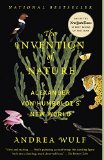
Alexander von Humboldt's New World
by Andrea Wulf Book Reviewed by:
Depicting Chimborazo in cross-section, the Naturgemälde strikingly illustrated nature as a web in which everything was connected. On it, Humboldt showed plants distributed according to their altitudes, ranging from subterranean mushroom species to the lichens that grew just below the snow line. At the foot of the mountain was the tropical zone of palms and, further up, the oaks and fern-like shrubs that preferred a more temperate climate. Every plant was placed on the mountain precisely where Humboldt had found them.
Humboldt produced his first sketch of the Naturgemälde in South America and then published it later as a beautiful three-foot by two-foot drawing. To the left and right of the mountain he placed several columns that provided related details and information. By picking a particular height of the mountain (as given in metres in the first left- and right-hand column), one could trace connections across the table and the drawing of the mountain to learn about gravity, say, or the blueness of the sky, humidity, atmospheric pressure, temperature, chemical composition of the air, as well as what species of animals and plants could be found at different altitudes. Humboldt showed eleven zones of plants, along with details of how they were linked to changes in altitude, temperature and so on. All this information could then be linked to the other major mountains across the world, which were listed according to their height in the fourth column to the left.
This variety and richness, but also the simplicity of the scientific information depicted, was unprecedented. Humboldt was the first scientist to present such data visually. The Naturgemälde showed for the first time that nature was a global force with corresponding climate zones across continents. Humboldt saw 'unity in variety'. Instead of placing plants in their taxonomic categories, he saw vegetation through the lens of climate and location: a radically new idea that still shapes our understanding of ecosystems today.
Excerpted from The Invention of Nature by Andrea Wulf. Copyright © 2015 by Andrea Wulf. Excerpted by permission of Knopf, a division of Random House LLC. All rights reserved. No part of this excerpt may be reproduced or reprinted without permission in writing from the publisher.
 (1).gif)
Being slightly paranoid is like being slightly pregnant – it tends to get worse.
Click Here to find out who said this, as well as discovering other famous literary quotes!

Can you name the title?
Test your book knowledge with our daily trivia challenge!
Your guide toexceptional books
BookBrowse seeks out and recommends the best in contemporary fiction and nonfiction—books that not only engage and entertain but also deepen our understanding of ourselves and the world around us.