
-
Your next favorite book
is waiting.
Summary | Excerpt | Reviews | Beyond the Book | Readalikes | Genres & Themes | Author Bio
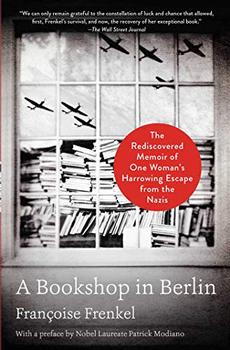
The Rediscovered Memoir of One Woman's Harrowing Escape from the Nazis
by Francoise Frenkel Book Reviewed by:
They would start lining up from dawn; they would bring a folding stool, a little food, a book, newspapers, and they would wait, first in the rains of September and October, then through the snow of November and December.
Separated from their countries of origin by the war, with no possibility of return, some without any money or assistance, these people waited, weary and numb. A terrible despondency reigned over this disparate crowd of uprooted souls.
With most able-bodied men having been called up under the general mobilization, the prefecture of police was staffed almost entirely by young women. They were completely unprepared for this enormous task and were quickly overwhelmed.
Armed with my folding stool, I queued for hours on end in order to obtain my residence permit to allow me to remain in France.
It was physically and mentally exhausting. On the inside I was fretting and fuming, but I valiantly endured the official police requirements. All foreigners, regardless of nationality or race, were required to undertake these lengthy formalities, implemented somewhat haphazardly. There was no intent to harass; it was merely a symptom of the general state of disarray.
Thus I waited patiently, some days coughing, and others even suffering a fever.
No matter! It was Paris, Paris with its afternoons spent along the banks of the Seine, next to the bouquinistes' stalls, which seemed to have filled with new treasures since my last visit.
There was widespread uncertainty. The press and radio lavished us with advice and instructions.
The publishers were remarkably generous toward me. They congratulated me and pledged their support for a new bookshop. The cultural attaché, who had, in turn, arrived back in Paris, had these very encouraging words for me. "You should be credited for remaining at your post until the very last minute." And he added, smiling, "Just like a valiant soldier."
He was trying hard to lessen the pain of separation from my beloved bookshop, just as before he had been so generous in helping me to defend it in the face of every adversity.
And so commenced for me, under a rainy sky, the infinitely dark days of the new war.
At last I obtained my residence permit. It stipulated that I could enjoy France's hospitality until the cessation of hostilities.
*
The rhythm of war accelerated at an ever-increasing rate. The Germans breached new borders. The enemy was approaching France. The "Phoney War" was drawing to an end.
However, confident in the strength of the Maginot Line, everybody still considered it impossible that the national border would be crossed.
At that moment, German reconnaissance raids commenced over Paris and its surrounds. Bombs fell on factories in the suburbs.
There was widespread uncertainty. The press and radio lavished us with advice and instructions. The public remained hesitant. Was it better to die in your home or suffocate in a cellar? When the sirens sounded, some remained in their beds, others went down to the cellar, then came back up or stationed themselves in the stairwell. Some ventured onto the front steps of the building "to see what was going on" and to gossip with neighbors.
Air-raid wardens were strict at first; then they relaxed. "At the end of the day, who knows what's best?" they admitted.
Parisian women took pride in not having been scared and would spend their mornings sharing their experiences on the telephone.
Only when confidence of being able to defend the city fell abruptly, toward the end of May 1940, did people consider abandoning Paris.
The government was advising people to leave; anybody whose presence in the capital was not absolutely necessary should go, and old people should be the first to leave.
Schools closed; the holidays were thus effectively brought forward by two months. Everybody was preparing to leave, and calmly so.
From A Bookshop in Berlin: The Rediscovered Memoir of One Woman's Harrowing Escape from the Nazis by Françoise Frenkel. Reprinted by permission of Atria, a Division of Simon & Schuster, Inc. Copyright © 2019 by Françoise Frenkel.


 (1).gif)
I like a thin book because it will steady a table...
Click Here to find out who said this, as well as discovering other famous literary quotes!

Can you name the title?
Test your book knowledge with our daily trivia challenge!
Your guide toexceptional books
BookBrowse seeks out and recommends the best in contemporary fiction and nonfiction—books that not only engage and entertain but also deepen our understanding of ourselves and the world around us.