
-
Your next favorite book
is waiting.
Summary | Excerpt | Reviews | Beyond the Book | Readalikes | Genres & Themes | Author Bio
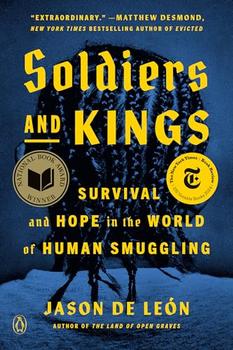
Survival and Hope in the World of Human Smuggling
by Jason De León Book Reviewed by:
This isn't to say that guías can't also be thieves, traffickers, murderers, and/or rapists. They can potentially be all those things and then some, which will become apparent as this story unfolds. But people contract smugglers because they give them the benefit of the doubt that no matter what happens, they will eventually get to their final destination, even if it involves hardship and shelling out more cash than was initially agreed upon. All migrants have heard stories of evil smugglers who abuse clients, and a significant number of them have had their own terrible firsthand experiences. But still, migrants make social contracts in good faith with guides in the hope that they will be protectors and not rob them, sell them into slavery, or abandon them in the jungle, desert, or the back of a semitruck. There are just enough "good" smugglers in the world for the economy of clandestine movement to function, even with the constant risk of things taking a bad turn at some point on the journey.
In Western popular media, smugglers are often portrayed as potbellied Latinos with silver- capped teeth and slick hair. They reek of cologne and drive shiny trucks bought with the hard- earned (or borrowed) money of desperate people trying to get to la USA. Roberto defied these stereotypes. He was a skinny, banged-up Honduran kid who was often homeless and living hand to mouth. He rarely had more than $20 to his name and was often more desperate than his clients. He knew how to guide people along the train tracks and through the jungle because he came of age in those dreadful places. But he never saw huge piles of money. He never got to drive a car. He was not a kingpin or someone who called the shots. There was nothing glamorous about his lifestyle or his brutally short existence.
Roberto's modest grave is marked by a wrought iron plaque that bears his name, birthday, and date of death. Somehow the engraver managed to get his last day on earth incorrect. But many would say that the details don't matter. To most, Roberto is a nobody. Just another young man from Honduras with a history of substance abuse and violent behavior. He was someone destined for an early grave, and cemeteries across Central America are full of the skeletons of people just like him: children born into generational poverty whose bleak futures are predetermined before they can even speak; kids who live fast and die fast because those are often the only choices they are given. Roberto is one of those kids. But he is not a nobody. He is a young person with dreams and aspirations who carries hope with him until the very end. Roberto is important enough that people will wail at his funeral and pray for his soul. Someone will scratch "I love you" in the wet concrete that is poured over the top of his tomb.
I will come to know Roberto as a soldier trying to survive on the train tracks in Mexico. He confides in me that he wants out of the smuggling game. It's gotten out of control. Death is breathing down his neck. He wants to run far away and reinvent a life for himself that doesn't include guns orknives or desperate people doing desperate things. Roberto asks me for help to escape his nightmare. I will have my chance to save him, but I will fail and he will die. The train tracks will take his life, and I will forever carry guilt for the things I didn't do.
As I sit on Roberto's grave in rural Honduras, I ponder the surrounding lush countryside. It's an awe- inspiring landscape that holds no future for so many people who must head north and roll the dice: migrants who will follow the train tracks across Mexico and pray that whatever is waiting for them at the end of the line is better than the cruel hardships and early death that they are running from in Honduras. This book is about Roberto and others like him who get caught up in the smuggling game. People on the train tracks who go by a thousand nicknames: Kingston, Flaco, Alma, Papo, Chino, Santos. People whose birth names are often mysteries until the end, when they are inscribed onto tombstones. In this book you will learn about the lives of smugglers and their intimate relationships with death. Destitute men and women who find themselves trapped in a world of violence and fast money while in search of hope; a world of guías who have no one to lead them to safety except maybe themselves. This is a journey down those train tracks.
Excerpted from Soldiers and Kings by Jason de Leon. Copyright © 2024 by Jason de Leon. Excerpted by permission of Viking. All rights reserved. No part of this excerpt may be reproduced or reprinted without permission in writing from the publisher.


 (1).gif)
Education is the period during which you are being instructed by somebody you do not know, about something you do ...
Click Here to find out who said this, as well as discovering other famous literary quotes!

Can you name the title?
Test your book knowledge with our daily trivia challenge!
Your guide toexceptional books
BookBrowse seeks out and recommends the best in contemporary fiction and nonfiction—books that not only engage and entertain but also deepen our understanding of ourselves and the world around us.