
-
Your next favorite book
is waiting.
Summary | Excerpt | Reviews | Beyond the Book | Readalikes | Genres & Themes | Author Bio
 Book Reviewed by:
Cities & Memory
3
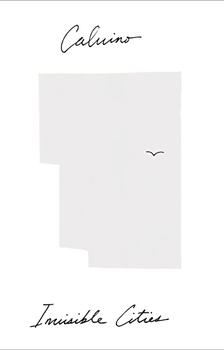
In vain, great-hearted Kublai, shall I attempt to describe Zaira, city of high bastions. I could tell you how many steps make up the streets rising like stairways, and the degree of the arcades' curves, and what kind of zinc scales cover the roofs; but I already know this would be the same as telling you nothing. The city does not consist of this, but of relationships between the measurements of its space and the events of its past: the height of a lamppost and the distance from the ground of a hanged usurper's swaying feet; the line strung from the lamppost to the railing opposite and the festoons that decorate the course of the queen's nuptial procession; the height of that railing and the leap of the adulterer who climbed over it at dawn; the tilt of a guttering and a cat's progress along it as he slips into the same window; the firing range of a gunboat which has suddenly appeared beyond the cape and the bomb that destroys the guttering; the rips in the fish net and the three old men seated on the dock mending nets and telling each other for the hundredth time the story of the gunboat of the usurper, who some say was the queen's illegitimate son, abandoned in his swaddling clothes there on the dock.
As this wave from memories flows in, the city soaks it up like a sponge and expands. A description of Zaira as it is today should contain all Zaira's past. The city, however, does not tell its past, but contains it like the lines of a hand, written in the corners of the streets, the gratings of the windows, the banisters of the steps, the antennae of the lightning rods, the poles of the flags, every segment marked in turn with scratches, indentations, scrolls.
Cities & Desire
2
At the end of three days, moving southward, you come upon Anastasia, a city with concentric canals watering it and kites flying over it. I should now list the wares that can profitably be bought here: agate, onyx, chrysoprase, and other varieties of chalcedony; I should praise the flesh of the golden pheasant cooked here over fires of seasoned cherry wood and sprinkled with much sweet marjoram; and tell of the women I have seen bathing in the pool of a garden and who sometimes—it is said—invite the stranger to disrobe with them and chase them in the water. But with all this, I would not be telling you the city's true essence; for while the description of Anastasia awakens desires one at a time only to force you to stifle them, when you are in the heart of Anastasia one morning your desires waken all at once and surround you. The city appears to you as a whole where no desire is lost and of which you are a part, and since it enjoys everything you do not enjoy, you can do nothing but inhabit this desire and be content. Such is the power, sometimes called malignant, sometimes benign, that Anastasia, the treacherous city, possesses; if for eight hours a day you work as a cutter of agate, onyx, chrysoprase, your labor which gives form to desire takes from desire its form, and you believe you are enjoying Anastasia wholly when you are only its slave.
Cities & Signs
1
You walk for days among trees and among stones. Rarely does the eye light on a thing, and then only when it has recognized that thing as the sign of another thing: a print in the sand indicates the tiger's passage; a marsh announces a vein of water; the hibiscus flower, the end of winter. All the rest is silent and interchangeable; trees and stones are only what they are.
Finally the journey leads to the city of Tamara. You penetrate it along streets thick with signboards jutting from the walls. The eye does not see things but images of things that mean other things: pincers point out the tooth-drawer's house; a tankard, the tavern; halberds, the barracks; scales, the grocer's. Statues and shields depict lions, dolphins, towers, stars: a sign that something—who knows what?—has as its sign a lion or a dolphin or a tower or a star. Other signals warn of what is forbidden in a given place (to enter the alley with wagons, to urinate behind the kiosk, to fish with your pole from the bridge) and what is allowed (watering zebras, playing bowls, burning relatives' corpses). From the doors of the temples the gods' statues are seen, each portrayed with his attributes—the cornucopia, the hourglass, the medusa—so that the worshiper can recognize them and address his prayers correctly. If a building has no signboard or figure, its very form and the position it occupies in the city's order suffice to indicate its function: the palace, the prison, the mint, the Pythagorean school, the brothel. The wares, too, which the vendors display on their stalls are valuable not in themselves but as signs of other things: the embroidered headband stands for elegance; the gilded palanquin, power; the volumes of Averroes, learning; the ankle bracelet, voluptuousness. Your gaze scans the streets as if they were written pages: the city says everything you must think, makes you repeat her discourse, and while you believe you are visiting Tamara you are only recording the names with which she defines herself and all her parts.
Excerpted from Invisible Cities by Italo Calvino. Copyright © 1978 by Italo Calvino. Excerpted by permission of Mariner Books. All rights reserved. No part of this excerpt may be reproduced or reprinted without permission in writing from the publisher.


 (1).gif)
The library is the temple of learning, and learning has liberated more people than all the wars in history
Click Here to find out who said this, as well as discovering other famous literary quotes!

Can you name the title?
Test your book knowledge with our daily trivia challenge!
Your guide toexceptional books
BookBrowse seeks out and recommends the best in contemporary fiction and nonfiction—books that not only engage and entertain but also deepen our understanding of ourselves and the world around us.