-
Your next favorite book
is waiting.
Summary | Excerpt | Reviews | Beyond the Book | Readalikes | Genres & Themes | Author Bio
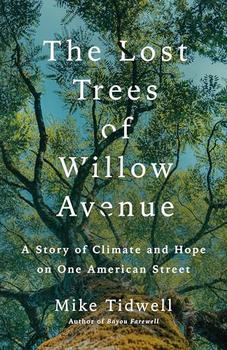
A Story of Climate and Hope on One American Street
by Mike Tidwell Book Reviewed by:
The main solution to climate change, of course, is clean energy. And on my block, just as we've seen the passing of trees, we've seen the coming of clean energy. As a nation, we've made solid strides on renewable power over the past thirty years. Low-cost solar panels hang on my roof and on commercial buildings and apartments all around me. And electric cars drive constantly up and down my street in this politically progressive neighborhood, making that pleasant humming sound my neighbor Paula calls "the faint harmony of angels."
A massive climate change bill passed by the US Congress in 2022 will effectively lock in the clean-energy revolution in this country. A complete reversal is just no longer possible no matter who occupies the White House—or what majorities make up Congress. Detroit is steadily retooling to make electric cars. Utility-scale solar power is now the cheapest energy in the history of … energy.
I've spent the last quarter century of my life fighting for these energy breakthroughs. I've lobbied on Capitol Hill, organized rallies in state capitals, and peacefully gone to jail blocking oil and gas pipelines. But clean energy alone can no longer save us. The genie from that bottle is out, yes, but we waited way, way too long to pop the cork. Full deployment is still many years away, which means carbon emissions will not fall at the rapid pace we need here and worldwide.
Given the lag, United Nations secretary-general António Guterres warns: "We are on a highway to climate hell with our foot still on the accelerator." That might have sounded like hyperbole just a few years ago. Now I just walk outside my front door and know he's probably right.
Already, serious policymakers are calling for "negative emissions," an attempt to suck carbon out of the air and store it in the ground in the form of crushed rock or with giant carbon-filtering machines or through agricultural practices. It's unclear whether these methods will make a guaranteed difference. They're expensive and almost certainly time-consuming beyond the planet's own stern stopwatch.
Others say we need to consider one more tool. It's a powerful tool capable of cooling the planet quickly, buying us some time. The technique is called solar radiation modification, or simply solar geoengineering. It sounds so crazy. But some really smart people at Harvard and elsewhere believe we have no choice but to explore various techniques to reflect sunlight away from the planet and back into outer space—and do it for decades. Think of it as a giant tree canopy for the whole world, a kind of solar shade high in the sky that would effectively replace—for a while—the dying oaks in my neighborhood and the wildfire-ravaged pines in California.
I've harbored doubts about this technique for a long time. But in January 2023, exhausted from twenty years of full-on climate activism while the oceans were still rising and heat waves were still blistering the planet and trees were still dying on my block, I began a quest to learn all I could about this emerging realm of "lifeboat" climate science.
This book is the story of that learning, coupled with the saga of my changing street, where human and ecological communities continue to suffer and adapt in moving and unpredictable ways.
Only in the past few years has a book like this been possible to write. Climate change has accelerated so much, with such extreme impacts everywhere, that you can now throw a dart at a spinning, lacquered globe, and wherever that dart lands, right at that tiny place, you can write a whole book about the conspicuous disruptions happening there. The story that follows—hyperlocal, replete with true narratives of life and death in one neighborhood—is proof of that. It's a harrowing and hopeful proxy for every street and every place in this nation and beyond.
1
Why Are the Trees Dying?
She probably weighed twenty tons when they finally cut her down on Willow Avenue. She had outlived Teddy Roosevelt, World War I, the Great Depression, the 1960s, the Reagan administration, September 11, the dawn of smartphones.
Excerpted from The Lost Trees of Willow Avenue by Mike Tidwell. Copyright © 2025 by Mike Tidwell. Excerpted by permission of St. Martin's Press. All rights reserved. No part of this excerpt may be reproduced or reprinted without permission in writing from the publisher.
 (1).gif)
Our wisdom comes from our experience, and our experience comes from our foolishness
Click Here to find out who said this, as well as discovering other famous literary quotes!

Can you name the title?
Test your book knowledge with our daily trivia challenge!
Your guide toexceptional books
BookBrowse seeks out and recommends the best in contemporary fiction and nonfiction—books that not only engage and entertain but also deepen our understanding of ourselves and the world around us.