
-
See Our Best Book
Club Books of 2026!
Summary | Excerpt | Reviews | Beyond the Book | Readalikes | Genres & Themes | Author Bio
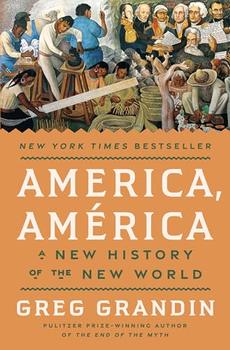
A New History of the New World
by Greg Grandin Book Reviewed by:
1.
Leaves of Grass
Philosophy begins in wonder," Socrates said. It matures, Hegel added, in terror, on the "slaughter bench" of history. So it was with the arrival of the Spanish in the New World.
Wonder there was when Christendom realized there existed another half a world, filled with rarezas, rarities, curious plants and animals but above all people, many more and many more different kinds than lived in all of Europe. Even before Copernicus, Europe was awakening to the idea that the Earth wasn't the center of existence, and that the universe contained, Giordano Bruno would soon reckon, "innumerable suns" and "infinite earths that equally revolve around these suns."
Scholars intuited a link between the celestial and earthly multitudes. There was one heavenly realm, containing an incalculable number of stars. There was one earthly estate, now known to contain many more millions of people than previously imagined. The realization that the earth was not the center of divine creation was as unsettling as the knowledge that Europe wasn't the center of the world.
What did this multiplication mean for the idea of Catholic holism, for the story of Genesis when God at Creation called into being first Adam, then Eve, who together produced a single linaje, or lineage, of descendants with a shared, if gory, history?
When reconciled with the Catholic premise of celestial unity, the diversity of the New World's peoples could support the ideal of equality. Time spent in the Caribbean, Mexico, and Central America convinced the Dominican priest, Bartolomé de las Casas, that the ancient philosophers and theologians who had argued that there existed categories of inferior humans, people born to be "natural slaves," were wrong. As it turned out, Las Casas wrote, the ancients didn't "know very much" about the world. The Dominican would continue to cite the sages when it suited his purpose, but for him, now, truth was to be found not in Aristotle but in America-and the most important truth was that humans everywhere were fundamentally the same. All were made in God's image. Their differences-skin color, hair texture, cultural practices, and religious beliefs-reflected the vast variety of the infinite divine.
And differences in appearance had nothing to do with human essence, which for Las Casas was everywhere the same. Every Indian he had met in the New World, he said, possessed both free will and the ability to reason. That alone made them human. They could remember the past, imagine the future, estimate probabilities, and could see, hear, feel, smell, and taste. They were born, matured, grew old, and became ill, and when they died their families grieved, as humans did everywhere. When happy, they laughed. When sad, they cried. They took delight in the good and despised the bad. From this, Las Casas issued a famous declaration: Todo linaje de los hombres es uno-All humanity is one.
At the same time, the New World's conquerors mocked the idea of humanity's oneness, laying the foundation for race supremacy. Spanish settlers and colonists legitimated cruel killing on an unprecedented scale, forcing the New World's inhabitants to labor in mines, fields, and waters, to extract the riches of America-gold, silver, pearls, dyes, and soon sugar and tobacco-that Europe would use to gild its empires, muster its armies, fund its wars, build its cathedrals, and pay for more voyages of conquest and enslavement. Never mind what priests like Las Casas were saying. Theologians were known to say one thing and its opposite. Indians were little better than apes put on earth to serve man. To dominate them was just. To work them to death no more a sin than to butcher a hog.
An Infinity of People
The people of the New World were "found." Then they were lost. Not immediately and not completely, but enough so that a group of Dominican and Franciscan priests wrote their superiors in Spain in 1517 wanting to know where they went. "Where are they, oh most illustrious fathers?" What happened to the men and women who upon Columbus's arrival two decades earlier were so many that they were like "leaves of grass?"
Excerpted from America, América by Greg Grandin. Copyright © 2025 by Greg Grandin. Excerpted by permission of Penguin Press. All rights reserved. No part of this excerpt may be reproduced or reprinted without permission in writing from the publisher.
The Sister's Curse
by Nicola Solvinic

The Lost Story of Eva Fuentes
by Chanel Cleeton

The Vanishing Place
by Zoë Rankin
 (1).gif)
Happiness belongs to the self sufficient
Click Here to find out who said this, as well as discovering other famous literary quotes!

Can you name the title?
Test your book knowledge with our daily trivia challenge!
Your guide toexceptional books
BookBrowse seeks out and recommends the best in contemporary fiction and nonfiction—books that not only engage and entertain but also deepen our understanding of ourselves and the world around us.