
-
See Our Best Book
Club Books of 2026!
Summary | Excerpt | Reviews | Beyond the Book | Readalikes | Genres & Themes | Author Bio
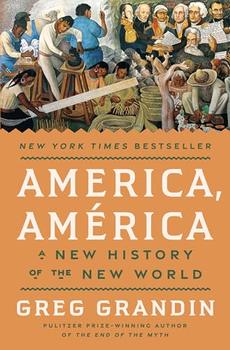
A New History of the New World
by Greg Grandin Book Reviewed by:
Demographers today aren't sure what the size of America's population was before the arrival of the Spanish. Most estimates fall between fifty and one hundred million inhabitants. The Spanish couldn't say. They knew that the Indies (the name América was in use for the New World in the early 1500s but not widely adopted until a little later) were densely populated with wildly varied peoples. They ranged from the elysian Taino, who seemed to have lived lush and well-nourished lives on the islands of the Caribbean; to the hierarchically organized, ostentatious, and scientific Aztec and Inka Empires in Mexico and Peru. Columbus thought the island of Hispaniola-Spain's first Caribbean colony, from where Hernando Cortés would soon lead his assault on Mexico-was "paradise," but a populated paradise, completely "cultivated like the countryside around Cordoba." He estimated that the island was home to over a million souls. Las Casas, who, seventeen years old, arrived in the Caribbean on April 15, 1502, thought that number too low. "An infinity of people" lived in the new lands, he later wrote. The New World was "filled with people, like a hive of bees."
"It was," he said, "as if God had placed all, or the majority, of the entire human race in these countries."
Later, European romantics would use the word sublime to describe the sensation evoked by confrontation with the grandeur and terror of nature, its existential enormity. And there's some of this feeling in the letters and chronicles left by Spanish warriors. As the Conquest proceeded, as Cortés began his march through Mexico, they wrote of their exploits climbing high peaks equal to the Alps, navigating great river systems, and trekking through dense forests. The volcano Popocatépetl rained fire and ice, bursting, Cortés wrote King Charles, with "so much force and noise it seemed as if the whole Sierra was crumbling to the ground."
Yet it wasn't nature that bedazzled the Spaniards as much as the "great city" of Tenochtitlán sitting below the volcano. "As large as Seville," Cortés wrote, and more populated than London, with "many wide and handsome streets," fine noble houses, engineered canals, and a complex hydroponic agricultural system. Further south, it wasn't volcanic eruptions that shivered European souls. It was Mapuche warriors overspread across a vast Andean valley mustered to defend their land. They "shook the world around them," one conquistador wrote, "with sudden dread."
There were so many people.
Then they began to die. The consensus is that the population was cut by between 85 to 95 percent within a century and a half. The Spanish Conquest, driven forward at a relentless pace by the consolidating Kingdom of Castile, inaugurated what the demographers Alexander Koch, Chris Brierley, Mark Maslin, and Simon Lewis call history's "largest human mortality event in proportion to the global population," a drop of upward of 56 million people by 1600. "The greatest genocide in human history," wrote Tzvetan Todorov in the 1980s.
The first wave of death was brought by Conquistador terror.
All the World Knows
Bartolomé de las Casas's transformation into a critic of the Conquest didn't happen until after the Conquest had made him rich. As a young boy growing up in Seville-he was born in 1484-Bartolomé had witnessed the glory heaped on Columbus upon his return from his first cross-Atlantic voyage and heard the stories of islands filled with gold, spices, and potential slaves. His merchant father, Pedro, and uncles Francisco and Juan were part of Columbus's crew, and Pedro used the wealth he acquired from sailing to pay for his son's education. Bartolomé became a "good Latinist" and began studying to become a priest. When Las Casas first landed in Hispaniola (today divided by Haiti in the west and the Dominican Republic in the east), his head was already crowned with a friar's tonsure. He worked with his father, who had given up sailing to settle on the island as a merchant. Las Casas continued his religious studies and, in 1507, traveled to Rome for his ordination.
Excerpted from America, América by Greg Grandin. Copyright © 2025 by Greg Grandin. Excerpted by permission of Penguin Press. All rights reserved. No part of this excerpt may be reproduced or reprinted without permission in writing from the publisher.
The Sister's Curse
by Nicola Solvinic

The Lost Story of Eva Fuentes
by Chanel Cleeton

The Vanishing Place
by Zoë Rankin
 (1).gif)
It is a fact of life that any discourse...will always please if it is five minutes shorter than people expect
Click Here to find out who said this, as well as discovering other famous literary quotes!

Can you name the title?
Test your book knowledge with our daily trivia challenge!
Your guide toexceptional books
BookBrowse seeks out and recommends the best in contemporary fiction and nonfiction—books that not only engage and entertain but also deepen our understanding of ourselves and the world around us.