-
Your next favorite book
is waiting.
Summary | Excerpt | Reviews | Beyond the Book | Readalikes | Genres & Themes | Author Bio
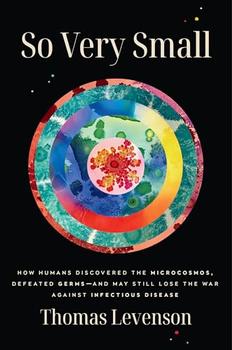
How Humans Discovered the Microcosmos, Defeated Germs--and May Still Lose the War Against Infectious Disease
by Thomas Levenson Book Reviewed by:
The calm held for a few weeks more. A handful of cases turned up in scattered locations both within and outside London's city wall. A few deaths were recorded in the official tallies, but the numbers remained reassuringly low: nine in the first full week of May, just three in the next. Crucially, each such case had been isolated, turning up almost exclusively in poorer neighborhoods. The metropolis seemed safe, so much so that the fire-and-brimstone minister Thomas Vincent wrote, "Fears are hushed and hopes take place, that the black cloud did but threaten ... but the wind would drive it away."
Then came the week of May 16–23, and a Bill of Mortality that listed seventeen plague deaths. Forty-two more Londoners died of the disease during the week ending June 6; more than a hundred followed in the next seven days. Worse news: the victims came from neighborhoods far from the initial outbreaks. By June, the plague had spread through the city and its suburbs, and the wealthy joined the poor in its path.
Pepys kept watch. "The plague is come into the City," he wrote on June 10, reaching all the way into a friend's house, "which ... troubles me mightily." Five days later he noted that "the towne grows very sickly, and people to be afeard of it." Chasing a wisp of hope, he wrote on June 20 that "people do think that the number will be fewer in towne than it was in the last weeke!" He had his own scare when the driver of a coach he had hired in central London collapsed at the reins, forcing Pepys to hail another coach, "with a sad heart for the poor man and trouble for myself." He escaped untouched that time, but soon enough his city and himself were utterly beset. "The sickness is got into our parish this week," he wrote on July 26, "and is got, indeed, every where."
Pepys was right. From the end of June, plague deaths reported in the weekly Bills of Mortality accelerated, doubling about every fortnight. The toll topped one thousand in the week ending on July 18, hitting 2,010 for the week ending on August 1, then reached almost four thousand by the fifteenth. It would not drop back below that number until mid-October. This was no mere episode but a true epidemic, a catastrophe that could swallow London whole.
That's how it was felt in the moment. London's plague year was an apocalypse, the divine judgment in which sin and virtue collapsed into the same pit. "Lovers, and friends, and companions in sin have stood aloof ... lest death should issue forth," Reverend Vincent wrote. Their fear: "that the grave is now opening its mouth to receive their bodies and hell opening its mouth to receive their souls." The physician Nathaniel Hodges left the theology to the ministers, but his account of the peak of the epidemic in August painted the same end-of-days picture. "In some Houses Carcases lay waiting for Burial," he wrote, "and in other Persons in their last Agonies." The living "bewailed both their Loss and the dismal Prospect of their own sudden Departure." Family life was destroyed: "Death was the sure Midwife to all Children, and Infants passed immediately from the Womb to the Grave; who would not melt with grief to see ... the Marriage-Bed changed the first Night into a Sepulchre." Some staggered to their deaths in the street, others collapsed and vomited as if poisoned, and some, like Pepys's coachman, were struck suddenly and died "in the Market, while they are buying Necessaries for the Support of Life."

Excerpted from So Very Small by Thomas Levenson. Copyright © 2025 by Thomas Levenson. Excerpted by permission of Random House. All rights reserved. No part of this excerpt may be reproduced or reprinted without permission in writing from the publisher.
 (1).gif)
A few books well chosen, and well made use of, will be more profitable than a great confused Alexandrian library.
Click Here to find out who said this, as well as discovering other famous literary quotes!

Can you name the title?
Test your book knowledge with our daily trivia challenge!
Your guide toexceptional books
BookBrowse seeks out and recommends the best in contemporary fiction and nonfiction—books that not only engage and entertain but also deepen our understanding of ourselves and the world around us.