

 Book Reviewed by:
In everyday life, at the macroscopic level, we can explain the physics of how things move; if you hit a billiard ball with a pool cue with a certain force, you can calculate where it will end up. But when dealing with near-invisible particles at a very small scale, it's a completely different ballgame. It has been discovered that determining where and how these particles move isn't predictable in the classical sense; their properties are erratic. So these particles are studied in terms of probability; it's probable that any given particle will be located here at a certain time, or it's probable that it will be moving at this velocity. This type of probabilistic scientific study (and its mathematical counterparts) is generally known as quantum mechanics.
 In 1927, Nobel Prize-winner Werner Heisenberg published what is called the "uncertainty principle," which sets forth a basic rule for how these particles probably work. It states that the more you know about their positions, the less you know about their velocities and vice versa. This, he explains, is because there is a fundamental inability to know both at the same time.
 This principle has led to many interpretations of quantum mechanics and, interestingly, to heated philosophical debates about the existence of parallel universes. Since a particle has a probability of being in any state at any given time, it's possible that it could be in two states at the same time (and that it doesn't settle on a form until an outside witness is there to observe it). Sound reasonable enough? Not to everyone.
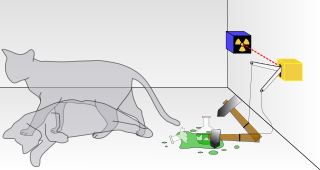
 Nobel prize-winning Austrian physicist Erwin Schrödinger wanted to demonstrate the paradoxes inherent in this interpretation of the uncertainty principle, so he devised a macroscopic thought experiment in which a cat is placed in a box, along with a small amount of radioactive material, a Geiger counter, and a device that will - if the radioactive material decays at all - break a vial of poison that will kill the cat. Whether or not the decay will take place is uncertain, but if it does, the cat will die.
 Schrödinger's experiment reveals the inconsistency behind this idea: if every particle can be in any (and every) state until a witness (i.e. an experimenter) observes it, the cat should be able to be both alive and dead simultaneously, until the experimenter opens the box and observes the cat's actual state. And, of course, as we understand that a living thing can't be both dead and alive at the same time, the paradox presents itself.
 This "beyond the book article" relates to



 (1).gif)

