-
Your next favorite book
is waiting.
Summary | Excerpt | Reviews | Beyond the Book | Read-Alikes | Genres & Themes | Author Bio

 Book Reviewed by:
This article relates to The Fly Trap

In his memoir, The Fly Trap, Fredrik Sjöberg writes: "hoverflies are meek and mild creatures, easy to collect, and ... appear in many guises. Sometimes they don't even look like flies. Some of them look like hornets, others like honeybees, parasitic ichneumon wasps, gadflies, or fragile, thin-as-thread mosquitoes so tiny that normal people never even notice them."
If you're "meek and mild" in the natural world, it helps to pretend to be bad and bold which explains hoverflies' expertise at Batesian mimicry, a natural process where species take on the threatening behaviors or looks of more offensive counterparts to ward off predators.
Around 6,000 species of hoverflies have been described. They are common throughout the world, except in the coldest of climates such as Antarctica. The frequent confusion of the marmalade hoverfly with the nasty wasp was in full display a decade ago in England when an unusually large population of them came ashore on England's southern beaches. "Children were screaming, people were covering up prams and pushchairs. If you stopped still for a moment, you could get covered in them. I was told that it was the same all the way to Kirby le Soken, and that's quite a step [away]. Drifts of the hoverflies also piled up along the foreshore between Walton and Clacton, as insects which had failed to make the Channel crossing were washed up by the tide," The Guardian reported.
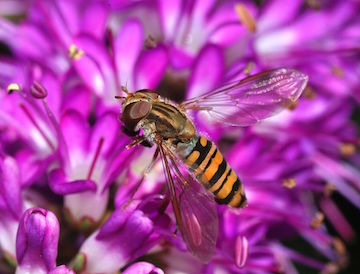
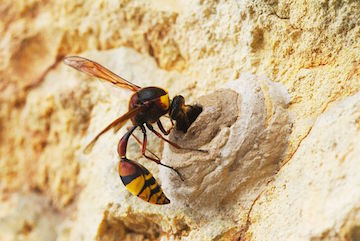
So what are the differences between a hoverfly and a wasp? For one thing, wasps have four wings, hoverflies have two. Wasps have a narrow "wasp" waist, while hoverflies are pretty chubby throughout. Wasps have fairly long antennae whereas the hoverfly has short stubby ones. The eyes of a hoverfly look like, well...that of a fly, whereas wasps' eyes are smaller and kidney-shaped, crunched close to the antennae.
Even if the insects are flying around too quickly for you to ID them closely, a quick check of the segmented waist and wings should lead you in the right direction. Given that hoverfly larvae (just like ladybugs) are great at eating aphids, it might be cause for celebration to spot hoverflies in your backyard.
Image of Marmalade Hoverfly, courtesy of Alvesgaspar
Image of Potter Wasp, courtesy of Chiswick Chap
Filed under Nature and the Environment
 This "beyond the book article" relates to The Fly Trap. It originally ran in July 2015 and has been updated for the
August 2016 paperback edition.
Go to magazine.
This "beyond the book article" relates to The Fly Trap. It originally ran in July 2015 and has been updated for the
August 2016 paperback edition.
Go to magazine.


 (1).gif)
Common sense is genius dressed in its working clothes.
Click Here to find out who said this, as well as discovering other famous literary quotes!

Can you name the title?
Test your book knowledge with our daily trivia challenge!
Your guide toexceptional books
BookBrowse seeks out and recommends the best in contemporary fiction and nonfiction—books that not only engage and entertain but also deepen our understanding of ourselves and the world around us.