
-
Your next favorite book
is waiting.
Summary | Excerpt | Reading Guide | Reviews | Beyond the Book | Read-Alikes | Genres & Themes | Author Bio
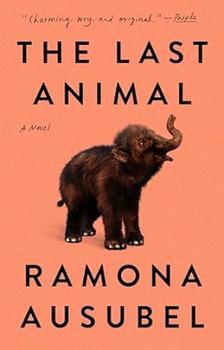
A Novel
by Ramona Ausubel Book Reviewed by:
This article relates to The Last Animal

.jpg "Heck cattle") The Last Animal by Ramona Ausubel describes a cutting-edge scientific endeavor to bring the woolly mammoth back from extinction by combining its DNA with that of a modern Asian elephant and growing the resulting embryo in an elephant's (or an artificial) womb. The animal that is born will not be genetically identical to a wooly mammoth, but a cold-resistant elephant that would occupy the same ecological niche. Though it sounds like something out of Jurassic Park, there is a similar, real-life project being undertaken by Colossal Biosciences which began in 2021 and is anticipated to be complete by 2027. The theoretical process involved was also described in the 2015 book How to Clone a Mammoth: The Science of De-Extinction by Beth Shapiro.
The Last Animal by Ramona Ausubel describes a cutting-edge scientific endeavor to bring the woolly mammoth back from extinction by combining its DNA with that of a modern Asian elephant and growing the resulting embryo in an elephant's (or an artificial) womb. The animal that is born will not be genetically identical to a wooly mammoth, but a cold-resistant elephant that would occupy the same ecological niche. Though it sounds like something out of Jurassic Park, there is a similar, real-life project being undertaken by Colossal Biosciences which began in 2021 and is anticipated to be complete by 2027. The theoretical process involved was also described in the 2015 book How to Clone a Mammoth: The Science of De-Extinction by Beth Shapiro.
A parallel project that is farther along and so might provide a model for how the mammoth project could eventually proceed is that of resurrecting the auroch (Bos primigenius), the ancestor of modern cattle, in Europe. The wild auroch was depicted in famous prehistoric cave paintings, such as those at Lascaux. Aurochs were six feet tall, had enormous horns, and roamed over thousands of acres in herds of about 30 animals. Their natural lifespan was 25–30 years. They were domesticated 9,000–10,000 years ago and all the known breeds of cattle are descended from them. The auroch went extinct in 1627, with the last known specimen identified from Poland's Jaktorów Forest.
Various ventures to revive the auroch are currently underway: the Tauros program in the Netherlands launched in 2008, and the Auerrind project in Germany started in 2013 and now has five breeding herds. Both were initiated by Rewilding Europe, an organization active in conservation and "rebuild[ing] wildlife diversity." The intention is to have self-sustaining herds of aurochs before 2030.
These are not the first attempts, however. Two zookeeper brothers, Heinz and Lutz Heck, bred cattle similar to aurochs in Germany in the 1920s–30s and released the resulting herds onto Hermann Göring's private grounds. But their endeavor was tainted by its association with the idea of creating Aryan super-breeds. Heck cattle are still known, though — for instance, as grazers on the Oostvaardersplassen nature reserve in the Netherlands.
Modern heritage breeds such as Highland and Longhorn cattle are most closely related to the auroch, and are thus used as proxies in back-breeding. Today's domesticated animals are the result of millennia of selective breeding for desirable characteristics; and modern-day techniques such as artificial insemination and embryo transplantation help speed up the process. Together, over many generations, these techniques maximize the traits of a hardy auroch-like breed that is being reintroduced onto restored pasture land and forests in Europe.
Heck cattle in Germany's Wildpark Rheingönheim, courtesy of Wikimedia Commons
Filed under Nature and the Environment
 This "beyond the book article" relates to The Last Animal. It originally ran in April 2023 and has been updated for the
March 2024 paperback edition.
Go to magazine.
This "beyond the book article" relates to The Last Animal. It originally ran in April 2023 and has been updated for the
March 2024 paperback edition.
Go to magazine.

 (1).gif)
Every good journalist has a novel in him - which is an excellent place for it.
Click Here to find out who said this, as well as discovering other famous literary quotes!

Can you name the title?
Test your book knowledge with our daily trivia challenge!
Your guide toexceptional books
BookBrowse seeks out and recommends the best in contemporary fiction and nonfiction—books that not only engage and entertain but also deepen our understanding of ourselves and the world around us.