-
Your next favorite book
is waiting.
Summary | Excerpt | Reviews | Beyond the Book | Read-Alikes | Genres & Themes | Author Bio

A Novel
by Brittany Newell Book Reviewed by:
This article relates to Soft Core

In the novel Soft Core, protagonist Ruth works at a San Francisco club as a stripper, a profession with a long history in the United States. The first striptease acts in America were part of vaudeville shows at carnivals and burlesque theatres around the turn of the twentieth century. One early "disrobing act" by a trapeze performer was famously captured on film in 1901. The road to stripping's current place in U.S. culture has been a long and bumpy one. Here are some of the milestones along the way:
1925: Minsky's Burlesque, a club in New York City that had become famous for its striptease performances, is raided by police. Minsky's was known as the first burlesque club to feature a runway, allowing performers to get closer to the audience. At the time, clubs were legally allowed to feature topless women posed in motionless "tableaus." Minsky's was raided because, unlike the law-abiding clubs, its topless performers moved.
1931: This year marks the first recorded use of the term "striptease," according to the Merriam-Webster Dictionary.
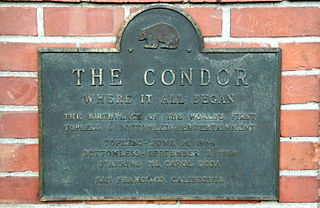 1964: Carol Doda, believed to be the first topless go-go dancer, debuts her risqué act at San Francisco's Condor Night Club. Within months, scores of clubs in the city would feature topless dancers. Doda became a local legend, with her silicone-enhanced breasts at one point insured by Lloyd's of London for $1.5 million (more than $15 million in 2024 dollars).
1969: The Condor Night Club goes "bottomless," launching a trend of fully nude dance performances.
1972: As quickly as it came into fashion, bottomless dancing becomes illegal in California.
1980: San Francisco's Mitchell Brothers O'Farrell Theatre, a pornographic movie theatre turned strip club, popularizes lap dancing. While the exact origins of the practice are disputed (some say lap dancing made its debut in New York, others in Montreal), this is the club believed to have really kickstarted the trend. Previously, performers hadn't touched the clientele. Dancers start earning much higher tips but face greater risk of sexual assault.
1991: Scores launches in New York City, spearheading a trend of high-end "gentlemen's clubs" that seek to counter strip clubs' seedy reputation.
1997: The Lusty Lady club in San Francisco becomes the first in the country to fully unionize, eventually becoming a worker-owned cooperative in 2003.
While still controversial and reviled by some, roughly a century after their debut, strip clubs have cemented their place in American culture.
Plaque outside the Condor Club in San Francisco, courtesy of Frank Steele, CC BY-SA 2.0
Filed under People, Eras & Events
 This article relates to Soft Core.
It first ran in the February 12, 2025
issue of BookBrowse Recommends.
This article relates to Soft Core.
It first ran in the February 12, 2025
issue of BookBrowse Recommends.



 (1).gif)
In youth we run into difficulties. In old age difficulties run into us
Click Here to find out who said this, as well as discovering other famous literary quotes!

Can you name the title?
Test your book knowledge with our daily trivia challenge!
Your guide toexceptional books
BookBrowse seeks out and recommends the best in contemporary fiction and nonfiction—books that not only engage and entertain but also deepen our understanding of ourselves and the world around us.