
-
Your next favorite book
is waiting.
Summary | Excerpt | Reading Guide | Reviews | Beyond the Book | Read-Alikes | Genres & Themes | Author Bio
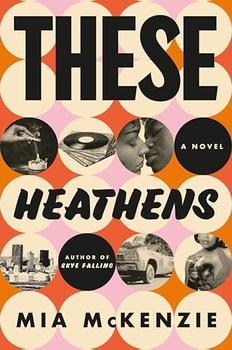
A Novel
by Mia McKenzie Book Reviewed by:
This article relates to These Heathens

.jpg "Frederick Douglass High School, serving Collier Heights") In These Heathens, set in 1960, 17-year-old Doris Steele visits a friend of her former teacher, who lives in the Collier Heights area in Atlanta, Georgia. Collier Heights was established in 1952 as an all-Black neighborhood, at a time when redlining meant that Black Georgians were significantly restricted in terms of housing. They were confined to certain "zones" and those who attempted to live outside of these designated spaces, in areas populated by whites, were targeted with threats and violence.
In These Heathens, set in 1960, 17-year-old Doris Steele visits a friend of her former teacher, who lives in the Collier Heights area in Atlanta, Georgia. Collier Heights was established in 1952 as an all-Black neighborhood, at a time when redlining meant that Black Georgians were significantly restricted in terms of housing. They were confined to certain "zones" and those who attempted to live outside of these designated spaces, in areas populated by whites, were targeted with threats and violence.
In the early 1950s, a Black housing developer named Robert Thompson, along with his team of colleagues, began scouting land for development with the goal of expanding the available options for Black residents of the Atlanta area. They essentially used the tools of redlining to their advantage by buying up land for Black housing, and then when white residents of nearby neighborhoods moved away so they would not have to live near Black people, they bought up that land too, and it was cheaper then because white people didn't want to live there. This is how Collier Heights became an all-Black community.
By the mid-1960s the town was 4,000 acres of suburban sprawl. It attracted residents who were middle class or, like Doris's teacher's friend Mrs. Broussard, upper-middle class. The houses were selling at this time for $20,000-$50,000 and featured modern amenities like intercom systems, sliding glass doors, and Formica counters. Most of the houses built were ranches, as this was a very popular style at the time. By the 1970s, the neighborhood had become a well-known destination for Black residents of Georgia and beyond; a feature conducted by the podcast 99% Invisible sums up the appeal succinctly: "Along with peace and fresh air, this cloistered all-Black suburb offered...a small break from white racism."
As depicted in These Heathens, Collier Heights was home at one time or another to multiple civil rights leaders, including Martin Luther King, Sr., and Ralph and Juanita Abernathy. When MLK, Jr. was assassinated, Richard Nixon visited the King family household there to pay his respects. In the book, it is noted that Mrs. Broussard's husband is a housing developer, much like Robert Thompson and the other Black visionaries that made Collier Heights a suburban dream. She explains to Doris, "This neighborhood is the first ever designed by and for our people." She goes on to say that since "restaurants in downtown Atlanta don't serve colored people...we entertain at home." A feature in Atlanta magazine about the houses in Collier Heights echoes the same point, referring to "elaborate party rooms" as a common feature. For Doris, who is from the rural town of Millen, Georgia, three hours from Atlanta by train, Collier Heights is the epitome of Black cosmopolitan sophistication.
As of 2009, the same year it was first listed on the National Register of Historic Places, the neighborhood consisted of around 1,700 homes. On its official website, it is described as a "beacon of hope for the upper middle-class and affluent African Americans in Atlanta who sought a community that would allow them to live comfortably, while celebrating their heritage." The current population of around 5,600 is currently roughly 95% Black.
Frederick Douglass High School in Atlanta in winter 2013
Photo by Dreman1731, CC BY-SA 3.0
Filed under Places, Cultures & Identities
 This article relates to These Heathens.
It first ran in the June 18, 2025
issue of BookBrowse Recommends.
This article relates to These Heathens.
It first ran in the June 18, 2025
issue of BookBrowse Recommends.

 (1).gif)
A library is thought in cold storage
Click Here to find out who said this, as well as discovering other famous literary quotes!

Can you name the title?
Test your book knowledge with our daily trivia challenge!
Your guide toexceptional books
BookBrowse seeks out and recommends the best in contemporary fiction and nonfiction—books that not only engage and entertain but also deepen our understanding of ourselves and the world around us.