-
Your next favorite book
is waiting.
Summary | Excerpt | Reading Guide | Reviews | Beyond the book | Read-Alikes | Genres & Themes | Author Bio
 Book Reviewed by:
It is 1521, just off the pilgrim's path in Santo Domingo de la Calzada, Spain, and Maria's future of fortune is set in a marriage match that will take her away from her mediocre life of serving her older brothers and spitting cherry pits in the dirt. It is 1827 in London, England, and Charlotte is sitting up stick-straight in the foyer of her Aunt Amelia's home, resigned to endure her first season of matchmaking. It is 2019 at a booming house party in Boston, Massachusetts, and Alice is making a vow to herself in a dirty bathroom mirror to shed the shy, reserved "Old Alice" to become "New Alice" for just one night.
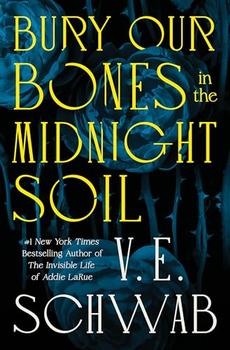
V.E. Schwab's new novel, Bury Our Bones in the Midnight Soil, tells the story of these three different women who are about to have an encounter with a captivating yet terrible creature, and then become one themselves. The word "vampire" isn't one that is thrown around lightly or even very often in these pages (though Schwab has dubbed the book her "toxic lesbian vampire saga" on Instagram); instead, Maria, Charlotte, and Alice are described as more akin to deadly blooms in a garden. Feared and desired in both life and death, they start their unique paths into their newly immortal lives: Maria must forever chase her most frivolous desires all over Europe; Charlotte escapes from polite society with a forbidden lover; Alice leaves the chaos of a broken home to become someone new. This is an epic, ambitious novel about confronting one's worst self, one's loneliness, and one's rage at the unfairness of life—and while I struggled to find a rhythm with its structure and balance of characters, it shines in its unapologetic female leads, its historical settings, and its captivating, if somewhat theatrical, prose style.
There's much to like here: Maria, Charlotte, and Alice are all vivid, vibrant characters. Maria and Charlotte are longing for something bigger than the paltry offerings of their current lives; I love how petty Maria is with her viscount husband and in-laws who just want her to produce heirs, and how Charlotte stays true to herself beneath the feigned politeness of the matchmaking process. Alice is also longing for something more, but her feelings are more sentimental and nostalgic, as she attempts to move on from the painful memories of her mother's death and father's second marriage. Not only did I empathize with these three immensely, but I also felt highly immersed in Schwab's depictions of historical settings and bodily sensations, both violent and sensual. The silent canals of Venice, the foggy streets of London, the clique-y campus of Harvard; heartbeats, cold fingers, and lips on a vulnerable neck: "Maria does not understand, not until she feels the bright and sudden stab of pain," Schwab writes. "Her hand flies to her neck, thinking she'd been cut. But instead of a blade or ragged wound, her fingers find soft hair, the widow's head bent against her throat. And yet beneath that softness. Something violent, sharp."
As the story goes on and the connection between Maria, Charlotte, and Alice becomes apparent with some revelations late in the novel, I did find myself rubbing up against the structure. Chapters switch often between the three perspectives, with Maria taking up most of the first part, Charlotte the second part, and Alice sprinkled in throughout. While I found Charlotte's later introduction into the novel to be a refreshing change in perspective, the fact that Maria is not as present in the second half was a bit confounding. Maria is the oldest of the three and the catalyst for both Charlotte and Alice's stories, and it was difficult for me not to think of the book as "Maria's story"; I'd argue that the little we see of her at the novel's end isn't sufficient for a character with her history and complexity.
But while Bury Our Bones In the Midnight Soil didn't give me the payoff I was looking for in these characters, I do think it will find a keen audience not only in its effort to fill the void of complex, dangerous female characters in genre fiction, but also in fans of dark, sexy, good fun—those who get a thrill from believing there is something old and mysterious lurking in the shadows.
 This review
first ran in the June 18, 2025
issue of BookBrowse Recommends.
This review
first ran in the June 18, 2025
issue of BookBrowse Recommends.

If you liked Bury Our Bones in the Midnight Soil, try these:
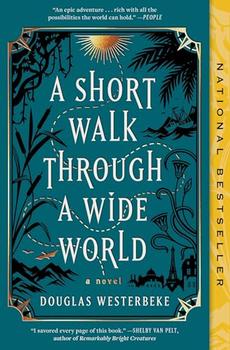
A Short Walk Through a Wide World
by Douglas Westerbeke
Published 2025
The Invisible Life of Addie LaRue meets Life of Pi in this dazzlingly epic debut that charts the incredible, adventurous life of one woman as she journeys the globe trying to outrun a mysterious curse that will destroy her if she stops moving.

by Leigh Bardugo
Published 2025
From the #1 New York Times bestselling author Leigh Bardugo comes a spellbinding novel set in the Spanish Golden Age.
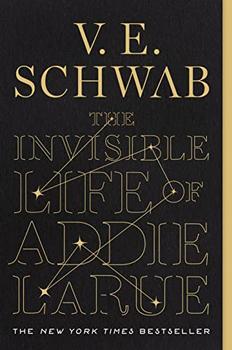
The Invisible Life of Addie LaRue
by Victoria E. Schwab
Published 2023
Winner of the 2020 BookBrowse Fiction Award
In the vein of The Time Traveler's Wife and Life After Life, The Invisible Life of Addie LaRue is New York Times bestselling author V. E. Schwab's genre-defying tour de force.
 (1).gif)
Books are the carriers of civilization
Click Here to find out who said this, as well as discovering other famous literary quotes!

Can you name the title?
Test your book knowledge with our daily trivia challenge!
Your guide toexceptional books
BookBrowse seeks out and recommends the best in contemporary fiction and nonfiction—books that not only engage and entertain but also deepen our understanding of ourselves and the world around us.