Write your own review!
Peggy_Anselmo
"We're so sorry, Uncle Enver"
A good book takes you out of the familiar and into an unknown world. This book did that for me. All I knew about Albania is that the comedian Jim Belushi came from there. Reading Lea Ypi's biography changed that. Her story is about a life bisected by the collapse of one system and an introduction to another which was anything but idyllic. In addition to being an illuminating memoir, it was also engagingly funny. Having lived through two opposing political ideologies and coming out as a world renowned political theorist makes me want to read more about her current perspectives.
Sonia F. (Freehold, NJ)
Freedom for one. Freedom for all
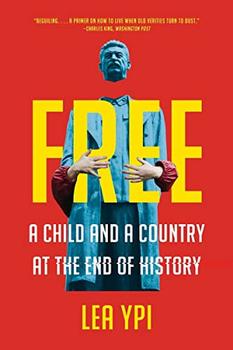
At first I was thrown off by the young narrator's voice in this coming of age memoir. At the opening it seemed funny the narrator never questioned the meaning of freedom until she hugged Stalin and the very flattering description of him. It then got very serious about growing up in Albania, the last Stalinist country of Europe.
I chose this book to review to learn more about Albania and what it was like growing up there and the end of communism in that region.
There is a famous quote that " the freedom of one man impinges on the freedom of the other. We are not free till all is free". While we in the west value our freedom, we must not forget what it is like for others like this young Albanian to witness queues, scarcity , secret police and executions. Friends and families disappear, loyalties were tested. Yip, the young narrator with sharp insight lays it out gently in this Bildungsroman book about how history can shape our lives and our politics. Her story is all our story.
Marion_Mueller
What is freedom?
What is freedom? Could freedom be different depending on where one lives and works and the time in history? Lea Ypi, professor at the London School of Economics, has written a memoir of her life during the period of the downfall of the Stalinist government in Albania, the civil war that ensued, and her leaving the country to study and live abroad. The book is divided into two parts: before December 1990 when the government fell and after, and covers her life from the age of ten or twelve until sixteen or seventeen when she leaves Albania.
She tells much of her story through the experiences of immediate family members, her grandmother, mother and father, as well as her own. The family history and personal biographies play a big role in how each family member sees and understands freedom. Grandmother Nini's family was an aristocratic family; her mother's family were large property owners, her father had his education and job opportunities redirected several times to meet the needs of the government. Lea's childhood outlook was influenced by the "philosophy" teacher at school who taught the Party Line. But life was peaceful and orderly, even the queues for basic supplies were peaceful and orderly.
Then, The Party was overthrown, and life changed. Foreigners showed up to help "establish" the new government in which her father was an MP. There were new rules. People were confused. People fled, including Lea's mother and younger brother, and eventually Lea herself. Whether a teenager would have absorbed all the idiosyncrasies of the political and cultural dynamics of the time is questionable. More than likely Ypi is seeing what happened through her adult perspective and not a teens. Nevertheless, the memoir is an important addition to contemporary writing about Marxism, socialism, communism, liberalism, capitalism…. It is important to carefully read the epilogue to understand how and why Ypi has written this study of "freedom" through the eyes of specific people. It is a lesson for today's young Marxists, socialists, communists, liberals and capitalists, and how and why they hold and/or shouldn't hold their theories. History should not be forgotten.
Darrell W. (Hillsboro, OR)
Philosophy of Freedom
Can you hug Stalin without embracing Communism? Lea Ypi answers this question and more in this novelesque memoir of her growing up in tiny Albania. Using personal anecdotes to recount family history as Albania moves from single-party socialism to a plural party government, Ypi unfolds a compelling personal story and teaches political theory and philosophy at the same time. The struggles of the Albanian people in the 1980's and 90's are poignantly displayed. Defining, developing and living with freedom underlies the narrative. In the end Ypi reveals her answers to what is freedom. This book can be read and enjoyed by a variety of audiences from discerning teenagers to time-worn political philosophers.
Daniel H. (Palos Heights, IL)
Almost 5 stars
This book almost had me ready to give a 5 Star review – for the first 90. I found so many parallels to present times, so much relevance. The various characters exhibited truisms (or seeming ones, from the perspective of the uninitiated) about authoritarianism which makes one think of the United States now. I almost felt it was fiction, rather than memoir. So moving and inspiring. Unfortunately, the author lost her voice at the end; the passion was gone. That said, I believe it is still a worthwhile read.
Laura_Poe
Defining "freedom"
In December 1990, when the "Velvet Revolution" came to Albania (the last of the Stalinist socialist governments in Eastern Europe), Lea Ypi, now a professor of political theory at the London School of Economics, was 11 years old. She experienced the transition from authoritarian socialism to a "western" multi-party democracy, complete with economic chaos which led to the Albanian Revolution:of 1997. On one level this book operates as a family history and memoir of the time period, reflecting on how changing conditions affected her family's life and her own experiences as a teenager. On another, more macro plane, Ypi explores the concept of :freedom" in all its complexity and its differing manifestations: freedom of religion, of movement, of thought, of speech. She argues that freedoms in one situation can become strictures in others, with a number of personally- experienced supporting examples.The book provided a useful first-hand look into a rapidly changing society in a time of great turmoil..
Eddie B. (Suitland, MD)
A Time In History with Drastic Changes and Enormous Challenges
Free, written by Lea Ypi is a harrowing coming of age tale about the fall of socialism during the late 1980's to the early 1990's in Albania from the subjective vantage point of the narrator. The fall of socialism was, for a lot of people the end of decades of oppression and suppression at the hands of the government they relied on. We are introduced to the narrator through a weaving of secrets. These secrets were not specific to the personal challenges of family life and legacy but also in the greater expanse of the societal fishbowl they lived in. Readers are invited to experience the narrators coming of age tale at a place and time in history with drastic changes and enormous challenges. The Albanian people wanted real freedom and the recognition of political pluralism. "After centuries of servitude under the Ottoman Empire and decades of struggle against the great powers who wanted to partition the country".
The strengths of the narrative relied on the connections that it had to the events as they happened. Realizations were also a common theme. In the wake of the changing social landscape of Albania, the narrator experiences an internal culture shock in accepting that the ideals that she held in high regard were built on the oppression of her people and the suppression of their dissent. Demonstrations became protests and dissent became difference of opinion as the population was given the opportunity to express their distrust and disapproval of the hardships they experienced at the hands of their government. One of the instances where ideals clashed and the narrators view of society began to broaden is when she was inadvertently caught up in a protest. Running away from the police officers who were tasked with disbursing the protestors, the narrator stopped at a statue of Stalin, a statue that she found solace in before that moment. As she clung to the statue there was an awareness that the society that she lived in was just as hollow as the statue that she clung to.
There is a deep appreciation for this narrative because of its ability to humanize through the narrators subjective experience. We are able to feel what the narrator feels and experience their lives before and after the fall of socialism.
Linda S. (Cranberry Township, PA)
Transitions
In Free, Lea Ypi opens with a memorable description of a young girl hugging the knees of the bronze statue of Joseph Stalin, which was made headless during recent student protests.
Her story revolves around her family and the political confusion that exists among them. Her homeland, Albania, is undergoing change and she is trying to grow up. Lea was 11 years old when communism began to collapse. She and her family enter periods of great transition in their thinking and in their lives. Much of the book involves conflicting feelings and questions in the minds of the central characters. Voting in free elections was unsettling for instance, and Lea has a lot of inner turmoil about the actions of her parents.
I was constantly trying to unlock an understanding of Lea's internal political evolution, making this book challenging to read. It was helpful to learn that she currently teaches political theory in London. Having little knowledge of Albania, I appreciated learning more about the turmoil within the country.

 Book Reviewed by:

 (1).gif)