Write your own review!
Lloyde_Newman
Overlooked Gem
One of my favorite genre of books is historical fiction. I started out not enticed by this book because it involved young women and abortion. Then, I realized I had volunteered working and providing music therapy for other young girls in Salem, Oregon who had their children as young as 12 about 8 years later. Yes, a whole room full of young mother's who had stories to tell and needed help and support with their choices. At times I felt overwhelmed caring for mothers and their children. But these young mothers had taught me much as I embraced their stories and lives.
Perkins-Valdez writing style is eloquent and illustrates a period in American history that has largely faded away. I plan to do further reading on this subject to see if more information is available.
Diane T. (Slingerlands, NY)
Some things just don't Change
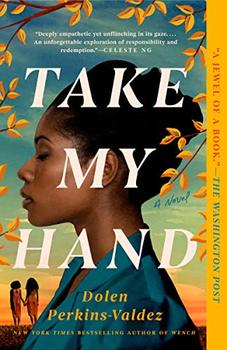
"Take My Hand" by Dolen Perkins-Valdez is a gut wrenching story, albeit fiction, based on true accounts of forced sterilization of girls and women of color. One might think that this takes place in "the dark ages", yet this happened in the 1970's, a mere 50 years ago. The book is voiced by a young nurse, working her first job in a Federally run Family Planning Clinic in Montgomery, Alabama. The nurse, Civil, is a black woman, daughter of a physician, who wants nothing more than to bring the women she attends to the much needed medical care that they don't have. The realization of what is happening under her watch spurs her to try to right an egregious wrong.
Perkins-Valdez speaks in a voice that is straightforward without bleeding heart melodrama. This makes the telling even more poignant. Her characters and their interactions are direct, giving this book a powerful message to all.
How ironic it is that those if us who were fortunate in choosing this book to read and review are doing this as the Supreme Court votes not to stay a Texas law to prohibit abortions after six weeks of pregnancy. Yes, the difference is the later is out in the open and the former was in secret and unauthorized. Yet the bottom line is the complete disregard of the bodily right of a woman to decide what is best for her! Some things just don't change!!
Diane S. (El Paso, TX)
A Story That's Needs to Be Told
It's 1973, and Civil Townsend has landed her first job as a nurse in a family planning clinic. She has high hopes until she realizes that ethically questionable procedures are being performed on women and young girls. The unfolding story is powerful and compelling, the characters are brave and unforgettable, and what happened is a story that must be told. Thank you, Dolen Perkins-Valdez, for opening my and other readers' eyes to this unconscionable tragedy.
Jennifer_W1
Highly Recommended
Perkins-Valdez knows how to weave a captivating story into serious social issues. Set in the early 1970s a young nurse takes on the battle against forced sterilization. Idealist Civil, privileged daughter of a Black physician, lands her first professional job at a family planning clinic in the Deep South. Motivated in part by her own guilty secret, Civil rushes in only to create more complications. Using fluent time shifts to tell the story, the author develops Civil's complex personal life and the campaign to halt government control over reproductive rights, especially those of Black women and those with few resources. This expertly written historic novel will magnetize readers interested in civil rights and strong intelligent female characters.
Juliana
Through the lens of fiction
This is an important book which uses fiction to make known and confront the world with some horrific real events. These events make us meditate on the trauma, suffering and injustice done to poor Black women in Alabama in the 1970’s and their long-term effects. And this is just the tip of the iceberg. Civil Townsend has just the right name and values to make personal the fight she engages in in the name of her two abused patients used for medical experimentation and other seriously damaging procedures. Then the first-person narrative becomes the perfect structure for Civil’s voice, fraught with guilt and love as it is, doubled by the alternating temporal planes which keep the past vivid and hurtful at the present time. The book is well-written and it boasts a cast of remarkable characters whose plight and pain we come to know closely and feel deeply as they get thrown into a legal battle. Take My Hand is relevant to anyone interested in civil rights issues and in a searing look at the past.
Diane_G1
Never forget...
As in many other fine novels about the south, the importance of remembering the past is stressed in Take My Hand by Dolen Perkins-Valdez; in the very first paragraph, the narrator describes her story as "a reminder to never forget." And that story is a horrific one, made more appalling by the fact that it is based in truth—as any reader who reads the jacket material will know beforehand.
Moving between 2016 and 1973, first person narrator Civil Townsend tells the story of an experience some fifty years in her past that continues to haunt her life and to influence every decision she makes. The setting is Montgomery, Alabama, 1973, a time and place still steeped in prejudice and racial injustice. Civil is a young black nurse stepping into her first job at the Montgomery Family Planning Clinic, a Federal agency whose clients were mostly from poor black families.
The setting created by Perkins-Valdez is remarkable for its verisimilitude. A native Montgomerian myself, I was quickly drawn back to 1973, to a Montgomery inhabited by black families, many of them impoverished, a few relatively affluent; and by white people, many motivated by ingrained, often paternalistic, racism, others by idealistic passion for bringing real change to Alabama. The well-paced narrative moving between past and present kept me immersed in the unfolding events and in the development of Civil's character as she struggled to deal with them. And the theme of the destroying presence of racial and sexual injustice and its enduring impact on those caught up in it is as timely now as it was forty-eight years ago.
Take My Hand should be read and appreciated and remembered, not only because it is based on a significant landmark case that advanced women's fight for the right to control their own bodies, but also because it is a well written, compelling, highly readable novel. Anyone who enjoys reading southern fiction, reading about the civil rights movement and/or the women's movement, or just reading a good novel with strong character development and a heartrending plot should immediately add Take My Hand to their TBR.
Judi_Ross
Take My Hand
Thank you BookBrowse and NetGalley for an ARC of this novel. I hope the published edition includes author's notes telling of the research conducted to tell this story. I read historical fiction to learn about the world.This fiction novel feels so authentic . It tells, with intimacy and compassion, about the horrific policy in the 1970s of sterilizing young, poor, black women in Alabama. We follow two underage girls who were mutilated without their knowledge or informed consent. In Take My Hand, a strong black nurse organizes a movement to hold the powerful white lawmakers to account and through her actions she makes enormous changes. Although this is a work of historical fiction, I was reminded of The Immortal Life of Henrietta Lacks. Our protagonist, Civil Townsend, is constantly made to tackle with the issue of doing good deeds that sometimes bring about unwanted outcomes. An older Civil is telling her daughter about her past. She was very young in this story and many of her acts and feelings show her immaturity. But as she matures, she can judge her behaviors objectively. Are acts of goodness altruistic or sometimes selfish? The characters are well-developed in this novel and I think you'll love them as much as I did.
Dominique G. (Plano, TX)
A great historical read on the untold story of medical experiments on black bodies in the 1970s
I knew very little of the deceptive practice of using black women's bodies for medical experiments. Through the lens of a young nurse, two sisters in Alabama in 1973; one gets to be transported into that inhumane world. The writing is so strong, the characters are well developed and you get caught up in their emotions; the story is compelling and repelling; messy in a way that life is. It would be a great book club selection. The subject matter reminded me of the Henrietta Lacks book for how black women's bodies were used without their consent or knowledge for medical experimentation. It is also the story of the trial that follows and the courage of a few who stood up and denounced it and how lives are torn apart by so called school of thought to rid the future of deemed 'inept' creatures through forced sterilization. This story and its characters made a deep impression on me.

 Book Reviewed by:

 (1).gif)