Book Club Discussion Questions
Please be aware that this discussion guide will contain spoilers!
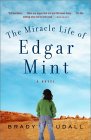
The introduction and discussion questions that follow are designed to enhance your group's discussion of Brady
Udall's extraordinary first novel,
The Miracle Life of Edgar Mint.. Also at BookBrowse, you'll find reviews, an extensive excerpt, an interview and a short biography.
ABOUT
At the beginning of this high-spirited and inexhaustibly inventive novel of
the American West, a seven-year-old boy on an Apache Indian reservation has his
head run over by a mail truck. Though his skull is crushed, Edgar miraculously
survives the accident after being resuscitated by a possibly deranged hospital
intern, Dr. Barry Pinkley. After three months in a coma, Edgar wakes up to find
himself in St. Divine's Hospital in Globe, Arizona, surrounded by other
survivors of horrific accidents. Alcoholic Art Crozier, pieced together after
the car crash that killed his wife and daughters, takes the boy under his wing.
When Edgar recovers his health but loses the ability to write with a pen, Art
gives him an old Hermes typewriter. He is soon filling up page after page in an
attempt to make sense of his increasingly dismal fate. Abandoned by his
grandmother and alcoholic mother, Edgar is sent to live at Willie Sherman
School, a boarding school cum dumping ground for unwanted Indian children. After
several years and many run-ins with the pathologically cruel bully Nelson
Norman, Edgar is finally taken into foster care by a Mormon family in Utah. But
despite this turn of better fortune, Edgar's one wish remains: to bring the
good news of his survival to the mailman who ran him over. His search leads him
to a small town in Pennsylvania, where a profoundly ironic tragedy awaits, and
where he finally finds a loving home.
The Miracle Life of Edgar Mint is an immensely enjoyable story, with an
unforgettable hero whose troubles and yearnings are completely captivating.
While Edgar suffers many losses, including the loss of most of the illusions
that make people's lives bearable, he maintains his innate goodness and his
belief in the redeeming power of language. The result is a miracle of
storytelling, bursting with heartache and hilarity and inhabited by characters
as outsized as the landscape of the American West.
READERS GUIDE
- "If I could tell you only one thing about my life it would be this:
when I was seven years old the mailman ran over my head. As formative events go,
nothing else comes close; my careening, zigzag existence, my wounded brain and
faith in God, my collisions with joy and affliction, all of it has come, in one
way or another, out of that moment on a summer morning when the left rear tire
of a United States postal jeep ground my tiny head into the hot gravel of the
San Carlos Apache Indian Reservation"[p.13]. How does the novel's opening
paragraph—and more broadly its opening chapter—work to draw the reader into
the story? How does the immediacy of the first-person narration affect the
reader's involvement with Edgar and his story?
- Edgar's mother doesn't even get up from the kitchen table when he
is run over by the mail truck [p. 16]. Why is Edgar so forgiving of her, even
though she abandons him and effectively kills herself with alcohol? Does she
provoke any sympathy in the reader?
- Edgar's father is a young white man from Connecticut who has come
west in the hope of becoming a cowboy. Is it surprising that Edgar never meets
or even tries to find his real father? Which characters take on parental roles
in his life?
📖
Get the full reading guide
Join BookBrowse free to unlock all 18 discussion questions, author background, themes, and more for The Miracle Life of Edgar Mint.
Join free — it takes 30 seconds
Already a member? Log in →
- How does the author develop themes of identity and belonging throughout the narrative?
- What role does the setting play in shaping the characters' decisions and relationships?
- Discuss how the ending reframes the events of the story. Were you surprised?
Unless otherwise stated, this discussion guide is reprinted with the permission of Vintage.
Any page references refer to a USA edition of the book, usually the trade paperback version, and may vary in other editions.

 (1).gif)