Book Club Discussion Questions
Please be aware that this discussion guide will contain spoilers!
Introduction
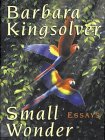
This is a collection of essays about who we seem to be, what remains
for us to live for, and what I believe we could make of ourselves. It
begins in a moment but ends with all of time. . . . I ask the readers
to understand that these essays are not incidental. I believe our
largest problems have grown from the earth's remotest corners as well
as our own backyards, and that salvation may lie in those places, too.
Barbara Kingsolver looks out her window and sees a bobcat. She slaps
a mosquito and senses that she is doing harm to more than just an
insect. She reads about bombs raining over the Afghan countryside and
thinks of the sons and daughters and the mothers and fathers who will
never recover from their grief. She hears a story about a bear nursing a
lost Iranian child and perceives it as a parable about universal
kindness and grace.
The essays in
Small Wonder tell us a couple of things about
Barbara Kingsolver. First, that she is a very observant person. And
second, that she understands connections: of humans to animals, of
America to its global neighbors, of rich to poor, of parents' actions to
their children's behavior. This understanding has made her one of
today's most insightful writers, and it infuses every one of her
luminous words.
The collection was conceived, she tells us, as a response to the
terrorist attacks on September 11. But it was prompted by a wisdom and
concern that existed well before those attacks; and made more immediate
in their aftermath. Kingsolver takes us to places we may never visit: a
remote clearing in the Mexican rainforest where innovative farmers are
tending an insecticide-free crop without disturbing the ecological
balance. To places that seem familiar: her own backyard, where her young
daughter is raising a chicken, collecting its eggs, and proudly feeding
her family breakfast. She shows us the gifts and promises of her family,
her writing, and her childhood. She reveals her own failings as well as
the ways our nation is failing its citizens and the rest of the globe.
Finally, she asks us to take a look at our lives and see in them the
world: out our windows and toward our neighbors, in our cupboards and
gardens and garbage cans, at our television sets and computers and
bookshelves, in our children's faces. In all these places, across the
world, she demonstrates that there is a chance to make a difference, one
small step at a time.
Some years back when Kingsolver was participating in a demonstration
against the Persian Gulf War, a young man in a pick-up drove by and
yelled, "It's your country bitch, love it or leave it!"
Recalling this incident during a television interview, she reconsiders
the comment. "Love it or leave it is a coward's slogan," she
says. "A more honorable slogan would be 'Love it and stay.' 'Love
it and get it right.' 'Love it and never shut up'."
Loving her country -- along with her family, her world, and the
animal and plant life that inhabit the globe -- and not shutting up
about it is what this collection of hopeful, angry, sad, bemused,
hilarious, quiet, and loud essays is all about.
Questions for Discussion
- Kingsolver opens her collection with a story out of Iran. A young
child wandered away from his home and was found, some distance away,
in a cave where he was sleeping safely in the embrace of a female
bear. She uses this remarkable example of maternal nurturing to
demonstrate that there is good in every living being, and that we
share more than we realize with those whom we presume to be our
enemies. Can you, like Kingsolver, make the connection between the
bear and your own private or public enemies? What does it take to
understand, and act on, the idea that "our greatest dread may
be our salvation"?
- Citing our nation's incredible wealth compared to most countries
around the globe, Kingsolver writes, "For most of my life I've
felt embarrassed by a facet of our national character that I would
have to call prideful wastefulness. What other name can there be for
our noisy, celebratory appetite for unnecessary things, and our vast
carelessness regarding their manufacture and disposal?" Do you
share her embarrassment? Why or why not?
- How would you answer her question, "How much do we need to
feel blessed, sated, and permanently safe? What is safety in this
world, and on what broad stones is that house built?" Do you
live with much more than you need? A little more? Not enough?
📖
Get the full reading guide
Join BookBrowse free to unlock all 11 discussion questions, author background, themes, and more for Small Wonder.
Join free — it takes 30 seconds
Already a member? Log in →
- How does the author develop themes of identity and belonging throughout the narrative?
- What role does the setting play in shaping the characters' decisions and relationships?
- Discuss how the ending reframes the events of the story. Were you surprised?
Unless otherwise stated, this discussion guide is reprinted with the permission of Harper Perennial.
Any page references refer to a USA edition of the book, usually the trade paperback version, and may vary in other editions.

 (1).gif)