Book Club Discussion Questions
Please be aware that this discussion guide will contain spoilers!
We normally think
of history as one catastrophe after another, war followed by war, outrage by
outrage--almost as if history were nothing more than all the narratives of human
pain, assembled in sequence. And surely this is, often enough, an adequate
description. But history is also the narratives of grace, the recountings of
those blessed and inexplicable moments when someone did something for someone
else, saved a life, bestowed a gift, gave something beyond what was required by
circumstance. In this series, The Hinges of History, I mean to retell the story
of the Western world as the story of the great gift-givers, those who entrusted
to our keeping one or another of the singular treasures that make up the
patrimony of the West. This is also the story of the evolution of Western
sensibility, a narration of how we became the people that we are and why we
think and feel the way we do. And it is, finally, a recounting of those
essential moments when everything was at stake, when the mighty stream that
became Western history was in ultimate danger and might have divided into a
hundred useless tributaries or frozen in death or evaporated altogether. But the
great gift-givers, arriving in the moment of crisis, provided for transition,
for transformation, and even for transfiguration, leaving us a world more varied
and complex, more awesome and delightful, more beautiful and strong than the one
they had found.
--Thomas Cahill
About This Reading Guide
The questions,
discussion topics, and author biography that follow are intended to enhance your
group's reading of the second book in Thomas Cahill's The Hinges of History
series,
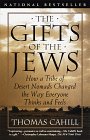
The Gifts of the Jews.
In
The Gifts of the Jews, Thomas Cahill asserts that Western civilization
would not be what it is today were it not for our Jewish ancestors. Christian,
atheist, Jew, believer, each of us can look at Avram and see that had he not
responded to what his God told him (lekh-lekha--"go forth"), we would
not be the people we are today. The Jewish people shaped the very way we think
and live. In
The Gifts of the Jews, we learn that processive time,
individual destiny, and social justice are so particular to the Jews that, for
all practical purposes, they invented them. Jewish men and women also left their
homes and journeyed when God told them to, changing who they were, changing who
we are. We see this change occurring in the biblical narratives: from Avram, who
gave us the possibility of faith in a single God, to Moses, who gave us the
radical morality and strict monotheism of the Ten Commandments, Cahill shows the
rich religious traditions that have also been such a major part of our Jewish
legacy. In short, as Cahill says, "The Jews gave us the Outside and the
Inside--our outlook and our inner life" [p. 240]. In
The Gifts of the
Jews, we are shown the value of revering the past while standing in the
present moment and looking forward to the future. The Jews developed an
integrated view of life and its obligations. They saw life as governed by a
single outlook. They saw the connection between the realms of law and wisdom.
They saw God as One, the universe's principle of unity. And, as we see in
Cahill's book, we do well to recognize this and thank them for these priceless
gifts they've given us all.
Readers' Guide
- The first
books of the Bible were originally preserved as oral tradition. Discuss the ways
in which oral tradition, despite its missing or inaccurate detail, can preserve
essential truths.
- Does the author give the Jews too much credit? Is philo-Semitism just
as dangerous as anti-Semitism?
- In the Sumerian Epic of Gilgamesh, a woman is used to tame and
civilize the man/beast Enkidu. Talk about the change that the Jews gave to our
perception of women. Of their role, their nature, their abilities, their
responsibilities.
📖
Get the full reading guide
Join BookBrowse free to unlock all 22 discussion questions, author background, themes, and more for The Gifts of The Jews.
Join free — it takes 30 seconds
Already a member? Log in →
- How does the author develop themes of identity and belonging throughout the narrative?
- What role does the setting play in shaping the characters' decisions and relationships?
- Discuss how the ending reframes the events of the story. Were you surprised?
Unless otherwise stated, this discussion guide is reprinted with the permission of Anchor Books.
Any page references refer to a USA edition of the book, usually the trade paperback version, and may vary in other editions.



 (1).gif)