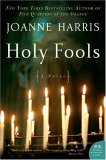
Book Club Discussion Questions
For supplemental discussion material see our Beyond the Book article, and our BookBrowse Review of Holy Fools.
Please be aware that this discussion guide will contain spoilers!
Introduction
Joanne Harris is known for crafting enticing storylines set in deliciously imaginative locales. With
Holy Fools, she once again transports us to a time and venue steeped in fervor. The opening scene alone signals the novel's ironic and intriguing undertones as a troupe of vagabond actors dazzles the residents of a remote French abbey, tucked away on an island off the coast of Brittany. It is the year 1610, an era of violent upheaval following the murder of King Henri IV. And with that brief visit from the performers, it will be a year of upheaval for the nuns of Sainte Marie-de-la-mer as well. Before Part One concludes, an adolescent is installed as Mother Superior, the acting troupe's seductive star begins masquerading as her confessor, and Sister Auguste (a.k.a. Juliette) reveals to us her former life as an acrobat, rope-dancer, and lover to the man now impersonating a priest.
Juliette's story lies at the heart of
Holy Fools. Hers is a tale of love and deception, passion and revenge, as she and 'Father Colombin' engage in the greatest (and most dangerous) show of their lives. Through each of its clever facets, Holy Fools raises a host of provocative topics. We hope that the following questions will enhance your discussion of this captivating novel.
Discussion Topics
- Near the end of chapter five, troupe member La Borgne says, 'Holy Fools, they called us. God's innocents. Nowadays they're just as likely to throw stones as to spare a crust for a poor unfortunate.' What did Juliette's performance days teach her about fools and foolishness? Who are the novel's wisest characters? Who in the novel is holy?
- Parenting plays a significant role in the novel's plot; Juliette is a devoted daughter and mother, while LeMerle and Isabelle imitate the roles of spiritual father and mother at the abbey. Discuss the other varieties of family and parenting presented in the book.
- Though Joanne Harris emphasizes that Holy Fools 'is altogether fictional and should not be seen as a historical representation of specific events,' she says that idea for the came to her when she was reading a history book, which mentioned an eleven-year-old Mother Superior who enacted stringent reforms at an abbey in Port-Royal. What other surprising depictions of life in seventeenth century France did you encounter while reading the novel? Are any contemporary cultures as turbulent as Juliette's?
📖
Get the full reading guide
Join BookBrowse free to unlock all 15 discussion questions, author background, themes, and more for Holy Fools.
Join free — it takes 30 seconds
Already a member? Log in →
- How does the author develop themes of identity and belonging throughout the narrative?
- What role does the setting play in shaping the characters' decisions and relationships?
- Discuss how the ending reframes the events of the story. Were you surprised?
Unless otherwise stated, this discussion guide is reprinted with the permission of Harper Perennial.
Any page references refer to a USA edition of the book, usually the trade paperback version, and may vary in other editions.

 (1).gif)