Book Club Discussion Questions
Please be aware that this discussion guide will contain spoilers!
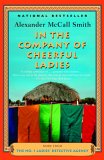
The introduction, discussion questions, suggestions for further reading, and author biography that follow are designed to enhance your group’s discussion of Alexander McCall Smith’s In the Company of Cheerful Ladies, the sixth novel in the acclaimed No. 1 Ladies’ Detective Agency series.
ABOUT THIS BOOK
Now married to Mr J. L. B. Matekoni, Precious Ramotswe has moved the office of the No. 1 Ladies’ Detective Agency to Tlokweng Road. The story opens with Precious Ramotswe and Grace Makutsi struggling to keep up with their investigative work, while Mr J. L. B. Matekoni is similarly burdened with the success of Tlokweng Road Speedy Motors. When Charlie, one of the apprentices at the garage, suddenly quits, Mma Ramotswe suspects that the young man’s newfound sense of freedom is connected to the woman she has seen him with—a married lady who drives around in a Mercedes. To help out, Mma Ramotswe offers a job to Mr Polopetsi, a man she met when she knocked him off his bicycle in a minor traffic accident. Meanwhile, Mma Ramotswe and Grace Makutsi follow the Mercedes one day and find that Charlie and his girlfriend are spending time at a shebeen—an illegal bar—located in, of all places, Mr J. L. B. Matekoni’s house, which he has rented out since his move to Zebra Drive. While Mr Polopetsi settles in at the garage, Grace begins taking dancing lessons in the hope of finding romance, only to be partnered with the most awkward man in the room. And then a visitor arrives, who threatens to throw Mma Ramotswe’s whole life into disarray by forcing her to confront a secret from her past.
All of this unfolds against the sunlit background of Mma Ramotswe’s beloved homeland, Botswana—a land of empty spaces, echoing skies, and an endless supply of soothing bush tea.
FOR DISCUSSION
- In the opening scene, Mma Ramotswe watches as a driver sideswipes a parked car and drives away without taking responsibility and as a woman at a market steals a bracelet from a merchant when his back is turned. Mma Ramotswe jumps up from the café and tries to alert the merchant to the robbery, but her waitress accuses her of trying to run out on the bill and attempts to elicit a bribe. How do such behaviors mark the difference, for Mma Ramotswe, between the old Botswana and the new? Why does she wish to maintain ties to the old ways of thinking?
-
Detective stories usually have complex plots and eventually solve a mystery. McCall Smith’s books, however, are not so much based on plot as on human interaction and on the fact that “the unexplained was unexplained not because there was anything beyond explanation, but simply because the ordinary, day-to-day explanation had not made itself apparent. Once one began to enquire, so-called mysteries rapidly tended to become something more prosaic” [p. 17]. How does Mma Ramotswe’s approach to the detective’s profession differ from that found in other detective novels you have read? Why is the mystery of the intruder left unresolved at the end of the story?
- At the church service Mma Ramotswe reflects, “It was a time of sickness, and charity was sorely tested. There were mothers here, mothers who would leave children behind them if they were called” [p. 27]. The minister refers to “this cruel illness that stalks Africa” [p. 31]. While the book doesn’t refer directly to HIV/AIDS, how does this deadly epidemic inflect McCall Smith’s presentation of modern Botswana, as well as his presentation of Mma Ramotswe’s state of mind?
📖
Get the full reading guide
Join BookBrowse free to unlock all 15 discussion questions, author background, themes, and more for In The Company of Cheerful Ladies.
Join free — it takes 30 seconds
Already a member? Log in →
- How does the author develop themes of identity and belonging throughout the narrative?
- What role does the setting play in shaping the characters' decisions and relationships?
- Discuss how the ending reframes the events of the story. Were you surprised?
Unless otherwise stated, this discussion guide is reprinted with the permission of Anchor Books.
Any page references refer to a USA edition of the book, usually the trade paperback version, and may vary in other editions.


 (1).gif)