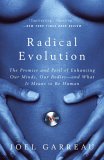
Book Club Discussion Questions
For supplemental discussion material see our Beyond the Book article, and our BookBrowse Review of Radical Evolution.
Please be aware that this discussion guide will contain spoilers!
One afternoon last fall, I was preparing for a parent-faculty meeting and
chatting with the novelist Adrienne Garreau, whose husband Joel was
working on a new book. I had greatly enjoyed Joel's
Edge City the
year before, so I asked her when the new book would be out and what it
was titled. "Soon," she replied, "and we have not decided on a title
yet." Flippantly, I offered to suggest one if she would let me read a
draft of the book and, to my surprise, she agreed, dropping off a sheath
of papers on a cardboard box later that afternoon.
My students the next day might well have wished she hadn't, because what
I thought would be a leisurely perusal quickly transformed into a
late-night compulsive read. My classes the next day were shoddily
prepared, and I only just managed to pull myself away from the
manuscript at the last minute. I started emailing title suggestions that
within hours, but as I progressed I realized that my first reactions
were too simplistic, not taking into account the shifts in the book's
development, so I sent retractions and revisions, which were in turn
retracted hours later. When I finished, I immediately passed the draft
on to a friend, who thanked me while explaining that with exams coming
up and a new novel to teach, he probably would not get to it for a few
weeks. "Just read the first chapter," I implored. Two days later, he
wanted to talk about the entire book over dinner.
Radical Evolution evoked a similar reaction from my book club, a
group of men who meet monthly for a meal and an often raucous
discussion. Given the book's futuristic emphasis, it seemed appropriate
to read it before publication, either on computer screens or PDF files,
and so with Joel's generous consent and my urging, we paired it with
Brave New World, a novel that eerily predicts many of the
all-too-real advances Joel discusses. We never really got to
Brave
New World that evening, though, because we all found it hard to
exhaust
Radical Evolution. There was so much to say, to wonder,
to debate.
I never helped much with the title, probably because there is so much
here that is so rich that any attempt to sum it up in a pithy phrase
seems to do the book an injustice, though
Radical Evolution is
far better than anything I generated. Indeed, the motivating question of
the book is what it means for human beings as a species to take control
of their minds and bodies: whether we are approaching a utopian era in
which we will determine our own destinies, whether we will spin out of
control and be struck down for our hubris in playing God, or whether we
are entering a more complex and multi-layered era of negotiation between
our basic human nature and our power to manipulate our lives. Of course,
our species has always been distinguished by our ability to control;
what Joel Garreau has succeeded in communicating so clearly is how the
stakes change as this manipulation shifts from an outside environment to
what we think of as our inner selves. It is a shift that may not be
reversible, one that may set in motion an irreversible series of
decisions. The players in this book debate whether this movement leads
to Heaven or Hell, but it is in framing this moment as one of choice and
in tracing these divergent paths that
Radical Evolution creates a
consciousness of the pivotal nature of this point in human history.
Yet this is just as much a book about people as it is a book about
ideas. We meet the visionaries who imagined the internet, virtual
reality, the World Wide Web, the technology of warfare, the
possibilities of genetic manipulation, robotics, and nanotechnology, and
through their voices we come to understand these technologies in
fundamentally human ways. We see medical advances through the eyes of
the severely disabled, and we debate the relative benefits of
pharmaceutical wizardry that will offer options, not just to mankind,
but to our children in their college years. Joel Garreau takes us back
two decades to put predictions for the next twenty years in perspective,
introducing this myriad of possibilities as an emerging dimension of our
own lives.
Radical Evolution becomes a deeply personal book, and
one that is undeniably important as well as compulsively engaging. Joel
Garreau reveals what future generations will clearly see as the truly
meaningful questions of our time, far more significant than the petty
issues that continually call for our attention.
So if you have not yet started, find a comfortable chair, preferably one
not surrounded by blinking green LED lights, and settle in. I am sure
you will sleep just fine, and you can take all the time you want. Just
read the first chapter.
Huntington Lyman, Ph.D.
- Radical Evolution concerns people as much as technology, and
discusses some of the ways that these new technological developments
will change how we work, date, interact and live our lives. Can you
think of other ways that the technologies discussed in the book may
impact and change our world?
- The fable of the peasant's wish dramatically illustrates the power
of a curve that rises exponentially (47). How likely do you think it is
that technological progress and power will continue to advance according
to Moore's Law? What technological obstacles or human decisions might
eventually slow this curve? What are the implications if there is no end
in sight?
- A 1943 report by Ryan and Gross classifies people as Innovators,
Early Adaptors, the Early Majority, the Later Majority, and Laggards
(60-61). Which are you? Do you have a predictable reaction to
innovations, or does it vary? How likely are you to embrace some of the
new capabilities discussed in the book that will be available to us in
the next fifteen years?
📖
Get the full reading guide
Join BookBrowse free to unlock all 13 discussion questions, author background, themes, and more for Radical Evolution.
Join free — it takes 30 seconds
Already a member? Log in →
- How does the author develop themes of identity and belonging throughout the narrative?
- What role does the setting play in shaping the characters' decisions and relationships?
- Discuss how the ending reframes the events of the story. Were you surprised?
Unless otherwise stated, this discussion guide is reprinted with the permission of Broadway Books.
Any page references refer to a USA edition of the book, usually the trade paperback version, and may vary in other editions.

 Book Reviewed by:

 (1).gif)