Book Club Discussion Questions
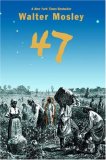
For supplemental discussion material see our Beyond the Book article, High John The Conqueror and our BookBrowse Review of 47.
Please be aware that this discussion guide will contain spoilers!
About This Book
An orphaned youth, born into slavery, discovers that his brutal circumstances
need not prevent him from taking the inner journey to self-awareness and
personal responsibility that ultimately define freedom.
When the cruel plantation owner determines that 47—a fourteen year-old who has
never been given a proper name—is old enough to labor as a field slave, 47 is
suddenly immersed in the adult world of abject bondage. Soon after, he meets an
adolescent runaway, Tall John.
Totally unlike many other memorable characters crafted in brilliant novels set
in the Antebellum South, Tall John has run to slavery through worlds unfathomed.
47 embarks on a fast-paced human drama and "scientific" journey with Tall John
into worlds beyond and deep inside himself to discover ultimate freedom.
Note to Teachers, Librarians, Group Leaders
This is not your mother's or grandmother's slavery novel. Young readers will
find little here of the pathos of slavery that so easily bores and tires. It is
peopled with those who are enslaved, yet they are empowered human beings. The
book urges young readers to fully imagine teen years spent doing slave labor and
simultaneously to envision unknown worlds of personal potential and victory.
47 is a book that will attract young urban males and suburban ones who
aspire to the image, with its unforced inferences to the contemporary enslavers
of prison and intra-group violence. While quite character-driven, the novel is
replete with continuing action, scientific vision and highly imagined hardware,
all of which fully engage teen and preteen boys, who are frequently kinesthetic
learners. Books with such depth that will also easily engage adolescent boys are
rare. Girls and adult readers will also enjoy the plot and character
development that is a trademark of Walter Mosley's writing style.
While excellent for individual reading and as a base for essays and papers, this
book can be useful far beyond the classroom. Group activities and
discussions can easily flow from it for a wide range of gatherings as diverse as
"Jack and Jill" socials to "Police Athletic League" gang prevention activities.
Pre-Reading Activity
- Slavery, then and now:
What do you know about slavery and
where did you learn it?
Are movies and books about slavery
historically accurate?
Most people would rather watch a movie or
read about any other subject than slavery. Why?
Give some
reasons people don't talk about slavery. Specifically, whites,
blacks, elders. Is it necessary for young people today to think
about slavery?
Introduce this question with a contemporary DVD or music
clip where the word "slavery" is used or a black person is seen in
shackles.
- Choices=Freedom:
This book hinges on the principle that
people have choices. No matter how constricted, there is always
some choice. Ask youths to describe a situation where they felt
they had no choice. Then examine the circumstances carefully
and make a written list of the choices available to them.
What are
things that prevent us from realizing our choices when we are in
situations where we feel we have no choice?
What are factors that
prevent us from acting on our choices? Is there anyone, anytime
who has no choices? Finally, what are the responsibilities that
come with the freedom to make choices?
- Names:
What I call myself/What I call you if we're alike/What I
let those who are not like me call me: Most names get meaning
by who uses them, what they are used for, how they are used,
when they are used and where they are used. Do you have a
nickname that only certain people may call you?
What are those
people really saying about you when they use that nickname?
How do they use the nickname; give an example.
What are the
occasions that you're likely to be glad to be called by your
nickname, and what are some when you wouldn't?
Where are you
comfortable being nicknamed and where do you prefer using
your real name?
How much of how we feel about nicknames applies to
group names?
What is the difference between a name and a label?
Why do some groups embrace their pejorative labels and other
groups don't?
How about a number representing who you are (i.e. a social
security number, a student ID number, a driver's license number)?
Does this practice diminish you as a person?
In what instance has society used numbers to glorify an individual
or group of individuals (sports figures)?
- How does the author develop themes of identity and belonging throughout the narrative?
- What role does the setting play in shaping the characters' decisions and relationships?
- Discuss how the ending reframes the events of the story. Were you surprised?
Unless otherwise stated, this discussion guide is reprinted with the permission of Little, Brown Books for Young Readers.
Any page references refer to a USA edition of the book, usually the trade paperback version, and may vary in other editions.

 Book Reviewed by:
 (1).gif)