Book Club Discussion Questions
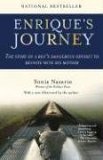
For supplemental discussion material see our Beyond the Book article, and our BookBrowse Review of Enrique's Journey.
Please be aware that this discussion guide will contain spoilers!
A Note for Teachers
Originally written as a newspaper series for the Los Angeles Times,
Enrique’s Journey tells the true story of a Honduran boy’s journey to find
his mother in America. As a literary text, the work lends itself easily to the
study of primary elements: plot, setting, character, theme, etc. Beginning in
Honduras with Enrique’s mother (Lourdes), the text follows multiple story lines
(those of Lourdes, Enrique, Enrique’s girlfriend, immigrant care workers, and
other immigrants). The text also includes multiple characters and encourages an
analysis of their motivations and the results of their actions. Enrique’s
Journey will also provide the catalyst for meaningful discussions of universal
themes such as parent-child conflict, family responsibility, separation, and
assimilation into new cultures.
As a social commentary, this work will fit easily into any social studies
classroom or into any class’s discussions of the issues the text presents.
Immigration policies in both the United States and in Mexico are brought sharply
into focus through this narrative. In addition, the incredibly divergent
attitudes of the people with whom Enrique has contact will provoke discussion of
and offer opportunities for analysis of the opinions toward immigration held by
different cultures. The narrative also deals with other social issues that can
prompt study and discussion, such as: poverty, economic policy (in the United
States, Mexico, and Central America), race relations, and gang activity.
Ultimately,
Enrique’s Journey can provide challenging and appropriate
study for middle school through college. Its story line and themes will lend
themselves easily to multiple levels of examination, in many different classroom
settings.
About This Book
Sparked by a conversation with the author’s maid, Carmen, about Carmen’s
separation and reunion with her own son, Minor,
Enrique’s Journey began
as a series of articles for the Los Angeles Times. After their publication, the
articles won two Pulitzer prizes (feature writing for Sonia Nazario and feature
photography for Don Bartletti), the George Polk Award for International
Reporting, and the Grand Prize of the Robert F. Kennedy Journalism Awards.
Realizing that the immigrant’s journey was “the adventure story of the
twenty-first century,” Sonia Nazario set out to tell a story that is very common
— the story of the trek to the United States (xvi). The unique aspect of her
treatment, however, is that the immigrant whose story she chooses to tell is
only a child, and he is one, Nazario discovered, of “an estimated 48,000
children who enter the United States from Central America and Mexico each year,
illegally and without either of their parents” (5). While she was researching
the story, Nazario also discovered the many hazards of these children’s journeys
and the sometimes disappointing outcome of their reunions with their families.
Enrique’s Journey tells the true story of a five-year-old boy whose
mother leaves him behind in Honduras so that she can seek better fortune in
America. Planning only to stay until she can send for her children or return
with enough money to support them, Enrique’s mother promises to bring him to be
with her, but each year setbacks prevent her from keeping her promise. Enrique
desperately misses his mother and believes that only she can understand and
support him.
After disappointing stays with other relatives, Enrique decides he will go to
America to find his mother. With only her phone number on a piece of paper,
Enrique sets out on the perilous journey at age 16. His journey means hopping
trains to get through Mexico to the United States border. Seven times he fails;
each time, though, he learns ways to make it further on the next trip.
After terrible hardships — attacks by gang members, near misses on the train,
extreme hunger and thirst — Enrique makes it to his mother, only to find that in
the years of separation, his image of her and the reality he finds are very much
different.
Teaching Ideas
This text offers a wide range of instructional opportunities in a variety of
courses. It is particularly well-suited to those in language arts, social
studies, and to courses within the social sciences. The text also lends itself
to a range of grade levels, beginning as early as middle school and up to
college-level coursework. The ideas addressed in the work have depth —
inequality, prejudice, parental conflict — but the pure adventure of the story
would allow any of these weighty issues to be glossed over in discussions in
lower grades. Other mature topics — rape, assault, robbery — while present in
the text, do not take place with such detail that they cannot be lightly touched
upon or ignored, depending on the teaching context.
This text also lends itself well to addressing the four strands of the language
arts curriculum — reading, writing, communication, and research — and to the
standards offered by the National Council of Teachers of English (these may be
accessed by linking to this site: http://www.ncte.org/about/over/standards/110846.htm
). The activities in this guide offer ideas for these four strands and in these
curriculum areas.
Enrique’s Journey easily lends itself to a study of immigration in the
United States and of the trends in immigration that have formed this “nation of
immigrants,” as President George W. Bush has called the country (http://www.whitehouse.gov/news/releases/2001/04/20010409-4.html
). Teachers may wish to have their classes trace the historical patterns of
immigration to the United States: from mostly northern European in the seventeen
and eighteen hundreds, to the addition of Scandinavian countries in the late
1800s, to southern European in the early 1900s, and finally to modern patterns
of immigration. Classes might also wish to examine peaks of immigration — Irish,
Chinese, Italian, Cuban, etc. — throughout America’s history and to examine
events that motivated these peaks.
Enrique’s Journey fits comfortably within the tradition of investigative
journalism that has often forced Americans to examine their beliefs and
practices. As Upton Sinclair’s The Jungle forced a closer look at the
meat-packing industry in the early 1900’s,
Enrique’s Journey shows Americans a
side of immigration they might not wish to see and, in the process, presents a
set of characters that can only create sympathy for immigrants’ plight–and
perhaps move its readers to a deeper understanding of and acceptance for the
immigrants with whom they might come into contact.
Finally,
Enrique’s Journey holds many parallels to other texts that have
become standard parts of many curricula. Enrique’s trip is an odyssey, and like
Odysseus,
Enrique’s Journey may be analyzed as an epic journey. The problems
Enrique faces are common problems that many students and their families may have
faced, as well; instructors may use these commonalities to generate discussion.
While Enrique’s story is a current story–which will allow students to find
parallels in daily newspapers and news magazines–it is, ultimately, timeless.
Enrique’s Journey is a story that is essential to the American, and,
further, to the human experience.
Discussion & Writing
Comprehension
“Prologue” — In this section of
Enrique’s Journey, the author allows readers an
inside view of her creative process. Nazario reviews her background as the child
of immigrants, her inspiration for writing this story, and the process — both
logistical and compositional — that she begins as she prepares to research and
write Enrique’s story. The writer tells how and where she finds Enrique and how
he is representative of the children whose story she desires to tell.
- How did the author get the idea for this work?
- What shift, that is a change from the 1980s, has taken place in the face of
the modern immigrant population?
- Why has this change in the profile of the typical immigrant taken place?
📖
Get the full reading guide
Join BookBrowse free to unlock all 91 discussion questions, author background, themes, and more for Enrique's Journey.
Join free — it takes 30 seconds
Already a member? Log in →
- How does the author develop themes of identity and belonging throughout the narrative?
- What role does the setting play in shaping the characters' decisions and relationships?
- Discuss how the ending reframes the events of the story. Were you surprised?
Unless otherwise stated, this discussion guide is reprinted with the permission of Random House.
Any page references refer to a USA edition of the book, usually the trade paperback version, and may vary in other editions.

 Book Reviewed by:


 (1).gif)