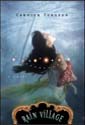
Book Club Discussion Questions
For supplemental discussion material see our Beyond the Book article, Background and our BookBrowse Review of Rain Village.
Please be aware that this discussion guide will contain spoilers!
About the Book
Influenced in part by Carolyn Turgeon’s background in comparative literature,
Rain Village went through many versions and revisions in the writing. It started with a short story she wrote in college based on the story of the three rings, from
The Decameron. It was set in the Pacific Northwest, in an imaginary town named Rain Village. The novel however is primarily set in two other locations, each of which stands out in rich contrast against the other two: the isolated town of Oakley, Kansas – dry, hot, and dusty—where the novel’s narrator and protagonist, Tessa Riley, grows up; and the lush and fragrant outskirts of Mexico City, winter quarters of the Velasquez Circus and ancestral home of the Ramirez family of high wire artists, reminiscent of the Flying Wallenda’s, which Tessa marries into.
The connecting force between these three settings is a larger than life woman named Mary Finn who we learn had run away from Rain Village at the age of 15 from an abusive father and her lover’s tragic death to join the Velasquez Circus and become lionized as the much loved trapeze artist, Marionetta. Disappearing from the circus as mysteriously as she had arrived, Mary reappears as the town librarian in Oakley, home to the novel’s narrator and protagonist, Tessa Riley. At the age of twelve, Tessa is barely four feet tall, and illiterate. Her father is physically and sexually abusive and doesn’t believe in books and learning. Mary teaches Tessa to read and write, and gives her a job at Mercy Library so that she can “make her contributions” to her family, learn essential life skills and, most important, save money to leave Oakley. Under Mary’s guidance and tutelage, Tessa thrives in the warmth and magic of Mary’s stories, along with the world of books in the library. Finally, she persuades Mary to teach her the trapeze, for which she is remarkably suited, both because of her diminutive size and her strength, developed from hours spent hanging from a curtain rod at home, her mother’s attempt to stretch Tessa’s body so that she will be strong enough to work the fields of the family farm. After several years, Mary suddenly commits suicide, and Tessa leaves Oakley, for good.
Grounded in these and other realities of Tessa’s world, some grim, some grueling,
Rain Village has a Once Upon a Time fairy tale quality to it. It is set vaguely in the early 20th century, but the atmosphere is one of timelessness. Literally, it’s about a girl who runs away from home to join the circus and finds fame and personal happiness, including a handsome Mexican husband, Mauro Ramirez, one of the family of high wire artists who star in the Velasquez Circus. It is also full of rich and thoroughly researched details of the sociology and politics of circus life, including the daily and painful details of the rigorous and constant training and practice that lie behind the glitter and glamour of the high wire and trapeze. And Tessa’s character is loosely based upon Lillian Leitzel, a trapeze artist from the early 20th century who developed the astonishing rope trick that Tessa invents in the novel, and was also married to a famous, trapeze artist.
But Tessa is haunted by Mary’s presence, under a spell fed by the circus world apocrypha that has built up about Mary over the years, the persistent demands upon her for stories about her life with Mary which keep her from leaving her past behind and, most of all, the survivor’s guilt she feels from Mary’s suicide. She becomes obsessed with the need to find out why Mary had herself run away from home to join the circus only to leave it, and finally, after teaching Tessa the trapeze, take her own life. When Mary’s mysterious nephew Costas blows in on a dry wind strangely full of Mary’s scent of cinnamon and cloves that has made everyone in the circus sick and crazy with fever dreams, Tessa recognizes him as a character in one of the fantastic stories Mary had told her years before. In desperation, she leaves with him to travel to Rain Village, and find out Mary’s secret.
What Tessa finds out, however, is the lesson of the story of the three rings. There are some things in this world that are unknowable, that must remain mysteries. And in coming to accept this discovery, what she finds is herself, and what she gains is the true fortune of personal peace and happiness.
Ultimately,
Rain Village is a story about the transformative power of storytelling. It is also a heartfelt and genuine tribute to librarians and the world of the American Public Library at its very best.
The Story of the Three Rings
As recounted by Boccaccio, in The Decameron (Novel III of the First Day):
The narrator is Filomena, who tells the story at the Queen’s behest. Saying that stories of people falling from good fortune into bad are many, she will tell a story illustrating that good sense may save us from misfortune: The Soldan of Egypt has gone broke from all his excesses in waging wars and celebrating his successes. He knows of an Alexandrian Jew, Melchisedech, who can loan him the money he needs to get out of debt, but who is known as being miserly with his resources. So he decides he will blackmail him, by trying to trick him into compromising himself with his answer to the following question: Which of the three Laws do you hold to be the True Law, the law of the Jews, the law of the Saracens (Muslims), or the law of the Christians?
Being no fool, Melchisedech answers as follows with the story of the three rings. Once upon a time, a great and rich man numbered among all his treasures a ring of such beauty and perfection that he decides to use it to designate his favored heir among his sons. And so the ring is passed down in the same way for many generations, until one such heir, a good and kind man, is faced with a dilemma. He has three good and loving sons, whom he loves equally. Each of course begs to be his chosen designate. What he does is have a maker of fine jewelry create two exact replicas of The Ring. He then gives one of the three rings, in private, to each of his three sons.
When the old man dies, each produces The Ring, and each contests the inheritance of the other. Since the three Rings are so perfectly alike and thus indistinguishable, the suit to determine the true Heir remains unsettled. And so it is with the question posed by the Soldan, says Melchisedech. Each of these peoples – the Jews, the Saracens, and the Christians – think themselves to have the True Law, as given to them by God the Father. But which of them is justified in thinking so, is a question which must remain unsettled, or unknown. The Soldan is so impressed by Melchisedech’s adroitness in avoiding the trap he had set for him that he comes clean on his need for money. In turn, Melchisedech loans him the money, which the Soldan pays back in full. He also rewards him with his lifelong friendship and makes him one of his trusted advisors.
Book Discussion Questions:
- What was your over all response to Rain Village? Did you find it at all relevant to your own life experience, or things that matter to you? How would you describe the tone of the novel? Discuss the settings of Rain Village. How appropriate, or not, do you think they are to the parts of the story and the characters associated with them? Why?
- The Decameron is one of the inspirations for Rain Village. It is a medieval story cycle, set during the time of The Plague. Its structure is this: a representative group of citizens – nobility and commoners—leave the city to escape the plague, having seen friends and family die the horrific Black Death. To comfort one another and take their minds off what they have left behind, they tell each other stories. What parallels to this structure can you find in Rain Village?
- The author tells us that the earliest version of Rain Village was a short story based on the Story of the Three Rings from The Decameron. How many “rings” do you find in Rain Village? How do they function to communicate a theme or illuminate the plot? Think beyond the ring that Mary wears around her neck. How many “threes” do you find in the novel? What do they suggest to you?
📖
Get the full reading guide
Join BookBrowse free to unlock all 10 discussion questions, author background, themes, and more for Rain Village.
Join free — it takes 30 seconds
Already a member? Log in →
- How does the author develop themes of identity and belonging throughout the narrative?
- What role does the setting play in shaping the characters' decisions and relationships?
- Discuss how the ending reframes the events of the story. Were you surprised?
Unless otherwise stated, this discussion guide is reprinted with the permission of Unbridled Books.
Any page references refer to a USA edition of the book, usually the trade paperback version, and may vary in other editions.

 Book Reviewed by:
 (1).gif)