Book Club Discussion Questions
Please be aware that this discussion guide will contain spoilers!
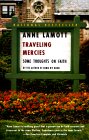
The questions, discussion topics, and author biography that follow are designed to enhance your reading of Anne Lamott's
Traveling Mercies. We hope that they will suggest a variety of ways to talk about this delightful and moving story of one woman's journey in faith.
When Anne Lamott was twenty-five, her father died after a long struggle with brain cancer. Over the next few years she herself began to suffer from an overwhelming sense of desperation and fear, which she tried to suppress with alcohol and pills. Although she was managing to write and publish successful novels at the time, it was clear that her life was spinning out of control. In
Traveling Mercies, a memoir that sparkles with wry wit and compassion, she now writes about this dark period of her life, and of her turn--to her own great surprise--to the community of Christian faith and love she found in a neighborhood church called St. Andrew's.
In a book that will be cherished by anyone who has pursued a spiritual search down all sorts of unlikely paths, grieved at the death of friends, or felt bewildered at the challenges that daily life presents to love and courage, Anne Lamott gives us a wise and often humorous account of living in faith.
For discussion
- Lamott quotes a Leonard Cohen song that goes, "There are cracks, cracks in everything, that's how the light gets in" (p. 39-40). Are people who are more "cracked"--more troubled or in pain--more likely to make the leap of faith than those who are outwardly more secure, more in control of their lives?
- Lamott explains, "My coming to faith did not start with a leap but rather a series of staggers from what seemed like one safe place to another. . . . Yet each step brought me closer to the ample verdant pad of faith on which I somehow stay afloat today" (p. 3). Yet on page 50 she notes that there was actually a moment of "conversion." How would you describe the process by which she came to religion? Is there necessarily a spiritual component to emerging from an addiction?
- Lamott writes of her parents and their friends: "They were fifties Cheever people, with their cocktails and affairs" (p. 10). Is this the reason for Anne's powerful girlhood desire to escape from her family and to be "adopted" by the mothers of her friends? Judging from the evidence she offers in the section called "Lily Pads," what was lacking in her own home that she needed?
📖
Get the full reading guide
Join BookBrowse free to unlock all 18 discussion questions, author background, themes, and more for Traveling Mercies.
Join free — it takes 30 seconds
Already a member? Log in →
- How does the author develop themes of identity and belonging throughout the narrative?
- What role does the setting play in shaping the characters' decisions and relationships?
- Discuss how the ending reframes the events of the story. Were you surprised?
Unless otherwise stated, this discussion guide is reprinted with the permission of Anchor Books.
Any page references refer to a USA edition of the book, usually the trade paperback version, and may vary in other editions.



 (1).gif)