Book Club Discussion Questions
For supplemental discussion material see our Beyond the Book article, American Slavery in the Seventeenth Century and our BookBrowse Review of A Mercy.
Please be aware that this discussion guide will contain spoilers!
About This Guide
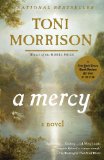
The following introduction, discussion questions, and suggestions for further reading are designed to enhance your group's discussion of Pulitzer Prize winner and Nobel Laureate Toni Morrison's searing new novel about the trauma of living in colonial America during the birth of the slave trade.
About This Book
Set in the 1680s, in the early stages of the slave trade,
A Mercy gives voice to a remarkable group of characters: Jacob, an Anglo-Dutch farmer, trader, and lender; his wife, Rebekka, newly arrived from England; their servant woman, the Native American Lina, whose tribe has been wiped out by smallpox; Florens, the slave girl he reluctantly accepts as payment for a bad loan; and the permanently shipwrecked Sorrow, daughter of a sea captain killed in a storm off the coast of the Carolinas. These characters take turns narrating the story, and their voices carry the physical and emotional scars of the struggles of their lives.
A Mercy is a visceral, intricately textured novel that takes readers right to the origins of America, a place where the seeds of the racial, religious, and class tensions that would later come to fruition in revolution and civil war were already being sown. It is a place where people are forced to make wrenching decisions. Jacob does not wish to take a slave as payment for a bad debt, but he feels it’s the best option available. Nor does he wish to traffic in slavery - he prides himself on his honest work - though he is willing to make huge profits off the slave labor of sugar plantations in Barbados. Florens's mother does not want to part with her daughter, but feels that Florens will be better off with Jacob than with her own cruel master. Rebekka knows that even as a white woman, the only choices open to her are wife, servant, and prostitute. Florens, Lina, and Sorrow, who are servants, know that if both their master and mistress die, their already circumscribed choices will disappear completely and they will be fair game for anyone. This is a world in which women - white, black, and Native American - are especially vulnerable, literally at the mercy of the men who hold power over them.
But
A Mercy is as much a novel of experience as ideas, and it is the vividness and immediacy of these characters that makes the novel so powerful. These are voices that have not been heard before, voices silenced first by cruelty and then by history.
In
A Mercy they are free to speak at last.
Reader's Guide
- Florens addresses her story to the blacksmith she loves and writes: "You can think what I tell you a confession, if you like, but one full of curiosities familiar only in dreams and during those moments when a dog's profile plays in the steam of a kettle" (page 3). In what sense is her story a confession? What are the dreamlike "curiosities" it is filled with?
- Florens writes to the blacksmith, "I am happy the world is breaking open for us, yet its newness trembles me" (page 5), and later, "Now I am knowing that unlike with Senhor, priests are unlove here" (page 7). In what ways is Florens's use of language strikingly eccentric and poetic? What does the way she speaks and writes reveal about who she is and what her experience has been?
- What does A Mercy reveal about Colonial America that is startling and new? In what ways does Morrison give this period in our history an emotional depth that cannot be found in text books?
📖
Get the full reading guide
Join BookBrowse free to unlock all 18 discussion questions, author background, themes, and more for A Mercy.
Join free — it takes 30 seconds
Already a member? Log in →
- How does the author develop themes of identity and belonging throughout the narrative?
- What role does the setting play in shaping the characters' decisions and relationships?
- Discuss how the ending reframes the events of the story. Were you surprised?
Unless otherwise stated, this discussion guide is reprinted with the permission of Vintage.
Any page references refer to a USA edition of the book, usually the trade paperback version, and may vary in other editions.

 Book Reviewed by:
 (1).gif)