Book Club Discussion Questions
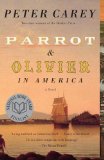
For supplemental discussion material see our Beyond the Book article, Alexis de Tocqueville, author of Democracy in America and our BookBrowse Review of Parrot and Olivier in America.
Please be aware that this discussion guide will contain spoilers!
About This Guide
The introduction, discussion questions, and suggested further reading that follow are designed to enhance your group's discussion of
Parrot and Olivier in America, the new novel, loosely based on the life of Alexis de Tocqueville, by the two-time winner of the Booker Prize and best-selling author Peter Carey.
About This Book
A tour de force of historical improvisation and vocal acrobatics, Peter Carey's new novel looks at postrevolutionary France and America through the eyes of two unforgettable narrators: Olivier and Parrot. The result is a vivid counterpoint and two wildly divergent perspectives on the same tumultuous period. It is also the story of a most unlikely friendship between a French lord and an English servant.
Olivier de Garmont is the scion of a noble family, Parrot the son of an itinerant printer. As the novel begins, Olivier's family has retreated to Normandy in the wake of the French Revolution and the Terror of 1793. Olivier is a sickly, sensitive child, and when he stumbles upon an engraving of Louis XVI being beheaded, he is forever after haunted by the guillotine. Olivier grows up to become a lawyer and to develop liberal views that put him at odds with the restored monarchy. To keep him out of harm's way, his family ships him off to America, where he is tasked to write a book on America's prison system.
The childhood of John Larrit, also known as Parrot because of his talent for mimicry, is even more perilous. He barely survives when he and his father are rousted out of a printer's house engaged in producing counterfeit paper money for Monsieur de Tilbot, the one-armed Marquis who fiercely resisted the revolution and who is a close friend of Olivier's mother. Tilbot saves Parrot but also turns him into his servant, thus beginning a role of deference and self-denial that will ensnare Parrot for many years to come. It is through the Marquis de Tilbot that Olivier and Parrot's fates will intersect when Olivier's mother enlists the Marquis, and the Marquis in turn enlists Parrot to protect—and spy on—Olivier in America.
Both Parrot and Olivier are profoundly affected by the democratic leveling of class distinctions they find in America. Olivier is alternately repulsed and fascinated, disdainful and admiring of the new democracy, while Parrot, after drifting aimlessly, finally finds the freedom he's been denied all his life. By showing us their reactions to the fledging democracy, Carey gives readers a visceral sense of just how thrilling and baffling a place America could be for new arrivals from Europe—and how unsettling of old-world social conventions. The typical relationship between servant and master is gradually subverted as Parrot and Olivier move from mutual contempt to genuine affection and friendship.
The novel is filled with subtle parallels between America in the early decades of the nineteenth century and at the beginning of the twenty-first. Olivier is appalled, for example, by the wanton destruction of America's Eastern forests and the national obsession with acquiring wealth: "It is strange, in New York and Philadelphia, to see the feverish enthusiasm which accompanies Americans' pursuit of prosperity and the way they are ceaselessly tormented by the vague fear that they have failed to choose the shortest route to achieve it" (p. 237)—an observation as accurate today as it was 170 years ago.
Written with Peter Carey's unmistakable narrative brilliance,
Parrot and Olivier is a historical novel in the best sense of the term, in that it inhabits a historical era with utter accuracy and authenticity but in doing so holds a mirror up to our time as well.
Reader's Guide
- Why does Carey choose to let Parrot and Olivier narrate their own stories? What makes their narrative voices so distinctive and engaging? What would be lost if the novel were told from a single perspective or by an omniscient narrator?
- In what ways are Parrot and Olivier uniquely positioned to represent the huge social changes that were sweeping across Europe and America during the late-eighteenth and early-nineteenth centuries?
- As he arrives in America, Olivier remarks that "the coast of Connecticut was the most shocking monument to avarice one could have ever witnessed, its ancient forests gone, smashed down and carted off for profit" (p. 144). What other instances of American greed does he observe? What is the irony of a French aristocrat being appalled by the greed given free rein by American democracy?
📖
Get the full reading guide
Join BookBrowse free to unlock all 14 discussion questions, author background, themes, and more for Parrot and Olivier in America.
Join free — it takes 30 seconds
Already a member? Log in →
- How does the author develop themes of identity and belonging throughout the narrative?
- What role does the setting play in shaping the characters' decisions and relationships?
- Discuss how the ending reframes the events of the story. Were you surprised?
Unless otherwise stated, this discussion guide is reprinted with the permission of Vintage.
Any page references refer to a USA edition of the book, usually the trade paperback version, and may vary in other editions.

 Book Reviewed by:


 (1).gif)