Book Club Discussion Questions
For supplemental discussion material see our Beyond the Book article, Artificial Photosynthesis and our BookBrowse Review of Solar.
Please be aware that this discussion guide will contain spoilers!
About This Guide
The introduction, discussion questions, and suggested further reading that follow are designed to enhance your group's discussion of
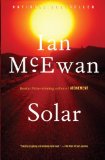
Solar, the new novel by Ian McEwan, Booker Prize winner and bestselling author of
Amsterdam and
Atonement.
About This Book
Solar approaches the largest and most important of themes—global warming—through the very particular lens of Michael Beard, a disheveled physicist floundering in the aftermath of a career that had brought him the Nobel Prize many years before.
As the novel begins, Beard's fifth marriage is unraveling. But this time, in a reversal of roles, it is because his wife is having an affair. Infidelities are Beard's stock-in-trade, but being cuckolded is a new and unsettling experience for him, and it seems part of larger downward trend in his life. He still speaks at conferences, lends his name to scientific institutions, and leads a government program devoted to developing clean energy. But he does all these things in a halfhearted way and is largely indifferent to the problem of global warming. That all changes when Aldous—an earnest postdoc who is passionate about both climate change and Beard's wife—enters the picture. After a freak accident, Beard is left with Aldous's ingenious plans for creating solar energy by imitating the process of photosynthesis. He sees a chance to reestablish his prominence as a physicist and save the world while he's at it.
But Michael Beard is an unlikely savior. His personal life seems to reflect not the solution to the problem of global warming but the cause of it. He is a man of immoderate appetites—for women, for acclaim, and, most irresistibly, for crisps. Dangerously overweight, he still cannot control his desire for fattening foods or alcohol. He vows to go on a diet, again and again, and repeatedly he fails. He is, like the species to which he belongs, an expert rationalizer and a skilled avoider of unpleasant facts. There is a blotch on the back of his hand that is ominously growing and darkening, and yet Beard, even though he is a scientist, cannot bring himself to take the proper medical action. He hesitates while the melanoma grows and threatens to metastasize. His doctor tells him that not thinking about the blotch won't make it go away—a warning that could just as accurately be directed to those who prefer not to think about global warming. In short, Beard embodies many of the characteristics of a civilization addicted to comfort and unable to change its course even as it is heading toward the cliff. That Beard sees himself as the man to create a way of harnessing solar energy sufficient to halt the climate catastrophe adds a layer of irony to the story that strikes at the heart of the human predicament. Beard is himself symptomatic of the narrow self-interest that keeps human beings from putting the health of the planet above their own desires.
The remarkable achievement is that McEwan manages to make Beard such a sympathetic character—though at times he comes closer to being pathetic than sympathetic. We watch with a kind of fascinated uneasiness as his self-created disasters threaten to pull him under, and yet with a kind of admiration and good humor, too. Perhaps because he is, in both his weaknesses and strengths, so much like us.
Reader's Guide
- Beard loves physics in part because he believes that it is "free of human taint" (p. 10). In what ways does the novel complicate this belief? In what sense is Beard's own work "tainted" by human entanglements?
- The narrative structure of Solar is mostly chronological. What effects does McEwan achieve by occasionally departing from a straightforward chronological progression?
- Beard claims he does not believe in the possibility of "profound inner change" (p. 77). Does he remain unchanged over the course of the novel?
- How does the author develop themes of identity and belonging throughout the narrative?
- What role does the setting play in shaping the characters' decisions and relationships?
- Discuss how the ending reframes the events of the story. Were you surprised?
Unless otherwise stated, this discussion guide is reprinted with the permission of Vintage.
Any page references refer to a USA edition of the book, usually the trade paperback version, and may vary in other editions.

 Book Reviewed by:


 (1).gif)