Book Club Discussion Questions
Please be aware that this discussion guide will contain spoilers!
The discussion topics, historical material, and bibliography that follow are meant to enhance your group's reading of David Guterson's
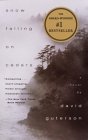
Snow Falling on Cedars. We hope that they will provide you with new ways of looking at--and talking about--a novel that has been widely praised for its eloquent dramatization of themes of love, justice, racism, community, and conscience. These ideas arise organically from the book's suspenseful story of a murder trial, its evocation of a lost love, and its brooding, poetically nuanced portraits of character and place.
The place is the fictional island of San Piedro off the coast of Washington, a community of "five thousand damp souls" [p. 5] who support themselves through salmon fishing and berry farming. The time is 1954, eight years after the end of World War II, in which some of San Piedro's young men lost their lives and many others were irreparably injured, physically as well as emotionally.
Now one of those survivors--a gill-netter named Carl Heine--has drowned under mysterious circumstances and another fisherman is on trial for his murder. The fact that the accused, Kabuo Miyamoto, is a first-generation Japanese American is not mere coincidence. To the local coroner, Heine's injuries suggested that the sheriff look for "a Jap with a bloody gun butt" [p. 59]. And among San Piedro's Anglos, hostility against Japanese still runs high, even if, like Kabuo, those Japanese were born and raised on the island and fought for the United States during the war. Kabuo's trial, in a sense, is a continuation of the white community's quarrel with its Asian neighbors.
But the Japanese--and particularly Kabuo and his wife, Hatsue--have their own grounds for resentment, stemming from years of bigotry that culminated during World War II, when thousands of Japanese Americans were interned in government relocation camps and Kabuo was effectively robbed of land that his father had worked and paid for. Even as the state presents its case against Kabuo Miyamoto, the reader is compelled to recognize the Miyamotos' case against their white neighbors, the best of whom stood by as an entire community was driven into exile. Their case never receives a public hearing: it can only be prosecuted in the courtrooms of memory and conscience.
It is not only the Japanese who remember. Among the trial's observers is Ishmael Chambers, the embittered war veteran who runs the
San Piedro Review. Ishmael is not an objective witness. He grew up with Carl and Kabuo. He lost an arm on Tarawa to Japanese machinegun fire. Most important, Hatsue was Ishmael's boyhood love and he has never come to terms with losing her. In the course of the trial he will find himself torn between rancor and conscience, loath to forgive Hatsue yet unable to condemn her husband. To a large extent,
Snow Falling on Cedars is about the ways in which Ishmael, Kabuo, and Hatsue at last acknowledge their respective losses and recognize the sense of mutual indebtedness and need that may survive even the gravest injuries and betrayals--the way in which loss itself may become a kind of kinship. In a place as isolated as San Piedro, "identity was geography instead of blood" [p. 206] and people make enemies reluctantly, knowing that "an enemy on an island is an enemy forever" [p. 439]. The snow that falls on David Guterson's hauntingly imagined world falls on everyone who lives in it.
Historical Background
Between 1901 and 1907, almost 110,000 Japanese immigrated to the United States. They were drawn by promises of ready work--American railroads actually sent recruiters to Japanese port cities, offering laborers three to five times their customary wages--and by worsening economic conditions in their homeland, which was undergoing social upheaval in the aftermath of the Meiji Restoration. Although many originally came as
dekaseginin--temporary sojourners--work was plentiful, not only on the railroads, but in the lumber camps, salmon fisheries, and fruit orchards of Oregon and Washington. Increasingly, the newcomers stayed on. Many purchased their own farms. In time, these
issei--first-generation Japanese--started families.
The Japanese government actively encouraged emigration, and although the Gentleman's Agreement of 1908 curbed the flow of Japanese men, it allowed unrestricted entry to their wives and children. Many women were "picture brides," who came to join husbands they knew only through photographs and letters and whom they had "married" by proxy in ceremonies in their native villages.
Very quickly the newcomers encountered antagonism. Although Japanese constituted less than two percent of all immigrants to the U.S., newspapers trumpeted an "invasion." The mayor of San Francisco proclaimed that "the Japanese are not the stuff of which American citizens can be made."
The Sacramento Bee warned that "the Japs...will increase like rats" if allowed to settle down. The Asiatic Exclusion League agitated for legislation to halt all Japanese immigration. Politicians ran for office on anti-Japanese platforms. In 1923, the state of Oregon prohibited
issei from legally buying land. A year later, Congress passed the National Origins Act, which banned all immigration from Japan.
In spite of this, the newcomers thrived. They found ways of getting around some laws (under Oregon's Alien Land Law, first-generation Japanese could legalize their land purchases by registering them in the names of their American-born-or nisei-children). They tolerated other laws. Meanwhile, the immigrants preserved the ceremonies and values of Japan even as they encouraged their children to acculturate and, particularly, to educate themselves. "You must outperform your detractors," one issei counseled his children. Typically, the nisei grew up thinking of themselves as Americans, yet were reminded of their difference every time they encountered the taunts and ostracism of their white neighbors.
Following the Japanese surprise attack on Pearl Harbor on December 7, 1941, hostility turned into paranoia--and paranoia became law. Japanese who had lived in America for thirty years were accused of spying for their native land. The day after Pearl Harbor, the U.S. Treasury Department ordered all Japanese-owned businesses closed and all
issei bank accounts frozen. The U.S. government had already compiled lists of Japanese whose loyalties might be suspect, and more than 1,000 businessmen, community leaders, priests, and educators were arrested up and down the West Coast.
The restrictions escalated. Japanese homes were searched for contraband. Telephone service was cut off. One newspaper columnist wrote: "I am for the immediate removal of every Japanese on the West Coast to a point deep in the interior....Herd 'em up, pack 'em off and give 'em the inside room in the badlands...let 'em be pinched, hurt, and hungry." In February 1942, President Franklin Roosevelt signed Executive Order 9066, which empowered the government to remove "any and all" persons of Japanese ancestry from sensitive military areas in four western states. Japanese residents had only days in which to evacuate. They were compelled to sell their land and businesses for a fraction of their value, or to lease them to neighbors who would later refuse to pay their rent. All told, some 110,000 Japanese Americans were deported from their homes to hastily built camps such as Tule Lake and Manzanar, where they lived behind barbed wire for the duration of the war.
Neither Germans nor Italians living in this country were subject to similar restrictions, and recently declassified documents reveal that the Japanese population was never considered a serious threat to American security. In all of World War II, no person of Japanese ancestry living in the United States, Alaska, or Hawaii was ever charged with any act of espionage or sabotage. As one
nisei later wrote, the victims of Executive Order 9066 were people whose "only crime was their face."
In 1988, the U.S. government formally apologized to Japanese citizens who had been deprived of their civil liberties during World War II.
This information was gathered from Lauren Kessler,
Stubborn Twig: Three Generations in the Life of a Japanese-American Family. New York, Random House, 1993.
For discussion - Snow Falling on Cedars opens in the middle of Kabuo Miyamoto's trial. It will be pages before we learn the crime of which he has been accused or the nature of the evidence against him. What effect does the author create by withholding this information and introducing it in the form of flashbacks? Where else in the narrative are critical revelations postponed? How is this novel's past related to its fictional present?
- The trial functions both as this novel's narrative frame and as its governing metaphor. As we follow it, we are compelled to ask larger questions about the nature of truth, guilt, and responsibility. How does the author interweave these two functions? Which characters are aware that what is at stake is more than one man's guilt?
- When the trial begins, San Piedro is in the midst of a snowstorm, which continues throughout its course. What role does snow play--both literally and metaphorically--in the book? Pay particular attention to the way in which snow blurs, freezes, isolates, and immobilizes, even as it holds out the promise of an "impossible winter purity" [p. 8]. How does nature shape this novel?
📖
Get the full reading guide
Join BookBrowse free to unlock all 20 discussion questions, author background, themes, and more for Snow Falling On Cedars.
Join free — it takes 30 seconds
Already a member? Log in →
- How does the author develop themes of identity and belonging throughout the narrative?
- What role does the setting play in shaping the characters' decisions and relationships?
- Discuss how the ending reframes the events of the story. Were you surprised?
Unless otherwise stated, this discussion guide is reprinted with the permission of Vintage.
Any page references refer to a USA edition of the book, usually the trade paperback version, and may vary in other editions.




 (1).gif)