Book Club Discussion Questions for The Mirror Thief by Martin Seay

Summary |  Excerpt |  Reading Guide |  Reviews |  Beyond the Book |  Read-Alikes |  Genres & Themes |  Author Bio
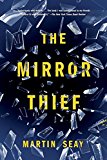
The Mirror Thief by Martin Seay

The Mirror Thief

by Martin Seay
  • BookBrowse Review:
  • Critics' Consensus (4):
  • Readers' Rating (2):
  • First Published:
  • May 10, 2016, 592 pages
  • Paperback:
  • Apr 2017, 592 pages
  • Rate this book

About this Book

Book Club Discussion Questions

Print PDF

In a book club? Subscribe to our Book Club Newsletter and get our best book club books of 2026!


For supplemental discussion material see our Beyond the Book article, Sixteenth Century Venice and our BookBrowse Review of The Mirror Thief.


Please be aware that this discussion guide will contain spoilers!

  1. The Mirror Thief takes place in three different locations, all of which are named Venice. This seems to indicate that in addition to being a setting for the plot, the concept of "Venice" animates the novel as an idea in itself. What is this idea?
  2. The word "Venice" never actually appears anywhere in The Mirror Thief, despite the fact that it is quite obviously set in three different places named Venice. What could be the significance of this? Why would the author refrain from using the name of the locations?
  3. What is the role of magic in the novel? Is it actual magic, or just implied? Is the magic – whether the sense of magic, or actual magic --- limited to the part of the story set in 16th century Venice setting, or is it in the two more modern-day settings as well? How might it function in each?
  4. In Las Vegas, Veronica tells Curtis that "the eye that tricks itself" is "the beginning of modern art." What does Veronica mean by this? And how might this idea inform the novel, if at all? (p. 274)
  5. In the hands of Stanley, card counting seems like an act of magic. What is the significance of card counting in the novel? Is it magic, craft, both—or is it something else altogether?
  6. Early in the novel, the author writes that "calling a thing by its name gives you power over it." (p. 88) What is an example in the book of a character naming something to achieve power over it? Is this related to the "mirrored" naming of each location in the book as "Venice"?
  7. The Mirror Thief features three distinct storylines, each in its own time and place, that eventually come together. Each of these narratives have a specific tone, language, and ambiance of their own. How does the author establish a unique sense of time and place in each narrative?


Unless otherwise stated, this discussion guide is reprinted with the permission of Melville House. Any page references refer to a USA edition of the book, usually the trade paperback version, and may vary in other editions.

Membership Advantages
  • Reviews
  • "Beyond the Book" articles
  • Free books to read and review (US only)
  • Find books by time period, setting & theme
  • Read-alike suggestions by book and author
  • Book club discussions
  • and much more!
  • Just $60 for 12 months or $20 for 3 months.
  • More about membership!

Beyond the Book:
  Sixteenth Century Venice

BookBrowse Book Club

Book Jacket
Broken Country (Reese's Book Club)
by Clare Leslie Hall

Members Recommend

Who Said...

If there is anything more dangerous to the life of the mind than having no independent commitment to ideas...

Click Here to find out who said this, as well as discovering other famous literary quotes!

Book
Trivia

  • Book Trivia

    Can you name the title?

    Test your book knowledge with our daily trivia challenge!

Wordplay

Solve this clue:

W the C A the M W P

and be entered to win..

Your guide toexceptional          books

BookBrowse seeks out and recommends the best in contemporary fiction and nonfiction—books that not only engage and entertain but also deepen our understanding of ourselves and the world around us.