Book Club Discussion Questions
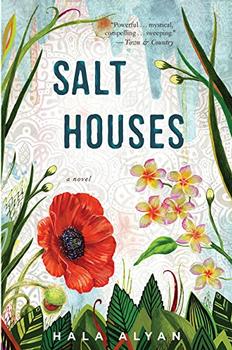
For supplemental discussion material see our Beyond the Book article, Makloubeh and our BookBrowse Review of Salt Houses.
Please be aware that this discussion guide will contain spoilers!
In
Salt Houses, Hala Alyan charts the diverging paths of one family through a century of violence and upheaval in the Middle East. Beginning with Salma and Hussam, we follow four generations of Palestinians torn from their homeland, whose wealth and privilege cannot shield them from the tumult of war—or from the more personal strife every family endures. The novel is, in particular, the story of strong women: of sisters, mothers, and daughters who chafe against each other just as often as they lean on each other for support. Alia is fiery and independent in her youth and never loses that spirit, even as she enters her final years; her youngest daughter is so much like her that each enrages the other, while her elder daughter is a throwback to Alia's own mother, with a serene devotion to Allah that worries her more secular family. That tension between combustible spirits can be found in the younger generations of the Yacoub family as well, along with the sense of unease that religious awakening can elicit in others.
The members of this family move from house to house, from country to country, never staying long enough to put down roots in one place. And yet each of them carries an inherited yearning for Palestine, a sense of thwarted belonging so strong that even the grandchildren identify themselves as Palestinians, though they've never been to their grandparents' home. Alia's husband Atef observes that their physical homes have been as ephemeral as structures of salt washed away by the sea, but their spiritual home, rooted in the deep bonds they have to each other and to the past, remains stable and strong.
Discussion Questions
- The novel begins with a cup reading—and a lie by omission. Salma sees dark omens in her daughter's coffee cup on Alia's wedding day, but chooses not to reveal them. She sees crossed knives, crumbling houses, and the image of a zebra: "A zebra is an exterior life, an unsettled life" (page 9). But Salma later questions what she saw in the cup: "Not a zebra, but a horse with smudges, a speckled horse. It means travel, perhaps, even a difficult first pregnancy, but luck; it also means luck" (page 23). In what ways does Alia's life—including her emotional life and relationships—fulfill these two interpretations of her mother's vision?
- As readers, we follow this family through several major real-world events: the Six-Day War, Saddam Hussein's invasion of Kuwait, the 9/11 attacks. How does viewing history through the prism of these individual lives change the way you think of those historical events?
- In the one chapter narrated from Mustafa's perspective, we see him gradually become inspired (or radicalized) by Imam Bakri. But he also acknowledges that his belief in Allah is "flighty" and that "if there is ever a sweeping of believers into one room and the rest into the other, he doesn't want to be on the wrong side of the door" (page 31). What do you think influences this character to become involved in increasingly violent politics?
📖
Get the full reading guide
Join BookBrowse free to unlock all 15 discussion questions, author background, themes, and more for Salt Houses.
Join free — it takes 30 seconds
Already a member? Log in →
- How does the author develop themes of identity and belonging throughout the narrative?
- What role does the setting play in shaping the characters' decisions and relationships?
- Discuss how the ending reframes the events of the story. Were you surprised?
Unless otherwise stated, this discussion guide is reprinted with the permission of Mariner Books.
Any page references refer to a USA edition of the book, usually the trade paperback version, and may vary in other editions.

 Book Reviewed by:

 (1).gif)