Book Club Discussion Questions
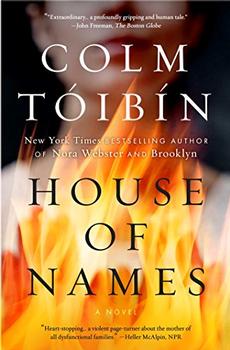
For supplemental discussion material see our Beyond the Book article, Women who Scheme: The Female as Villain in Greek Tragedies and Beyond and our BookBrowse Review of House of Names.
Please be aware that this discussion guide will contain spoilers!
A Note From The AuthorWhen I had finished my novel
Nora Webster, which followed
Brooklyn, I knew that I would not write about Enniscorthy again for a while. I felt as though I had dreamed the town where I grew up out of my system.
One day, a friend suggested I should look at the story of Clytemnestra, the figure in Greek theatre, who murdered her husband, Agamemnon, and was in turn murdered by her son, Orestes, egged on by his sister Electra.
At first I was not sure. But I became interested in re-seeing this fierce and ferociously dramatic family. I saw motive. I saw love and hatred and jealousy. I saw most of the book happening in a single space, almost like a town, a place full of secrets and whispers and rumors.
Even though
House of Names is animated by murder and mayhem and the struggle for power, it is still a story about a single family as it tears itself asunder. No matter what happens, I was dealing with family dynamics, something I have been dramatizing in all my books: the same emotions, the same regrets, the same elemental feelings.
Only this time it was happening in ancient Greece rather than in the streets of Enniscorthy.
Colm Tóibín
Questions- Clytemnestra speaks of "a hunger I had come to know too and had come to appreciate" (page 3) in the opening pages. What does this hunger signify? Why do death and appetite come together in these early scenes, particularly for Clytemnestra?
- Agamemnon and his men seem to believe in the gods so much that they will sacrifice Iphigenia unquestioningly, while this act cements for Clytemnestra "that I did not believe at all in the power of the gods" (page 32). Do you think she is the only one with doubts?
- Why does Clytemnestra brush Electra aside after Iphigenia's death? Could the consequences of Clytemnestra's "first mistake" (page 40) with Electra have been avoided?
📖
Get the full reading guide
Join BookBrowse free to unlock all 21 discussion questions, author background, themes, and more for House of Names.
Join free — it takes 30 seconds
Already a member? Log in →
- How does the author develop themes of identity and belonging throughout the narrative?
- What role does the setting play in shaping the characters' decisions and relationships?
- Discuss how the ending reframes the events of the story. Were you surprised?
Unless otherwise stated, this discussion guide is reprinted with the permission of Scribner.
Any page references refer to a USA edition of the book, usually the trade paperback version, and may vary in other editions.