Book Club Discussion Questions
Please be aware that this discussion guide will contain spoilers!
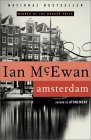
When you read Ian McEwan's most recent novel,
Amsterdam, you'll understand why it won the Booker Prize. When you read his earlier works, you'll wonder why he didn't win it sooner.
The four McEwan novels--Booker Prize-winning
Amsterdam,
Enduring Love,
Black Dogs, and
The Innocent--included in this Reading Group Companion, showcase the author's range and skill as he delivers unlikely, and welcome, combinations of suspense, ethics, philosophy, and political and religious ideology. In lesser hands, such a mix might be lethal. In McEwan's, it's intoxicating.
About This Book
On a chilly February day, two old friends meet in the throng outside a London crematorium to pay their last respects to Molly Lane. Both Clive Linley and Vernon Halliday had been Molly's lovers in the days before they reached their current eminence: Clive is Britain's most successful modern composer, and Vernon is editor of the newspaper
The Judge. Gorgeous, feisty Molly had other lovers, too, notably Julian Garmony, Foreign Secretary, a notorious right-winger tipped to be the next prime minister.
In the days that follow Molly's funeral, Clive and Vernon will make a pact with consequences that neither could have foreseen. Each will make a disastrous moral decision, their friendship will be tested to its limits, and Julian Garmony will be fighting for his political life. A sharp contemporary morality tale, cleverly disguised as a comic novel,
Amsterdam is "as sheerly enjoyable a book as one is likely to pick up this year" (
The Washington Post Book World).
Questions for Discussion
- Talk about the tone of this novel. Is it ironic? Humorous? Menacing?
- Think about Clive and Vernon and your feelings about each at different stages of the novel. Did those feelings change? If so, at what key points?
- In a relatively short novel, the author devotes many pages to Clive's creative process. What do you think of the author's description of the process itself and of his decision to give it so much space?
📖
Get the full reading guide
Join BookBrowse free to unlock all 18 discussion questions, author background, themes, and more for Amsterdam.
Join free — it takes 30 seconds
Already a member? Log in →
- How does the author develop themes of identity and belonging throughout the narrative?
- What role does the setting play in shaping the characters' decisions and relationships?
- Discuss how the ending reframes the events of the story. Were you surprised?
Unless otherwise stated, this discussion guide is reprinted with the permission of Anchor Books.
Any page references refer to a USA edition of the book, usually the trade paperback version, and may vary in other editions.

 (1).gif)