Book Club Discussion Questions
Please be aware that this discussion guide will contain spoilers!
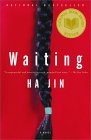
Ha Jin's novel
Waiting was the winner of the 1999 winner of the National Book Award for Fiction. This quietly poignant novel of love and repression in Communist China begins in 1966 when Lin Kong, an army doctor, falls in love with the young nurse Manna Wu during a forced military march. They would like to marry, but Lin has a wife at home, in a rural village far from his army posting. His wife, Shuyu, is an illiterate peasant with bound feet, whom he was married to by arrangement so that his parents would have a daughter-in-law to care for them in old age. Each year, Lin travels back to Goose Village to divorce Shuyu in the county court; each year he is defeated, either by the judge or by the intervention of his wife's brother. Because adultery is forbidden by the Communist Party, the years pass slowly and Lin and Manna wait chastely for their fate to change. By the time 18 years have passed--the interim after which a man can divorce his wife even without her consent--what had begun as a sweet and passionate romance has turned into something far more complicated and more real.
Written with grace, wry humor, and an uncompromising realism,
Waiting gives readers a story that puts their cherished ideals of individualism and self-fulfillment in a wholly different perspective.
For discussion: Waiting
- Ha Jin has said that the idea for Waiting came to him when he read a newspaper story about a woman who described her husband as loveless: "She wished her husband could have an affair with another woman.... At least that would prove he was capable of love."* When late in the novel Lin realizes that "he had never loved a woman wholeheartedly and that he had always been the loved one" (p. 296), do you think Ha Jin is calling attention to an individual problem--his protagonist's passive temperament--or a universal one?
- Lin Kong is a man who seems to want to move beyond the values of traditional village life, with its familial bonds and rootedness. If marrying Manna Wu will bring him the more modern life he desires, one based on self-fulfillment and independence, why does he have such difficulty obtaining his divorce? Is he undecided as to what he wants? What does he stand to lose in giving up Shuyu? How do the choices he faces relate to similar ones faced by men and women in America today?
- Geng Yang tells Lin, "You're always afraid that people will call you a bad man. You strive to have a good heart. But what is a heart? Just a chunk of flesh that a dog can eat. Your problem originates in your own character, and you must first change yourself" (p. 167). How insightful is this remark? Should Lin try to be more heartless with regard to his wife? How is the remark tempered by what you know of Geng Yang's character?
📖
Get the full reading guide
Join BookBrowse free to unlock all 22 discussion questions, author background, themes, and more for Waiting.
Join free — it takes 30 seconds
Already a member? Log in →
- How does the author develop themes of identity and belonging throughout the narrative?
- What role does the setting play in shaping the characters' decisions and relationships?
- Discuss how the ending reframes the events of the story. Were you surprised?
Unless otherwise stated, this discussion guide is reprinted with the permission of Vintage.
Any page references refer to a USA edition of the book, usually the trade paperback version, and may vary in other editions.


 (1).gif)