Book Club Discussion Questions
Please be aware that this discussion guide will contain spoilers!
Introduction
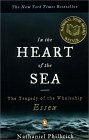
It began in the summer of 1997. I never seem to get much writing done in the summer. Nantucket is a madhouse in July and August, and for me it's been a time for sculpting an existing manuscript rather than creating a new one. That said, I was desperately trying to finish up a book called Abram's Eyes, about the island's Native American legacy. All summer I'd been wrestling with the epilogue. I was attempting to link the Indians' myths of Maushop—a friendly giant who finally turns on his own family, beating his wife and transforming his children into killer whales—to Herman Melville's myth-making use of the Essex disaster, in which the whaleman's normally benign prey, the mammoth sperm whale, unaccountably attacks and sinks a Nantucket whaleship, but it just wasn't working.
It was during a family vacation in Maine that it came to me: how to finish the book I was working on and how to start the next one. We were sailing a chartered boat in Maine's Penobscot Bay when I found myself thinking less about the whale and more about the men and what had happened to them after the attack. Then it hit me, the scene with which I would begin
In the Heart of the Sea: two emaciated survivors found sucking the marrow from the bones of their dead shipmates. With the bones leading the way, I saw with a startling, almost instantaneous clarity that the Essex was something more than the whaling yarn that inspired
Moby-Dick, it was one of the greatest survival tales ever told.
It wasn't until about three months later, in December of 1997, that I was able to turn my undivided attention to the Essex. Having by that point written two books of Nantucket history, I had almost a decade's worth of relevant research behind me. What I felt I needed more than anything else was a new angle on the island and whaling, a perspective that did not take Nantucket and its history for granted. So I decided to become a tourist in my own town.
With notebook in hand, I spent an afternoon at the Nantucket whaling museum, a place I'd visited countless times, but instead of looking for an answer to a specific question, I was in search of more general impressions. I came away from my three-hour ramble through what is an old candle factory stuffed with a fascinating assortment of artifacts with a renewed sense of the size and strength of the whale. There were iron harpoon shafts that had been twisted as if they'd been pieces of taffy. Somehow I'd never noticed them before, and if I had, I'd resisted the tendency to say, "Wow!" I began to see Nantucket as an almost medieval place, dominated by its own one-sided version of war, complete with tattered signal flags, portraits of its ocean-going knights of old, and decorated with the dusty bones of the defeated. In the basement of the museum is a huge whale oil cask, an object that made me see whaling as not just a battle but also a business. Whale oil, I realized, was what petroleum is to us today, and Nantucket, this little sandbank at the edge of a watery wilderness, was the Mobil Oil headquarters of the nineteenth century.
The biggest surprise while writing the book were the directions in which my research led me. I never would have anticipated, for example, integrating information about a starvation experiment conducted at the University of Minnesota during World War II in a book about a whaling voyage in the early nineteenth century. But it was the science, I began to realize, that made the story seem all the more real and frightening to a modern audience.
One anecdote about my starvation research: In December, a week or so before Christmas 1998, my wife stopped by our local library to pick up a copy of an article I'd ordered through Interlibrary Loan. The reference librarian greeted her with a look of concern. "Is Nat all right?" she asked. Somewhat bewildered, my wife assured her that, yes, he wasn't getting out much these days, but everything was fine. It wasn't until she was walking back to her car that Melissa looked to see that the article was entitled "The Nutritional Value of Cannibalism."
Discussion Questions - In 1820, Nantucket was a Quaker town. What do Quakers believe? Was it hypocritical of a Quaker community to embrace such a violent occupation as whaling?
- Given their proximity to the shipwreck, why did the Essex survivors avoid the South Pacific islands? What factors—historical, cultural, and otherwise—contributed to the decision to take a longer route home?
- With what you've learned about the people of Nantucket and the whalemen in particular, can you explain their fearlessness in the face of nature? And, conversely, their great fear of strange human beings? How is our world different today? Does this account somewhat for our contemporary fascination with tales of man versus nature?
📖
Get the full reading guide
Join BookBrowse free to unlock all 10 discussion questions, author background, themes, and more for In the Heart of the Sea.
Join free — it takes 30 seconds
Already a member? Log in →
- How does the author develop themes of identity and belonging throughout the narrative?
- What role does the setting play in shaping the characters' decisions and relationships?
- Discuss how the ending reframes the events of the story. Were you surprised?
Unless otherwise stated, this discussion guide is reprinted with the permission of Penguin.
Any page references refer to a USA edition of the book, usually the trade paperback version, and may vary in other editions.



 (1).gif)