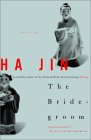
Book Club Discussion Questions
Please be aware that this discussion guide will contain spoilers!
The questions, discussion topics, and author biography that follow are
intended to enhance your group's reading of
The Bridegroom, Ha Jin's
latest collection of short fiction.
About this book
With these tales - three of which have been selected for inclusion in
The
Best American Short Stories - Ha Jin returns to Muji City, the same provincial
city in northern China that was the setting of his National Book Award-winning
novel
Waiting. The stories take place in contemporary times, after the
end of the Cultural Revolution, as the repressive years of Maoist reeducation
give way to a new and often confusing set of circumstances. China remains an
essentially communist nation, but begins cautiously to open itself to individual
entrepreneurship in business. With the great majority of people still working in
state-owned industries, political situations are inseparable from the details of
everyday life. As the characters in these stories struggle to make a living,
they cope with government bureaucracy and the occasional intrusion of communist
party officials into their domestic affairs.
In the title story a handsome young man marries a homely girl, to the surprise
and relief of her guardian. But good fortune gives way to grief when the man is
found guilty of the "bourgeois crime" of homosexuality. In
"After
Cowboy Chicken Came to Town," an American-run fried chicken restaurant
creates conflict among its Chinese workers, who find to their dismay that
American enterprise has its own set of injustices. And in
"Alive," a
man who has traveled on business to a distant city is injured in an earthquake,
loses his memory, and marries a woman whose family has been killed, only to
suddenly remember the family he left behind. When he returns to them, he finds
that since he has been presumed dead, he has lost his job and his apartment, and
he begins to regret his decision to come home. The stories in
The Bridegroom,
in all their humor and sadness, are expressions of their author's unswervingly
realistic perspective on human nature and on life in contemporary China.
Discussion Questions
- In "Saboteur," the protagonist is victimized by a couple of
police officers who arrest him on false charges and release him only when he
agrees to sign the incriminating "self-criticism" they have
written for him. His revenge is deliberate and ultimately murderous. Given
that he thinks the situation is "ridiculous" [p. 10], are Mr.
Chiu's acts of retaliation and anger even more unjust than those of the
police officers who mistreated him? Does Ha Jin imply that Mr. Chiu's sort
of rage is spurred by the particular abuses of power in Chinese society? How
might such a story be transposed to an American situation?
- Revenge also figures powerfully in "Flame." When Nimei decided
to marry Jiang Bing, Hsu Peng's last words to her were, "I hate you!
I'll get my revenge" [p. 130]. What is lacking in Nimei's life that she
is willing to indulge in romantic speculation about Hsu Peng's impending
visit and allow herself to forget his promise of vengeance? What
distinguishes the acts of revenge in "Saboteur" and
"Flame"? Where are the reader's sympathies in "Flame"?
What is so particularly fitting about the way Hsu Peng triumphs over Nimei?
- Which aspects of "Alive" are most cruelly ironic? Does Guhan do
the right thing by leaving his new family and returning to his old one, or
would he have been better off staying in Taifu? If you have read Waiting,
how is "Alive" reminiscent of that novel?
📖
Get the full reading guide
Join BookBrowse free to unlock all 11 discussion questions, author background, themes, and more for The Bridegroom.
Join free — it takes 30 seconds
Already a member? Log in →
- How does the author develop themes of identity and belonging throughout the narrative?
- What role does the setting play in shaping the characters' decisions and relationships?
- Discuss how the ending reframes the events of the story. Were you surprised?
Unless otherwise stated, this discussion guide is reprinted with the permission of Vintage.
Any page references refer to a USA edition of the book, usually the trade paperback version, and may vary in other editions.

 (1).gif)