Book Club Discussion Questions
Please be aware that this discussion guide will contain spoilers!
Introduction
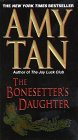
The first time Amy Tan - The New York Times best-selling author of
The Joy Luck Club, The Kitchen God's Wife, and
The Hundred Secret Senses - learned her mother's real name as well as that of her grandmother was on the day she died. It happened as Tan and several siblings - unified by a need to feel helpful instead of helpless - gathered to discuss their dying mother's past and prepare her obituary. Tan was stunned when she realized she had not known her own mother's birth name. It was just one of several surprises. In the act of writing a simple obituary Tan came to realize there was still so much she did not know about her. Soon afterwards she began rewriting the novel she had been working on for five years. Inspired by her own experiences with family secrets kept by one generation from the next, and drawn from a lifetime of questions and images, the result is
The Bonesetter's Daughter.
The story begins when Ruth Young, a ghostwriter of self-help books, comes across a clipped stack of papers in the bottom of a desk drawer. Young has been caring for her ailing mother, LuLing, who is beginning to show the unmistakable signs of Alzheimer's disease. Written in Chinese by LuLing years earlier, when she first started worrying something was wrong with her memory, the papers contain a narrative of LuLing's life as a girl in China, and the life of her own mother, the daughter of the Famous Bonesetter from the village of Xian Xin - Immortal Heart - near the Mouth of the Mountain. Within the calligraphed pages Ruth finds the truth about a mother's heart, what she cannot tell her daughter yet hopes her daughter will never forget.
With her latest novel Amy Tan explores the changing place one has in a family of names that were nearly forgotten. Just as she herself has done, Tan shows Ruth finding the secrets and fragments of her mother's past - its heartfelt desires, its deepest wounds, its most profound hopes - and with each new discovery reconfiguring her assessment of the woman who shaped her life, who is in her bones.
The extent to which Tan's newest novel mixes pure fiction with elements of autobiography is made clear by Tan herself. In acknowledgements of
The Bonesetter's Daughter she writes, "The heart of this story belongs to my grandmother, its voice to my mother."
Discussion Questions - Memory plays an important role in The Bonesetter's Daughter. How is Ruth’s life affected by her childhood memories? How do LuLing’s memories affect her behavior around Ruth?
- How does LuLing attempt to convey the difficulties of her formative years to Ruth? Does she succeed? Why/why not? In the constant sparring between Ruth and LuLing, who do you think is at fault?
- Much of The Bonesetter's Daughter revolves around superstition. How does this aspect of Chinese culture affect LuLing’s actions? Is Ruth superstitious? Does she realize that she is manipulating her mother as a child?
📖
Get the full reading guide
Join BookBrowse free to unlock all 10 discussion questions, author background, themes, and more for The Bonesetter's Daughter.
Join free — it takes 30 seconds
Already a member? Log in →
- How does the author develop themes of identity and belonging throughout the narrative?
- What role does the setting play in shaping the characters' decisions and relationships?
- Discuss how the ending reframes the events of the story. Were you surprised?
Unless otherwise stated, this discussion guide is reprinted with the permission of Ballantine Books.
Any page references refer to a USA edition of the book, usually the trade paperback version, and may vary in other editions.



 (1).gif)