Book Club Discussion Questions
Please be aware that this discussion guide will contain spoilers!
About this Guide
This reading group guide is designed to
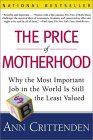
enhance your discussion and personal reading of Ann Crittenden's
acclaimed work
The Price of Motherhood. We hope that this guide
will also be a useful reference tool that will lead you to further
topics of inquiry.
About the Book
Women may be more
liberated these days, but mothers aren't. That's the provocative
conclusion Ann Crittenden has drawn after years of research, including
her own experiences as a mom. Revealing the glaring disparities
between mothers and childless women in America,
The Price of
Motherhood puts the spotlight on the unspoken ways in which we
have scorned what's often touted as the most important job of all.
Single mothers and married mothers alike experience the financial
impact of the years of unpaid labor incurred in raising kids, but it
doesn't have to be this way. Offering numerous practical solutions,
some of which were successfully implemented in other countries years
ago,
The Price of Motherhood has already sparked constructive
dialogues about the exploitation of America's mothers. A compelling
plea for more respect and resources on behalf of mothers, this is a
book that has the power to improve the lives of all Americans, and to
transform a future generation.
Facts and Figures
- America's 30-year-old childless
women earn 90% of men's wages, but earnings for mothers of the same
age and education level are only 70% of men's.
- The loss of income resulting from
motherhood ("The Mommy Tax") is typically more than $1 million for
college-educated American women.
- The U.S. is one of only six
countries in the world that does not provide paid parental leave.
- Professional nannies qualify for
Social Security benefits, but a stay-at-home mother will earn a zero
on her retirement-benefit account for every year she spends caring
for her children.
- More than one-third of all
divorced mothers have to go on welfare because child-support
formulas don't factor in the cost of being the primary caregiver.
- Fathers are statistically less
likely than mothers to spend money on their children's health and
education.
- As demonstrated by the Zoë Baird
incident, immigration policy keeps skilled caregivers out of the
country by classifying even highly trained nannies as "unskilled."
- Only eight states have laws
prohibiting discrimination against parents in the workplace.
- Only 49% of female CEOs have kids,
compared to 84% of male CEOs.
Discussion
Questions
-
Ann Crittenden states in her first footnote that she defines
"mother" as any caregiver, male or female. How does that detail affect
her portrayal of parenting issues throughout the book? What motivates
society to assume that women are better candidates for caring for
children and the elderly than men?
- For female readers: If you and your husband earned exactly the same
amount, but neither of you were allowed to work part-time, would you
feel comfortable becoming the wage-earner while your husband stayed
home with the kids?
- How much more would you be willing to pay in taxes if it meant that
the U.S. would implement the Swedish policies, which grant parents a
full year of paid leave and a 3/4 work week until their children reach
school age, and the French system of top-notch government-sponsored
day care for all?
📖
Get the full reading guide
Join BookBrowse free to unlock all 36 discussion questions, author background, themes, and more for The Price of Motherhood.
Join free — it takes 30 seconds
Already a member? Log in →
- How does the author develop themes of identity and belonging throughout the narrative?
- What role does the setting play in shaping the characters' decisions and relationships?
- Discuss how the ending reframes the events of the story. Were you surprised?
Unless otherwise stated, this discussion guide is reprinted with the permission of Owl Books.
Any page references refer to a USA edition of the book, usually the trade paperback version, and may vary in other editions.



 (1).gif)