Book Club Discussion Questions
Please be aware that this discussion guide will contain spoilers!
Introduction
With his bestselling memoir
The Color of Water, James McBride created
a fascinating story of growing up in the projects of Red Hook, Brooklyn and a
vivid portrait of his indomitable mother. Now, in his first novel, he broadens
his scope from personal history to the larger history of WWII and the little
known role that black soldiers played in it.
The story begins in 1983 with the abrupt and unexplained shooting by Hector
Negron, a New York City postal employee, of a man who wanted only to purchase a
stamp. Why Hector has killed this man and how he came to possess the head of the
statue of the Primavera, which had adorned the Santa Trinita bridge in Florence
since the sixteenth century, is the mystery that
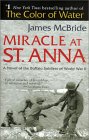
Miracle at St. Anna sets
out, in a most circuitous fashion, to solve.
Stepping back forty years, the novel plunges us into the world of the
all-Negro 92nd Division, into the fierce fighting of WWII in the mountains of
Italy, and into the hearts and minds of four unforgettable soldiers. It is a war
in which the unquestioned racial attitudes of 1940s America take on
life-and-death consequences on the battlefield, as white commanders willfully
jeopardize their black troops. It is, as private Bishop says, "a white
man's war.... Niggers ain't got nothing to do with it." But when Sam Train,
an illiterate giant of a soldier from North Carolina, saves a white Italian boy
from the invading Germans, a journey begins that will take Sam, Bishop, Hector
Negron, and Lieutenant Stamps far from their Division commanders to the remote
mountain village of St. Anna di Stazzema. Here they will encounter the village
witch, a beautiful young woman, partisan fighters led by the legendary
"Black Butterfly," and an Italian family that treats them with an
equality they have never before experienced. More importantly, it is here, in
the aftermath of a brutal Nazi massacre, that they will witness miracles and
make the powerful discovery that "everybody got something to do with
everything."
With a view of the war that is both panoramic in its sweep and deeply
personal in its exploration of the human spirit,
Miracle at St. Anna
brings to life a largely overlooked historical moment and extends the reach of
James McBride's considerable storytelling powers.
Discussion Questions
- Why do you think McBride chose to frame his WWII story with the post
office episode that takes place in 1983? How does this narrative frame
clarify or comment on the picture of the war it contains?
- What knowledge of the African American experience in WWII did you bring to
Miracle at St. Anna? How did reading the novel deepen your
understanding of this aspect of the war?
- In a fiery argument with Stamps, Bishop says, "So now the great white
father sends you out here to shoot Germans so he can hang you back home for
looking at his woman wrong.... The Negro don't have doodleysquat to do with
this...this devilment, this war-to-free-the-world shit" [p. 147-9]. In
what ways does the war reveal the racism and hypocrisy entrenched in
American society? How are the black soldiers treated by their white
commanders? How are they treated by the Italians? Is Bishop's cynicism
justified?
📖
Get the full reading guide
Join BookBrowse free to unlock all 10 discussion questions, author background, themes, and more for Miracle At St. Anna.
Join free — it takes 30 seconds
Already a member? Log in →
- How does the author develop themes of identity and belonging throughout the narrative?
- What role does the setting play in shaping the characters' decisions and relationships?
- Discuss how the ending reframes the events of the story. Were you surprised?
Unless otherwise stated, this discussion guide is reprinted with the permission of Riverhead Books.
Any page references refer to a USA edition of the book, usually the trade paperback version, and may vary in other editions.




 (1).gif)