Book Club Discussion Questions
Please be aware that this discussion guide will contain spoilers!
About This Book
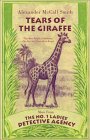
Tears of the Giraffe finds Precious Ramotswe firmly established as Botswana's first and
only lady detective. She's not getting rich, but she's not losing money
either, and under the imaginary ledger for
happiness, her account is
full. Indeed, she is about to marry Mr J.L.B. Matekoni, owner of Tlokweng Road
Speedy Motors. Mr J.L.B. Matekoni is a thoroughly honest and loving man, a man
whose generous impulses not only send him to the local orphanage to fix a water
pump free of charge but also, somehow, bring him home with two small children.
Now Mma Ramotswe has not only a husband but a family to care for, something she
had not allowed herself to hope for after her own child died at birth.
But into this rich, full life comes Mrs. Curtain, an American whose son
disappeared in the Kalahari desert ten years ago. Michael Curtain had been
living in a commune, working on finding a better way to grow vegetables in the
harsh land of Botswana, when he vanished one night without warning and without a
trace. Stricken with grief, Mrs. Curtain has searched in every way possible for
years, exhausting every avenue of inquiry, until the American Embassy
recommended Mma Ramotswe. And even though Mma Ramotswe knows that old unsolved
cases such as the one Mrs. Curtain brings her are what is known in the business
as "stale enquiries," she agrees to try to discover what happened to Michael
Curtain.
Given her own experience of losing a child, she can empathize with Mrs. Curtain.
And in many ways empathy—between Mma Ramotswe and Mrs. Curtain, between Mr
J.L.B. Matekoni and the orphan children, even between wheelchair-bound Motholeli
and the engine of a van—is the central theme of Alexander McCall Smith's
extraordinary novel. The idea that we are all "brothers and sisters" is what
guides the story, sustains the lives of its remarkable characters, and offers
readers so much more than the satisfaction of seeing a mystery solved.
Reader's Guide
- What distinguishes Tears of the Giraffe from most other mysteries?
What qualities make it such a charming and affirmative book? In what ways does
Mma Ramotswe differ from such archetypal detectives as Sherlock Holmes, Sam
Spade, and Philip Marlowe?
- Mrs. Curtain says that when she first came to Africa, she had "the usual
ideas about it—a hotchpotch of images of big game and savannah and Kilimanjaro
rising out of the cloud . . . famines and civil wars and potbellied, half-naked
children staring at the camera, sunk in hopelessness" [p. 27]. How does her
experience of Africa alter these ideas? Why does she feel that "everything
about my own country seemed so shoddy and superficial when held up against what
I saw in Africa" [p. 29]? What deeper and truer understanding of Africa does
the novel itself offer readers who might share Mrs. Curtain's preconceptions?
- Mma Ramotswe knows that Mrs. Curtain's case—finding out what happened
to her son ten years ago—is what is referred to in The Principles of
Private Detection as "a stale enquiry" [p. 61]. Why does she accept the
case, in spite of that? What special empathy does she feel for Mrs. Curtain?
📖
Get the full reading guide
Join BookBrowse free to unlock all 14 discussion questions, author background, themes, and more for Tears of The Giraffe.
Join free — it takes 30 seconds
Already a member? Log in →
- How does the author develop themes of identity and belonging throughout the narrative?
- What role does the setting play in shaping the characters' decisions and relationships?
- Discuss how the ending reframes the events of the story. Were you surprised?
Unless otherwise stated, this discussion guide is reprinted with the permission of Anchor Books.
Any page references refer to a USA edition of the book, usually the trade paperback version, and may vary in other editions.


 (1).gif)