-
Your next favorite book
is waiting.
Summary | Excerpt | Reading Guide | Reviews | Beyond the book | Read-Alikes | Genres & Themes | Author Bio
 Book Reviewed by:
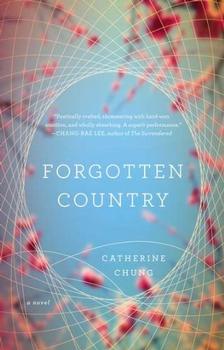
Weaving Korean folklore within a modern narrative of immigration and identity, Forgotten Country is a fierce exploration of the inevitability of loss, the conflict between obligation and freedom, and a family struggling to find its way out of silence and back to one another.
On the night Janie waits for her sister, Hannah, to be born, her grandmother tells her a story: Since the Japanese occupation of Korea, their family has lost a daughter in every generation, so Janie is charged with keeping Hannah safe. As time passes, Janie hears more stories, while facts remain unspoken. Her father tells tales about numbers, and in his stories everything works out. In her mother's stories, deer explode in fields, frogs bury their loved ones in the ocean, and girls jump from cliffs and fall like flowers into the sea. Within all these stories are warnings.
Years later, when Hannah inexplicably cuts all ties and disappears, Janie embarks on a mission to find her sister and finally uncover the truth beneath her family's silence. To do so, she must confront their history, the reason for her parents' sudden move to America twenty years earlier, and ultimately her conflicted feelings toward her sister and her own role in the betrayal behind their estrangement.
Weaving Korean folklore within a modern narrative of immigration and identity, Forgotten Country is a fierce exploration of the inevitability of loss, the conflict between obligation and freedom, and a family struggling to find its way out of silence and back to one another.
1.
The year that Hannah disappeared, the first frost came early,
killing everything in the garden. It took the cantaloupe and the
tomatoes; the leaves of lettuce turned brittle and snapped. Even
the kale withered and died. In front, the wine-colored roses froze,
powdered gray with the cold, like silk flowers in an attic covered
with dust. My father and I had planted the garden over several
weekends, and tended it carefully. Then it had overgrown itself,
the tomatoes winding themselves up the wall of our house and
stretching out to span the distance to the fence. After the frost
we'd left it all winter without trimming anything back. Now we
stood on the lawn, surveying the ruin, tracking damp patches of
ground wherever we stepped.
"We're selling the house," my father said, blowing warm air on
his hands.
"That makes sense," I said, but it felt suddenly difficult to breathe.
My parents had told me they were going back to Korea, so I'd known
selling our house was a ...
...Chung knows her protagonist, and the strength of that finely tuned characterization carries the plot. Even when some plot points remain unresolved, it is forgivable because, well, that's just the kind of person Janie is. Her Eastern/Western culture blend doesn't beg easy answers or pat resolutions. So, reader, we will have to forego them as well. No matter. Really. Some of the best books leave us with undigested morsels to ponder at our leisure. Now that Chung has reached such a high bar with fiction-as-memoir I look forward to where her considerable skills will take her next...continued
Full Review
 (427 words)
(Reviewed by Donna Chavez).
 Chang-rae Lee, author of The Surrendered and Native Speaker
It is a rare novel - debut or otherwise - that can sing at once with such tenderness and ferocity, with such intense feeling and exquisite restraint. Forgotten Country is just that book, poetically crafted, shimmering with hard-won emotion, and wholly absorbing. A superb performance. Julie Otsuka, author of When the Emperor Was Divine and The Buddha in the Attic
A heartbreaking debut novel that will leave you quietly shattered in its wake. Forgotten Country is an exquisitely rendered account of a Korean immigrant family divided by two sisters, two countries and a curse that spans generations. Catherine Chung has written a haunting meditation on family loyalty and the lingering legacy of war. Justin Torres, author of We the Animals
I was left utterly devastated by the wonder and heartbreak captured in these pages. Forgotten Country is overflowing with folktales and family secrets, with American and Korean traditions, with haunting prose and mathematical beauty. Here is a book to cherish, and to celebrate. When I finished the last page I made a promise to myself to be more fearless and fierce with my love; it's that kind of book.
Chang-rae Lee, author of The Surrendered and Native Speaker
It is a rare novel - debut or otherwise - that can sing at once with such tenderness and ferocity, with such intense feeling and exquisite restraint. Forgotten Country is just that book, poetically crafted, shimmering with hard-won emotion, and wholly absorbing. A superb performance. Julie Otsuka, author of When the Emperor Was Divine and The Buddha in the Attic
A heartbreaking debut novel that will leave you quietly shattered in its wake. Forgotten Country is an exquisitely rendered account of a Korean immigrant family divided by two sisters, two countries and a curse that spans generations. Catherine Chung has written a haunting meditation on family loyalty and the lingering legacy of war. Justin Torres, author of We the Animals
I was left utterly devastated by the wonder and heartbreak captured in these pages. Forgotten Country is overflowing with folktales and family secrets, with American and Korean traditions, with haunting prose and mathematical beauty. Here is a book to cherish, and to celebrate. When I finished the last page I made a promise to myself to be more fearless and fierce with my love; it's that kind of book.The family in Forgotten Country flees South Korea in the tumultuous wake of what many South Koreans consider to be the worst tragedy in Korean history since World War II - worse even than the Korean War. Indeed by all accounts the event that took place in May of 1980, known as the Kwangju Massacre, when hundreds of students and private citizens of a university town (also known as Gwangju or Gwangju Metropolitan City) were slain by the Korean military, is widely acknowledged as a national tragedy.
 It all began as a demonstration against the military dictatorship of General Chun Doo Hwan who had dashed any hopes of democratic elections upon the assassination of South Korea's previous leader by declaring martial law and imposing ...
If you liked Forgotten Country, try these:
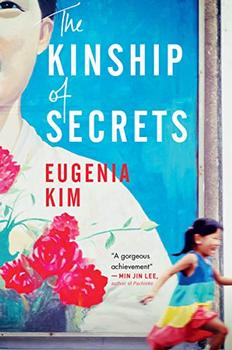
by Eugenia Kim
Published 2019
From the author of The Calligrapher's Daughter comes the riveting story of two sisters, one raised in the United States, the other in South Korea, and the family that bound them together even as the Korean War kept them apart.

by Paul Fischer
Published 2015
A rare glimpse into a secretive world, illuminating a fascinating chapter of North Korea's history that helps explain how it became the hermetically sealed, intensely stage-managed country it remains today.
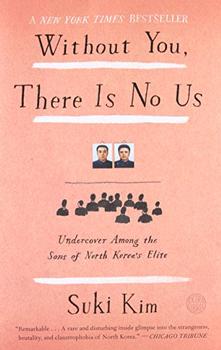
by Suki Kim
Published 2015
A haunting memoir of teaching English to the sons of North Korea's ruling class during the last six months of Kim Jong-il's reign
 (1).gif)
There is no such thing as a moral or immoral book. Books are either well written or badly written. That is all.
Click Here to find out who said this, as well as discovering other famous literary quotes!

Can you name the title?
Test your book knowledge with our daily trivia challenge!